Forty Minutes Until the Tomato Apologized
So you want to know why I’m sitting here pushing a knife across a wet rock for forty minutes? Yeah. Fair question.
Look, it started with a tomato. I was trying to slice tomatoes for lunch—nothing fancy, just thin rounds for a sandwich—and the knife was tearing them. Not cutting. Dragging the skin into the flesh, leaving ragged edges, squirting seeds across the cutting board. You know that moment when you realize a tool has betrayed you? Like discovering the pen you’ve been shaking for thirty seconds doesn’t have a dead cartridge, it has a clogged feed?
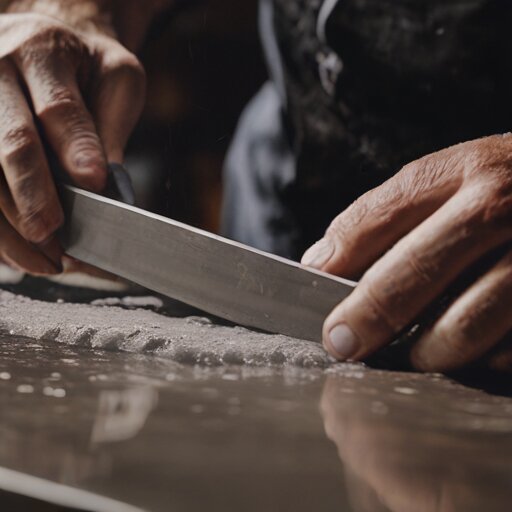
The knife was dull. Obviously. But here’s the thing—I’d been browsing Japanese craft supplies for weeks. Gold powder for the kintsugi repairs. Linen thread and bone folders for bookbinding. And the algorithm, bless its mercantile heart, had started showing me whetstones. Combination stones, specifically—one grit on each side, like those Belgian geological accidents where coarse blue and fine yellow occur in adjacent strata.
I ordered a 1000/6000 before I’d finished the tomato.
The thing about sharpening is that everyone thinks they understand it. You rub the blade against something abrasive. The blade gets sharper. Done. Except no, not really. The geometry matters enormously. You’re creating an intersection of two planes that meets at an apex thin enough to part material, and the angle of those planes determines everything. Too acute and the edge chips. Too obtuse and you’re pushing instead of slicing. Japanese knives want around 15-17 degrees per side. Western knives want 20-25. The steel itself has opinions—harder steel holds a thinner angle but shatters more easily; softer steel is forgiving but dulls faster.
You’re probably thinking this sounds obsessive.
It is. That’s the point.
When the stone arrived, I soaked it in water for ten minutes—waterstones work wet, the liquid carrying away the metal particles and exposing fresh abrasive. Then I did something that turned out to matter: I checked my angle with the spine-height trick. If you hold the blade edge-down on the stone and raise the spine until it’s roughly the height of the blade width, you’re at about 15 degrees. Two pennies stacked under the spine. A matchbook. Whatever.
The first stroke felt wrong. Not painful wrong, just foreign. You’re pushing away from yourself at this precise angle, trailing the edge, keeping your wrist locked while your elbow does the work. Forty strokes on one side. Check for the burr. Flip. Forty strokes on the other. Check again.
The burr is how you know you’ve actually reached the edge. When you grind metal, a thin foil curls over to the opposite side—you can catch it with your fingernail, a slight roughness perpendicular to the blade. No burr means you’re still polishing the bevel behind the apex, not the apex itself. The first time I found it was genuinely exciting. Physical proof. Like reading capacitance on a multimeter when you’ve been guessing about a circuit.