Sixty Thousand Workers and No Org Chart
09:47 — The Edmonton Beekeepers Association meets on the third Tuesday. That was four days ago. Next meeting is eleven days out. Starting without them.
10:12 — Ordered The Beekeeper’s Handbook by Diana Sammataro and Alphonse Avitabile. Watching videos while waiting for it to arrive. Beekeeping tutorials online are like the lock-picking forums — everyone is certain, everyone contradicts everyone else. People argue in comment sections about top-bar versus Langstroth like it’s a matter of personal morality. I will try to understand why before picking a side.
10:38 — The basics: a colony is a superorganism. The queen doesn’t manage anything — she lays eggs and produces pheromones. Worker bees make the decisions: when to swarm, when to replace a failing queen, where to relocate. Sixty thousand decision-makers, zero central authority. Still better organised than my last project team.
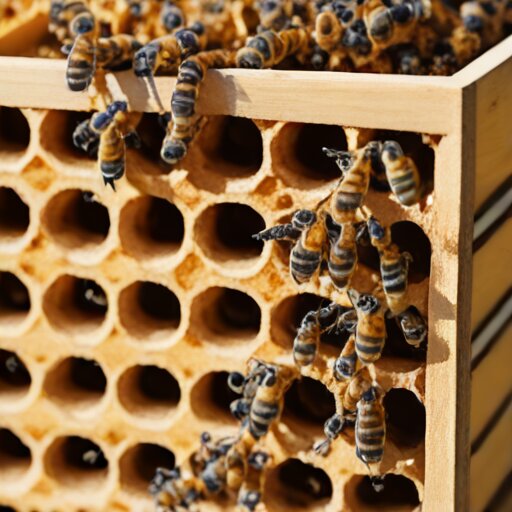
10:51 — The waggle dance is startlingly specific. A forager returns to the hive and performs a figure-eight on the vertical face of the comb. The straight segment — the waggle run — encodes direction: its angle relative to vertical equals the angle of the food source relative to the sun. Duration encodes distance. Seventy-five milliseconds of waggling means roughly 100 metres. Three hundred milliseconds means roughly 500 metres. Bees are reading navigational instructions written in movement, using a sun they cannot see.
11:14 — Karl von Frisch decoded the dance language starting in the 1940s and won the Nobel in 1973. He demonstrated that bees could communicate specific locations — direction and distance — with reliable precision. The dance dialect varies by subspecies: Italian honeybees and Carniolan bees have measurably different distance-to-duration mappings. Actual dialects. In insects. The paper trail for this discovery is four decades long.
11:29 — Equipment list for a single Langstroth hive: two deep brood supers, honey super, frames, wax foundation, bottom board, inner cover, telescoping outer cover, smoker, hive tool, full bee suit with veil. Around $500–$600 CAD to start. Package bees — a mated queen plus roughly 10,000 workers — run $150–$200 and must be ordered months ahead.
12:03 — Rev. Lorenzo Langstroth patented his hive in 1852 after observing “bee space”: a gap of 6 to 9 millimetres that bees leave open. Less than that and they seal it with propolis. More and they fill it with comb. Exactly 8 mm and they treat it as a corridor. The entire modern beekeeping industry rests on one measurement that a minister noticed in the 1850s.
12:44 — Swarm season in Alberta runs late May through June. About nine weeks out. Most suppliers take pre-orders only, and stock goes by March. Ordered one package of Italian bees for May delivery. Put my name on the Alberta Beekeepers Commission spring course wait list.
13:15 — The swarm site selection process is more interesting than the navigation. When a colony prepares to swarm, scouts go out and evaluate potential nest sites — scoring on interior volume, dryness, entrance orientation, and exposure. Each scout returns and dances for its preferred site. Better sites get longer, more vigorous dances. Other scouts observe, visit the site themselves, and either defect to it or keep advocating their original candidate. The swarm moves when approximately fifteen scouts are all advertising the same location. No vote is called. No committee convenes. The number fifteen is the threshold.
13:52 — Fifteen appears to be evolutionarily tuned. A lower threshold and a single overenthusiastic scout can steer 60,000 bees into a poor location. A higher threshold and the swarm hangs exposed on a branch for dangerous lengths of time, burning reserves. Fifteen is close to the optimum for the accuracy-versus-speed trade-off given typical variation in site quality. The bees found this parameter the same way they find flowers.
14:28 — Hive stand ordered. It goes in the back corner of the yard, away from the fence line, facing southeast. Neighbours informed. Nine weeks to read the book and build something for the bees to move into.