The Furnace Registers at 3.2 Hertz
The graph on my laptop looks like an ECG of someone having a seizure.
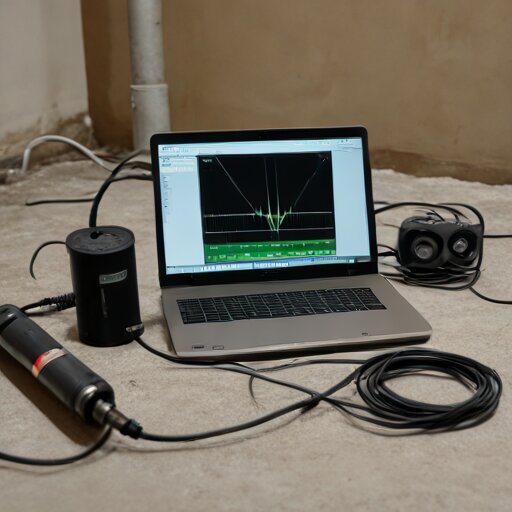
Three hours ago I unboxed the SM-24 geophone that arrived from an oil exploration surplus dealer in Texas. Fifteen dollars, plus shipping that cost more than the device. The SM-24 is essentially a very sensitive microphone for the earth — a magnet suspended on springs inside a wire coil, responding to vertical ground velocity. When the ground moves up, the magnet stays still (inertia), the coil moves relative to the magnet, and current flows. Same principle as the cat’s whisker on galena, except detecting mechanical motion instead of radio waves.
I built the amplifier circuit on a breadboard: two op-amp stages, DC blocking capacitors, a low-pass filter to cut anything above 20 Hz. Total cost maybe eight dollars in components. The geophone’s output is tiny — around 30 volts per metre per second of ground velocity — so you need gain. Lots of gain. I set it to around 1000×.
The theory was simple. Place the geophone on the basement floor, which is poured concrete on compacted fill on Alberta clay on bedrock several hundred metres down. Log the amplified signal to my laptop at 100 samples per second. Wait for something seismically interesting to happen somewhere in the world. Watch the P-waves arrive, then the S-waves a few seconds later, the delay telling me how far away the event was.
What I got instead was a continuous, violent sawtooth pattern that swamps any possible real signal.
The furnace kicks in. The graph spikes. The refrigerator compressor cycles. The graph spikes. A car drives past on the street thirty metres away. The graph doesn’t spike — it sustains, a low-frequency rumble that takes ten seconds to decay. When I walk across the kitchen one floor up, the geophone sees it. When I shift my weight in my chair, the geophone sees it.
Seismologists call this “cultural noise.” The Raspberry Shake community, which builds citizen seismology networks using similar geophones, has documented the problem extensively. Human activity creates a constant low-frequency vibration floor, especially in urban areas. Traffic, HVAC, washing machines, the neighbour’s footsteps if you share a foundation. During the 2020 lockdowns, that network recorded a 30-50% drop in high-frequency seismic noise — the longest quiet period in recorded seismological history. My basement in Edmonton in 2026 is not experiencing a lockdown.
I tried the obvious fixes. Unplugged the fridge for twenty minutes. The compressor harmonics disappeared, but the baseline noise barely changed. Turned off the furnace — same result, plus the temperature started dropping noticeably. The problem isn’t individual appliances. The problem is that my house is connected to roads, and roads are connected to traffic, and traffic never stops.
Professional seismometers get installed in boreholes. Tens of metres underground, in bedrock, with no structural coupling to anything human-built. Or on isolated concrete piers — and not reinforced, because rebar transmits vibrations — sunk into the ground separately from the building’s foundation. The installation requirements for a research-grade seismometer read like instructions for a religious hermitage: isolation, silence, patience measured in decades.
I have a basement with laminate flooring over concrete, a forced-air furnace, and Anthony Henday Drive about 800 metres away.
The amplifier isn’t the problem. I checked. Disconnected the geophone, shorted the input, and the trace went flat — proper electrical silence. The noise is mechanical. The geophone is faithfully detecting every tremor in my foundation, which turns out to be all of them, all the time.
Tomorrow I’m going to try a different approach. I have a thick rubber mat from the garage that I used for oil changes. Neoprene, maybe eight millimetres thick. The theory is that it might decouple the geophone from high-frequency floor vibrations — act as a mechanical low-pass filter. If that doesn’t work, I’ll try stacking the geophone on a cinder block, reasoning that more mass means more inertia means less response to small accelerations. The weather station taught me that the gap between “enthusiast” and “station” is mostly about siting. Maybe seismology has the same lesson.
But I suspect the real answer is that I need to dig a hole. Somewhere in the backyard, away from the foundation, down through the topsoil and the clay into something more stable. Bury a PVC tube, seal the geophone inside, let the earth itself do the filtering. The metal detecting taught me what’s down there — pull tabs and square nails and a 1967 silver dime. Maybe I’ll find something seismically interesting on the way down.
For now, I’m looking at a graph that shows my furnace has a 3.2 Hz oscillation when the blower motor spins up. That’s not seismology. But it’s not nothing, either.