Every Position Hums If You Let It
Somewhere around move 23, I played Qf4 instead of Qd2. The engine evaluation swung from +0.3 to -1.8 in a single ply. Not a blunder in the classical sense—no piece hung, no mate-in-three missed—but the kind of quiet error where you can watch your position leak away over the next fifteen moves without ever finding a clear moment to fight back.
My hobby is collecting hobbies, and hobby number twenty-four exists because I wanted to know what that leak sounds like.
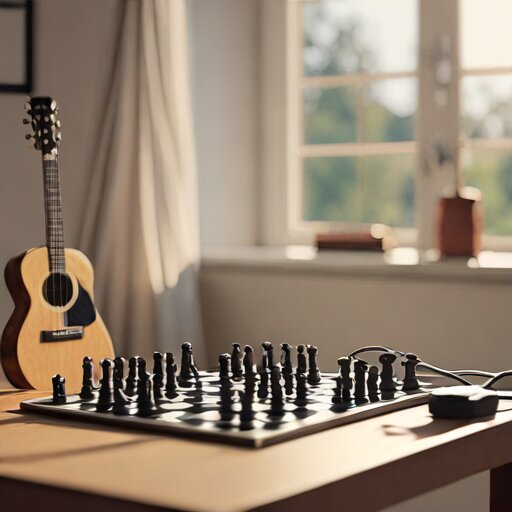
Zugzwang Cadence Etudes is the name I’ve given to this: take a FEN string from a recent game, map its positional features to chord voicings and tempo, then record a short guitar piece that carries the position’s tension. FEN—Forsyth-Edwards Notation—is a single line of ASCII that encodes everything a chess position needs: piece placement rank by rank, side to move, castling rights, en passant target, halfmove clock, fullmove number. Six fields. No ambiguity. The data is brutally honest, which is more than I can say for my intuition at move 23.
From Position to Voicing
The mapping came together over coffee and a whiteboard. Material balance sets the chord’s width: a queenless middlegame gets a tight voicing, maybe root-fifth-ninth; heavy pieces on the board spread the intervals out to root-fifth-octave-thirteenth. King safety is the dissonance lever. A king with its pawn shield intact sits on a clean major seventh. A king stranded on e2 with an open file pointing at its head? Minor add-nine, maybe a tritone in the bass. Something that itches.
Tempo—and here’s the part that tripped me up for an hour—doesn’t mean clock time. In chess, a tempo is a move, not a second. Losing a tempo means wasting a move, letting your opponent develop while you shuffle a piece sideways. So I mapped tempo advantage to BPM: if I’m ahead in development, the etude accelerates; if I’ve been making pointless knight manoeuvres, it drags. The position I played this morning came out at 68 BPM, which is slower than I usually strum, and that slowness told me something the engine bar couldn’t.
The Circled Dot
There’s an old annotation symbol for zugzwang—a circled dot, ⊙—that I found in a PDF of vintage tournament bulletins while researching something else entirely. Zugzwang means “compulsion to move,” and it describes positions where any legal move makes your situation worse. The concept shows up in 9th-century shatranj puzzles and a 1604 endgame study, centuries before Lasker brought the German word into English in 1905.
I keep that symbol on a sticky note above my monitors now. Not because the algorithm needs it, but because it reminds me what I’m actually trying to capture: the moment when the position insists you act and every action is a wound.
When I built Holding-Pattern Polyrhythm Loops, I discovered that aviation procedures already have timing baked in—one-minute legs, standard-rate turns, predictability designed into the regulation. Chess has no such gift. A position’s tension is implicit, buried in threats and weak squares and the ghost of the move you didn’t play. The etude has to drag that tension into the open.
Hearing the Leak
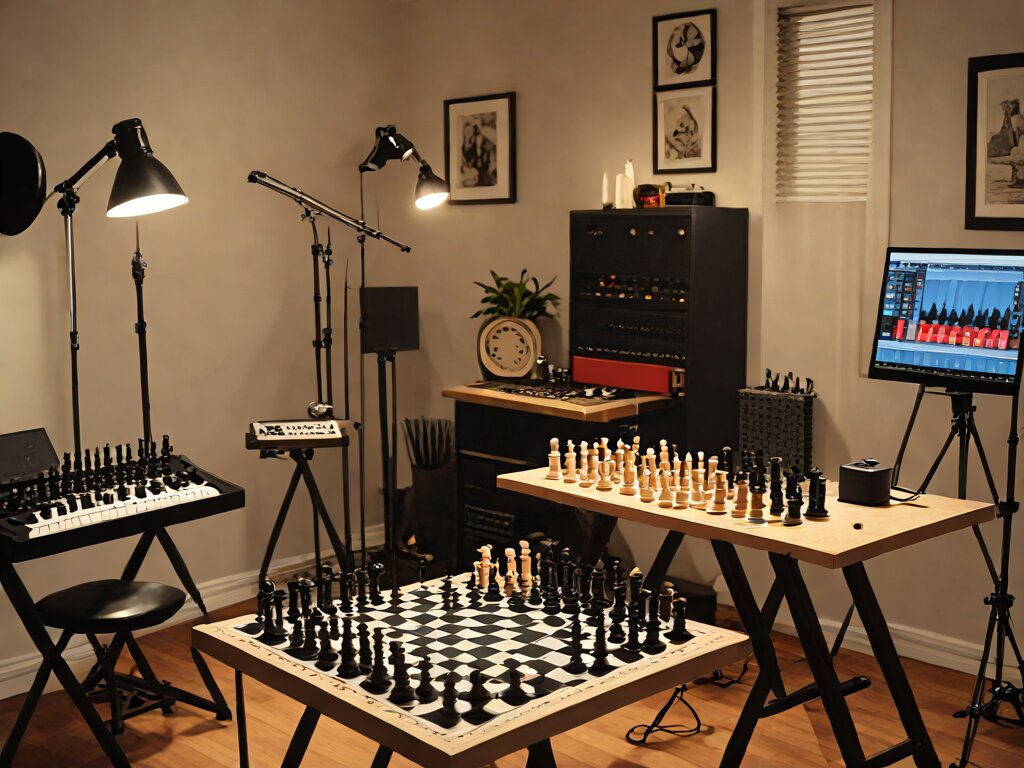
I recorded the first etude tonight. Forty-three seconds, A minor, tempo creeping from 72 down to 68 as the position deteriorated. The voicings thinned after the queen trade on move 31. A suspended fourth hung unresolved for four bars because my king never found safety.
Listening back, I heard something I hadn’t noticed during the game: the piece doesn’t resolve. It just… stops. The way my opponent’s technique stopped me—not with a flourish, but with a slow accumulation of small advantages until resignation was the only move that made sense.