The Payload Stopped Talking at Eight Hundred Metres
The farmer’s name was Dwight, and he was remarkably calm about the whole thing.
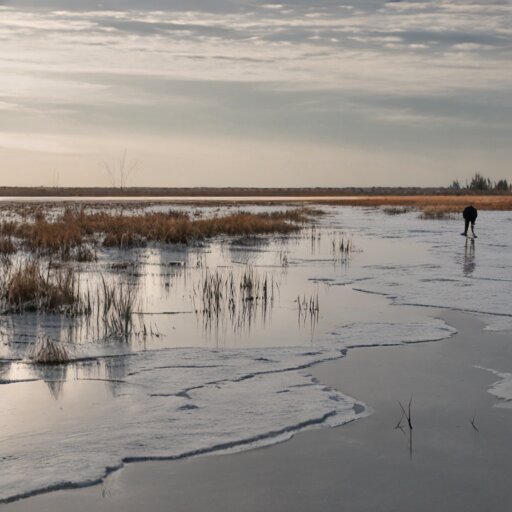
“There’s a styrofoam box in my slough,” he said on the phone, like he was reporting a weather update. “Parachute’s tangled in the cattails. You want I should leave it, or…”
I told him I’d be there in two hours. It took three. The CUSF predictor had promised a landing near Drumheller—same as the December flight that later became chord maps and panorama stitches—but the February jet stream had other plans. The payload came down 80 kilometres east, in a depression full of frozen water and cattails and apparently one very patient rancher who found my “PLEASE CALL” note and actually called.
My hobby is collecting hobbies, and hobby number two just reminded me that collecting doesn’t always mean keeping.
What the Predictor Didn’t Know
The Cambridge predictor uses NOAA GFS wind data, updated every six hours. Between my 6 AM prediction run and the 9 AM launch, the jet stream shifted. Not dramatically—maybe 30 kilometres at altitude—but that 30 kilometres at 28,000 metres compounds on the way down. By the time the payload hit the tropopause, it was already drifting into territory my map didn’t show.
Winter launches are dicey this way. The polar jet is fast and fickle. December’s flight worked because I happened to launch during a stable high-pressure window. This time I watched the GFS update come through at 11 AM while the balloon was somewhere over the Red Deer River, already committed. The new landing estimate jumped 70 kilometres east. I started driving before it even burst.
The Signal That Stopped Talking
APRS on 144.390 MHz is line-of-sight. At altitude, that’s magnificent—the payload can reach IGates 300 kilometres away. But during descent, especially into terrain with any relief at all, the signal drops behind the horizon and vanishes.
The last packet came through at 847 metres AGL. The payload was still 12 minutes from touchdown, descending at roughly 6 m/s under the parachute. That’s 4.3 kilometres of untracked drift. By the time Dwight found it, the sun was low and the batteries in my handheld were screaming.
I’ve run the math since. The slough sits in a shallow basin, maybe 8 metres below the surrounding prairie. That’s enough. VHF doesn’t bend around terrain; it just stops. If the payload had landed on flat ground 200 metres further west, I’d have had a packet from the surface.
Recovery
Dwight met me at his gate in an ATV. We drove across frozen stubble to the edge of the slough, and there it was—orange parachute splayed across the ice like a jellyfish, the styrofoam cooler resting on its side in a tangle of dead reeds. The ice held my weight, barely. I could hear it creaking.
The payload was intact. The GoPro had run until the battery died at 23,000 metres—two hours of footage, including 47 minutes of stratospheric horizon shots I might still stitch into something. The APRS tracker’s LED was still blinking, oblivious to its radio silence, writing position reports to nobody.
The GPS log showed what happened: a sharp eastward push between 9 and 12 kilometres, right through the jet stream core, then a long diagonal drift down into Dwight’s back forty. The parachute did its job. The landing was soft. The only casualty was my prediction confidence.
What I’ll Do Differently
More helium next time. This flight had 450 grams of positive lift—conservative, aimed at a 5 m/s ascent rate to maximize altitude. But slower ascent means more time in the jet stream, more drift, more uncertainty. A February launch probably wants 700-800 grams, accepting a lower burst altitude in exchange for a tighter landing ellipse.
I’m also adding a secondary tracker. Something on 70 cm, lower power, different digipeater path. Redundancy isn’t paranoid when your payload is a frozen slough and a stranger’s goodwill.
Dwight refused the recovery fee I tried to hand him. “Just tell me what happens up there,” he said. So I showed him the footage on my phone—the curvature of the Earth, the black sky, the moment of burst where the camera spins and the balloon fragments drift past like confetti.
He watched it twice.
“That’s my slough,” he said, pointing at a brown smudge near the horizon. “From space.”
It wasn’t space. Not technically. But I didn’t correct him. Sometimes the hobby isn’t about the data you collect—it’s about the stranger who calls you back, and the ice that holds your weight, and the orange parachute waiting in the cattails like it knew you’d come.