Four Weeks Before the Gravel Remembers How to Shine
Silicon carbide exists in space. That’s the fact I keep turning over while loading stones into the barrel.
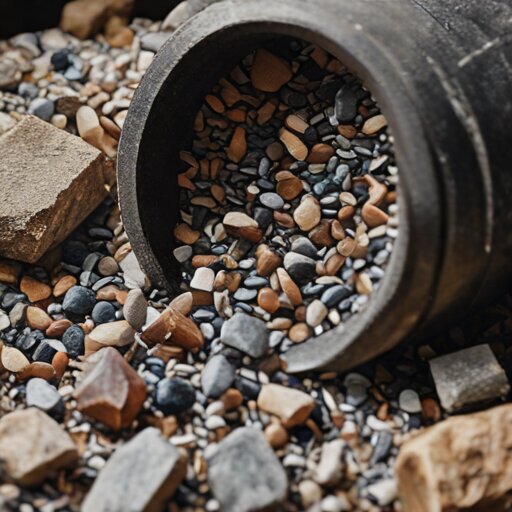
The compound—carborundum, if you want the industrial name—was first identified in 1893 inside the Canyon Diablo meteorite, fragments of which are scattered across Arizona where the iron punched through atmosphere and exploded on impact. Astronomers have since found silicon carbide is common around carbon-rich stars, condensing in their outer layers as stardust. The grit I’m pouring into this barrel is synthetic, manufactured in an electric furnace, but chemically identical to material drifting between solar systems.
I bought the tumbler on a whim. Or what felt like a whim, though hobbies rarely arrive without preamble. Last week I was at the hardware store hunting for a finer-grained sharpening stone—something in the 3000-grit range to refine the edge I’d been working on with my new whetstones. The sharpening aisle shares a wall with the lapidary section: polished agates, geodes split open to show amethyst cathedrals, bags of rough jasper labeled for tumbling.
Polished agate looks like it was manufactured. The surface is so uniformly smooth, so oddly perfect, that your brain insists it must be plastic. But these started as gravel. Ugly, dull, angular chunks of chalcedony that someone ran through progressive grits for a month until the crystalline structure caught the light.
Same logic as sharpening. Same logic as kintsugi, where lacquer cures in a humidity box over days because it cannot be rushed. You work through coarse, medium, fine, polish—each stage removing the scratches left by the previous one, trading visible damage for invisible damage until there’s nothing left to remove.
The tumbler was on clearance. Forty-eight dollars, rubber-lined barrel, a small motor that mounts on a pair of rails. The included instructions fit on a single page: fill the barrel two-thirds with rocks, add grit and water, run for seven to ten days, clean thoroughly, repeat with finer grit. Four stages total. Minimum time to completion: four weeks.
Sorting is the part nobody mentions. The starter kit came with a mixed bag of rough stones—some jasper, some tiger’s eye, a few pieces of what I think is carnelian—and I almost loaded them straight into the barrel before catching myself.
Mohs hardness. The scale runs from 1 (talc) to 10 (diamond), and everything in a single batch needs to fall within a point or two of each other. Mix a calcite (3) with a jasper (7) and you’ll grind the soft stone to powder while barely touching the hard one. The jasper will be round; the calcite will be gone.
I don’t have a proper hardness testing kit, so I improvised. A steel file scratches anything below 6.5. Glass sits around 5.5. I worked through the pile piece by piece: file marks it, set it aside; file doesn’t mark it, test against the glass; glass scratches it, set it aside; glass doesn’t scratch it, probably safe for this batch.
Twenty minutes later I had two piles. The keepers measured somewhere between 6 and 7 on the scale. Close enough.
The barrel takes about 500 grams of stone, plus two tablespoons of 60/90 grit, plus enough water to just cover the rocks. The manual says the water level matters—too much and the abrasive gets too diluted, too little and the stones don’t tumble smoothly. When I pressed the lid on and lifted the barrel to the rails, it had the weight of something that was about to work very hard for a very long time.
The motor runs at about 25 RPM. You don’t spin the stones; you roll them. The idea is that they slide past each other continuously, with grit particles between them grinding away at every surface. It sounds like a distant washing machine—a rhythmic slosh and thump, almost hypnotic once you stop listening for it.
I set it in the corner of the garage and walked away.