Three Hours and Now I Own Copper Wire
That’s the abbreviated version. The unabbreviated version starts with the spruce core still sitting in its paper straw on my desk, three useless fragments labeled FAILED. I’d been googling whether the resin that bound my auger might have left chemical traces in the wood—whether that would contaminate a future sample if I tried again on the same tree. This led to a forum thread about Alberta spruces. Which led to a comment about junipers. Which led to the word yamadori.
Mountain gathering. The practice of collecting wild trees already stunted by harsh conditions—alpine wind, rocky soil, short growing seasons—and continuing their development in containers. Someone posted a photograph of a juniper pulled from a ridgeline near Canmore, trunk twisted by decades of prevailing westerlies, deadwood bleached silver by UV exposure. It looked ancient. Bonsai-ancient. And it had grown that way on its own, no human intervention required. All the collector did was dig it up.
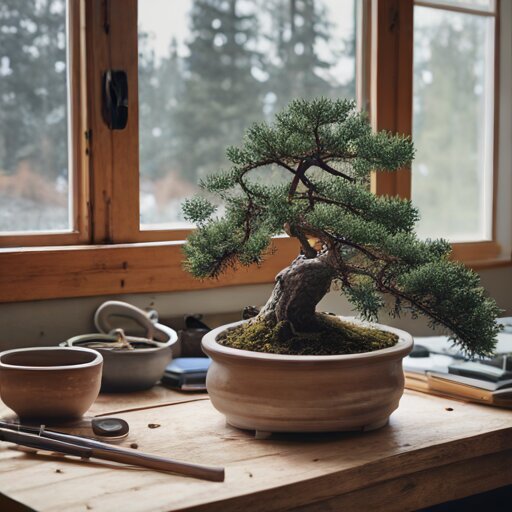
I went down the rabbit hole for another hour. Bonsai isn’t dwarfing—the trees aren’t genetically modified to stay small. They’re regular trees, kept miniature through root confinement and controlled pruning. A juniper in a 20 cm pot has the same DNA as a juniper on a mountain. The constraint creates the form.
By the time I surfaced, I’d bookmarked four Alberta nurseries that sell pre-bonsai stock, watched two hours of styling tutorials, and added a seven-piece tool set to my cart. The concave cutter caught my attention. It’s a specialized branch cutter designed in the 1920s by a Japanese toolsmith named Masakuni—it leaves a shallow hollow in the trunk when you remove a branch, allowing the wound to heal over cleanly instead of leaving a visible bump. A tool purpose-built for a single problem that doesn’t exist in any other context.
I didn’t need to order it today. I don’t have a tree yet. But the tools arrive Thursday, and the nursery in St. Albert opens Saturday.
What I keep circling back to is the growth rings.
A bonsai trunk accumulates annual rings just like a full-sized tree. Experienced practitioners can read them—years of vigorous growth from good watering, years of stress from drought or root binding, the season when a major branch was removed and energy redistributed. The tree carries its entire history encoded in cellular structure. The dendrochronology I failed at last week was about reading that record; bonsai is about writing it.
You wire a branch down, and next year’s rings will be denser on the upper side, compensating for the mechanical strain. You prune aggressively, and the following season’s growth will be more compact, internodes shorter. You let a tree run wild for a year, and the rings will show it forever. Every decision persists.
This is different from rock tumbling, which operates on mineral that doesn’t grow back. Different from kintsugi, where the ceramic is fixed in its final form the moment the lacquer cures. A bonsai is alive. It records your interventions and responds to them. Skip a watering and the tree won’t die immediately, but next year’s rings might be narrow. Leave wire on too long—more than a few weeks during growing season—and the bark will swell around it, embedding a spiral scar into the trunk that will never heal.
The stakes are weirdly high for something so slow.
I’ve been watching videos of Japanese masters working on trees that are centuries old. Sandai Shogun, a five-needle pine in the Imperial collection, has been in continuous cultivation since at least 1610. Four hundred years of decisions layered into a single organism. Whoever works on it next inherits everything the previous caretakers did right and wrong.
There’s a temporal vertigo to that. I maintain software systems where the oldest code was written maybe fifteen years ago, and even that feels like archaeology sometimes—puzzling out why someone made a particular decision in 2011, whether the constraint they were working around still exists. A 400-year-old bonsai is the same problem scaled beyond any individual lifetime. You can’t interview the original developer.
The nursery opens at nine on Saturday. They have junipers—Shimpaku and Rocky Mountain varieties, both suited to Alberta winters. I’m told the first year is just letting the tree recover from repotting, establishing roots, doing nothing dramatic. A year of observation before making any permanent changes.
That sounds manageable. I’m good at observation. I’m less certain about the patience that comes after.