Nine Rotations Before the Thread Trapped Itself
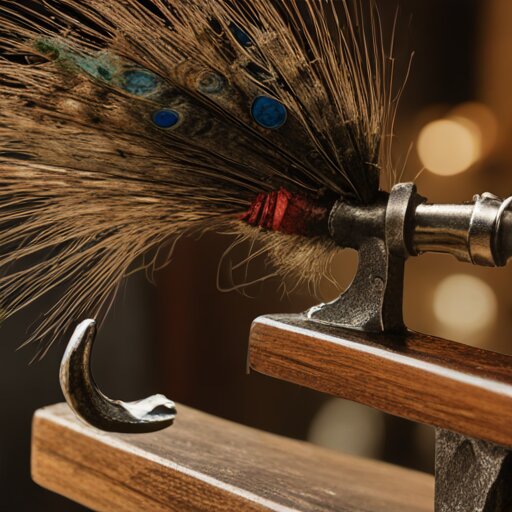
A mayfly hatched from rainwater pooled in the drip tray under my bonsai. I mentioned it to a colleague who fly fishes, and within an hour I was staring at his fly box — rows of tiny feathered hooks, each one a hypothesis about insect anatomy rendered in thread and fur. I ordered a vise that afternoon. What follows is what I’ve learned about the fundamental operation: attaching thread to a hook without it unravelling.
The Thread Foundation
Everything in fly tying depends on one counterintuitive fact: thread doesn’t grip metal. A hook is smooth, usually bronze or black nickel finish, and thread has no inherent adhesion. The entire structure of a fly — body, hackle, tail, wing — stays together through friction created by wrapping thread over itself in specific ways. Lose tension for a moment and the whole thing unwinds.
The standard thread attachment sequence:
- Hold the thread end against the near side of the hook shank, angled toward the bend
- Make 4-5 touching wraps over the tag end, moving toward the eye
- Pull the tag end to snug the wraps against the shank
- Trim the tag flush
- Continue wrapping back toward the bend, creating the foundation layer
Those first wraps are holding the thread in place purely through compression — thread crossing thread at slight angles. The friction coefficient of waxed thread on itself is surprisingly high. Once you have eight or ten wraps, the foundation is solid enough to hang a bobbin from, which is good, because that’s exactly what you do while manipulating materials.
Why Thread Tension Isn’t Intuitive
When I learned to wind pickup coils for guitar electronics, the goal was consistent tension throughout. Fly tying is different. Tension varies deliberately depending on what you’re doing:
| Operation | Tension | Reason |
|---|---|---|
| Foundation wraps | Firm | Creates grip on bare shank |
| Securing soft materials (dubbing, herl) | Medium | Compresses without cutting |
| Locking down quill or tinsel | Light first wrap, firm second | Allows repositioning, then locks |
| Whip finish | Very light | Knot must slide into place |
Overtightening is the beginner failure mode. Thread is strong — 8/0 Uni-Thread breaks at around 0.7 kg — but the materials it’s securing are fragile. Wrap peacock herl too tightly and the iridescent fibres shear off. Wrap hackle stems too tightly and they snap. The bobbin provides constant drag, but the final tension comes from how high you lift it before letting gravity take over.
The Whip Finish
This is the knot that ends every fly. Its purpose is to lock the thread in place without bulk, since any added mass near the eye affects how the fly swims or floats. The tool — a whip finisher — looks like a bent wire with a hook and a cradle. Its operation takes most beginners twenty or thirty attempts to internalize.
The geometry: you’re creating a series of half-hitches where the thread wraps over itself while simultaneously capturing the working end underneath. When you pull the tool away and draw the thread tight, the tag end slides under multiple wraps and locks. Properly executed, the head of the fly is four or five thread-widths wide. Improperly executed, you’ve got a lump that won’t pass through the hook eye of the fly above it in the box.
I failed the whip finish nine times before one held. The motion is rotational — the tool orbits the hook shank while the thread triangle maintains contact — but my hands kept trying to make it linear. The breakthrough came when I stopped watching my hands and watched the thread angle instead. As long as the triangle stays open and the working thread crosses over the standing thread, the geometry works.
Material Prep Matters More Than Technique
Hackle feathers have a stem with barbs projecting at angles. Before wrapping, you strip the fuzzy fibres from the base of the stem (they’d just mat into an ugly clump) and stroke the remaining barbs backward so they stand perpendicular. This takes thirty seconds and makes wrapping possible. Skip it and you’re fighting the feather’s natural lay for every turn.
Same principle applies to tail fibres: stack them in a hair stacker (a tube with a closed bottom — drop fibres in, tap, and the tips align) before measuring and tying in. Dubbing (loose fur) needs to be twisted onto waxed thread in one direction only, creating a fuzzy rope you wrap like chenille.
The tying itself is fast. The preparation is slow. This inverts my usual relationship with craft work, where I want to rush through setup and linger on execution.
Three flies in. They look like something a fish might believe is an insect, if the fish were very optimistic and the water very murky. But the thread held. That’s the foundation everything else depends on.