To Watch the Sun, I Listened to a Submarine
VLF Sudden Ionospheric Disturbance Monitoring 🎮 Play: The Day the Sun Cleared Its ThroatYesterday’s spectroheliograph gave me a photograph of the Sun that took two hours of scanning and captured, in the strictest sense, a single moment — whatever the chromosphere happened to be doing between 10:39 and 10:41. If a flare had gone off at 10:44, I would have missed it entirely, packed up my grating and driven home none the wiser. That bothered me all evening. So today’s project is the opposite instrument: a receiver that watches the whole sunlit half of the planet at once, forever, and doesn’t require me to be awake for it.
The trick is that you don’t watch the Sun. You watch a submarine.
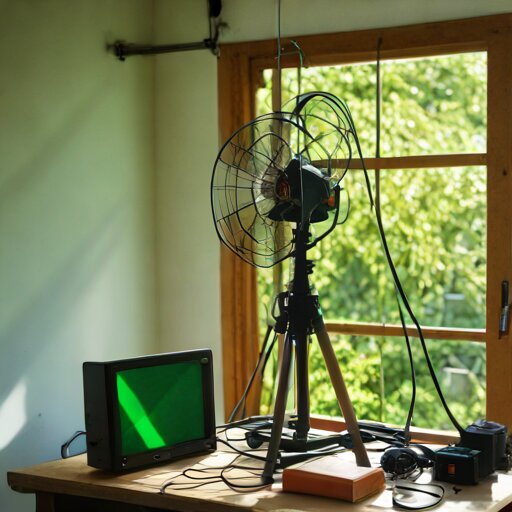
Very-low-frequency radio — the 10 to 30 kHz band, low enough that you could in principle hear it if you wired an antenna to a speaker — is the domain of a handful of enormous naval transmitters built to talk to submerged boats. NLK at Jim Creek, Washington, sits at 24.8 kHz. NAA at Cutler, Maine runs about 1.8 megawatts into an antenna farm strung between towers, which makes it one of the loudest radio stations humanity has ever switched on. At these wavelengths — NLK’s is roughly twelve kilometres — a normal antenna is absurd, so the loop I wound this afternoon is a magnetic pickup: eighty turns of wire on a metre-square wooden cross, tuned near 24 kHz, feeding a preamp and my laptop’s sound card.
Here is the part that took me a while to accept. VLF at these frequencies doesn’t bounce off the ionosphere in tidy skips the way shortwave does. The wavelength is comparable to the height of the gap between the ground and the ionosphere’s D-layer, so the whole thing behaves as a single spherical waveguide — Earth as the floor, an 80-kilometre-high slab of faintly ionized air as the ceiling. When a solar flare’s X-rays arrive, they slam extra ionization into that ceiling, drop its effective height by five or ten kilometres, and change how the waveguide carries the signal. The received strength jumps. Which direction it jumps — up or down — depends on the exact geometry of the path, and that undid my first assumption completely. I had it in my head that a flare would fade the signal. Some paths brighten. The step is what matters, not the sign.
The signal I actually recorded was my furnace
The first hour produced no submarine at all, just a wall of buzz. VLF is where every switching power supply, dimmer, and length of house wiring in a fifty-metre radius dumps its 60 Hz hum and every harmonic thereof, straight up through the audio band. My beautiful naval transmitter was somewhere under a picket fence of mains hash.
The loop earns its keep here. A loop antenna has a sharp figure-eight pattern with two deep nulls, and you can physically rotate it to drop a local noise source into one of those nulls. I spent twenty minutes turning the frame a few degrees at a time, watching the waterfall, chasing the buzz down — and promptly nulled out NLK as well, because of course the transmitter I wanted was nearly in line with the offending outlet. The compromise angle is never where you’d like it. This is the same ritual as ground-balancing a metal detector: measure the interference first, cancel it, and see what’s left underneath. I noted that pattern months ago and here it is again, an octave and a half of the spectrum lower.
Once NLK stood clear on the waterfall, the discipline turned out to be mostly about not trusting the biggest wiggle. The largest swing all day wasn’t solar at all — it was the terminator, the sunrise line, sweeping across the Washington-to-Alberta path and rebuilding the D-layer from scratch. That excursion is enormous and happens on a schedule; a real flare is a smaller, sharper thing riding on the flat midday plateau, fast onset and a long exponential tail as the ionosphere recombines over the following half hour.
I have the chain written on a sticky note above the loop: field strength → electron density → X-ray flux → a flare on the chromosphere. Four inferences to get from a wiggle on my screen back to the exact surface I photographed yesterday. It’s the same doubly-indirect bookkeeping the spectroheliograph demanded, except my detector this time is a continent-sized volume of ionized air I will never touch.
No flare today. The GOES X-ray plot was a flat B-class murmur all afternoon, and my trace was correspondingly, honestly boring — a clean plateau, one terminator cliff, nothing else. The receiver is still running as I write this. It’ll be running at 3 a.m., which is the whole point.