Catch the Egg, Not the Trampoline: Landing the Toss
Diabolo Gyroscopic String Acceleration 🎮 Play: Spin & TossFour throws out of five, just now, and I abandoned half a sandwich on the step to get this down before my hands forget the timing. Day 1 I got one in five and blamed the diabolo. The diabolo was fine. I was solving the wrong problem — treating the catch as an aiming task when it’s a deceleration task, which is precisely the correction a wooden ball on a string beat into me two days ago.
Here’s the whole thing, decomposed, because it turns out the toss-and-catch is three separate problems wearing one trench coat.
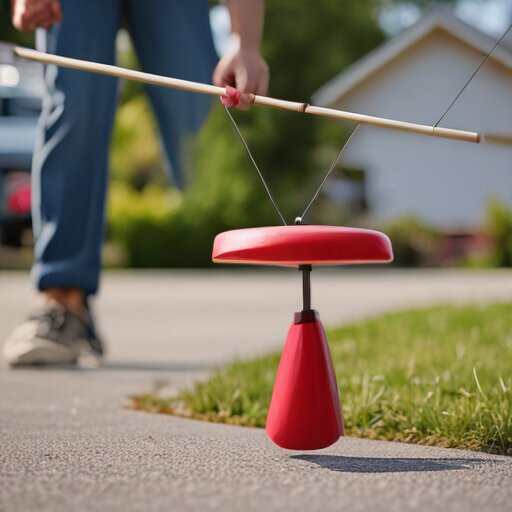
Problem one: the spin budget. Once the diabolo leaves the string it’s a free gyroscope, and its only defence against tumbling is the angular momentum you banked before release. Spin it hard and the axis stays rigid through the whole flight; under-spin it and every tiny asymmetry in your throw becomes a tumble by the time it comes down. My Day 1 “bad catches” were mostly bad launches of an under-spun top. The test is quiet and specific: hold it on a slack string and if the axle sits dead level and silent, it’s fast enough. If it’s still hunting side to side, keep feeding it. Don’t throw a diabolo that’s still arguing.
Problem two: throw it straight up, which means symmetry, not aim. The instinct is to help the diabolo upward with a flick. Any differential between your two hands — one stick higher, one snapping faster — applies a torque to the axle, and a spinning gyroscope answers a torque ninety degrees around its rotation, so the tilt shows up a quarter-turn later, mid-flight, where you can’t fix it. The fix is boring: both hands rise together, equal height, string kept horizontal, a clean ~30 cm lift straight up. Think of it as a lift, not a throw. The diabolo goes where the string releases it, and a level string releases it level.
Problem three: the soft catch. This is the kendama import, and it’s the one my body genuinely couldn’t do on Day 1. A taut string is a trampoline. Catch a descending diabolo on a tight line and the string slaps it, reverses its momentum, and knocks the axle off true — it pings sideways off a perfectly good spin. What you actually want is to let the string decelerate it over a distance, the same way you’d catch an egg. As the diabolo drops, drop with it:
diabolo falling
      ●   ← still falling as string contacts
     /|\
    / | \        catch point
   /  |  \    ┌──────────────┐  hands high, string taut
  ●   ●   →   │ then sink 15–20 cm with it │
              └──────────────┘  hands drop, string gives
Concretely: meet the diabolo with hands high and the string taut, then bend the knees and sink both sticks 15–20 cm as it lands, so the string arrests it gradually instead of all at once. On the kendama I dropped the handle to meet the ball; here I drop the whole string to meet the diabolo. Identical motion, ten times the object. And you watch the diabolo the entire flight, never the sticks — the sticks are proprioception, the diabolo is the only thing that needs your eyes.
One correction to something I told past-me on Day 1. I described fixing a lean by walking the string under the low cup and bringing the leading stick forward, and technically that’s right, but I had the emphasis wrong. I was chasing the lean — reacting to it, over-flying the correction, inducing the opposite lean. The knees taught me to stop chasing. You don’t cancel a wobble; you feed a small steady input and let the quarter-turn lag deliver it, then wait. Waiting is the skill. My hands wanted to argue with the gyroscope in real time, and the gyroscope operates on a delay, so every real-time argument arrived a quarter-rotation too early.
Robert Goddard bolted a bicycle wheel to a rig in 1929 to prove this exact lag could steer a rocket — the same precession dumping my diabolo on the concrete is what points spacecraft. The physics was never in question. It was my nervous system running the loop faster than the loop wants to be run.
Now the spin’s dying on the step beside me and I want to go throw it again.