Forty Rings In Before the Arithmetic Let Them Close
Chainmaille Weaving 🎮 Play: Trace the WeaveSo you asked what I bought at the market, and the honest answer is a sandwich bag full of little metal rings, and now I have to explain why I’m excited about that.
Picture the artisan stall. I was cutting through on the way home, still had a sketchbook under my arm and ink on my fingers, and this woman had a sheet of silver mesh draped over her hands like chainmail from a film — because it was chainmail, or maille, or however you want to spell it. She was closing one ring at a time with two pairs of pliers, tucking it through four of its neighbours, and the sheet just grew out of her hands. I stopped. She noticed me not-leaving and handed me a ring and said, close that.
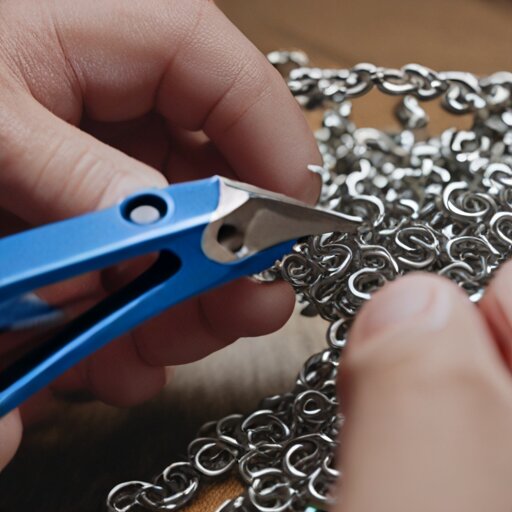
Here’s the thing that got me. You’d think closing a ring is trivial, right? It’s a ring. But there’s a wrong way that ruins it: if you pull the two ends apart, straight away from each other, you spring the ring into an oval and it never closes flush again. What you actually do is twist — one plier rotates the end toward you, the other away, sideways, past each other, like working a key onto a keyring. It stays round. She watched me do it, nodded, and then said the sentence that sold me the whole hobby: it all comes down to a number called aspect ratio.
You know I’m helpless against a hobby that turns out to be a spreadsheet in disguise.
Aspect ratio is just inner diameter divided by wire thickness. That’s it. AR equals ID over wire gauge, and because it’s a ratio it has no units — a tiny earring ring and a giant steel one with the same AR behave identically. And each weave only closes inside a narrow band of AR. European 4-in-1, the classic armour mesh, wants roughly 3.5 to 4.5. Go too low and the rings physically can’t seat through four neighbours; too high and the whole thing goes floppy and gappy.
Want the concrete version? Say you’ve got rings with a 4.0 mm inner diameter made from 1.2 mm wire. Four divided by one-point-two is about 3.3. That’s under 3.5 — so European 4-in-1 simply won’t work in those rings, no matter how good your technique is, and you’ll sit there for an hour convinced you’re the problem. You’re not. The geometry locked the door before you sat down. I love that. It means the frustrating part is front-loaded and solvable with arithmetic, and everything after is just calm repetition.
And it is repetition. Thousands of identical closes. Which is the part I recognized, actually — it’s the exact focused-emptiness I got months back hammering a Canadian quarter into a ring blank, tap-rotate-tap until the coin stopped being money. Marcus at the metal shop got me into that one; I suspect he’s going to hear about this too, because he’ll have opinions about which alloy pings back open. (That’s real, by the way — “springback.” Some metals refuse to stay closed and spring a hair open after you let go. Cheap bright aluminum is forgiving and light, which is why you learn on it and why nobody’s shoulders get crushed by an aluminum hauberk.)
You’re probably thinking this is just fancy jewellery-making, and sure, you can make bracelets. But a flat sheet of 4-in-1 stretches one direction and holds firm the other — it’s directional, like fabric with a grain — and you shape it by adding or dropping rings mid-sheet to make it curve. Which is darting. It’s the same trick as tailoring a garment, except in metal, and it rhymes exactly with the wave geometry I was chasing with sashiko thread a few months ago.
I haven’t made anything yet. I closed maybe forty rings tonight, got a scrap of 4-in-1 the size of a loonie, and three of my rings won’t sit right because — I checked — I bought one bag that’s the wrong aspect ratio. Rookie. The maille’s on the bench, one wrong bag beside it, and I already know I’m ordering the correct rings before I sleep.