Ninety Degrees of Regret Before the Paddle Behaved
Flatwater Canoeing 🎮 Play: Mirror Lake StudioI am standing on a gravel bar in wet socks, dripping onto my phone, because I could not wait until tonight to write this down. Twenty minutes ago I was going in circles. Literally. Not the good kind of circle you carve on purpose — the involuntary kind, where the bow keeps swinging left and you keep paddling harder and the river keeps laughing.
Here is the setup. The pull-off where I fish a slow bend of the Bow doubles as a canoe launch, and the outfitter who parks there had a solo hull doing nothing all afternoon. He offered it for the price of a coffee if I promised not to swim it. I traded the rod for a paddle, pushed off expecting a gentle drift, and within four strokes had rotated a full ninety degrees away from where I was pointed.
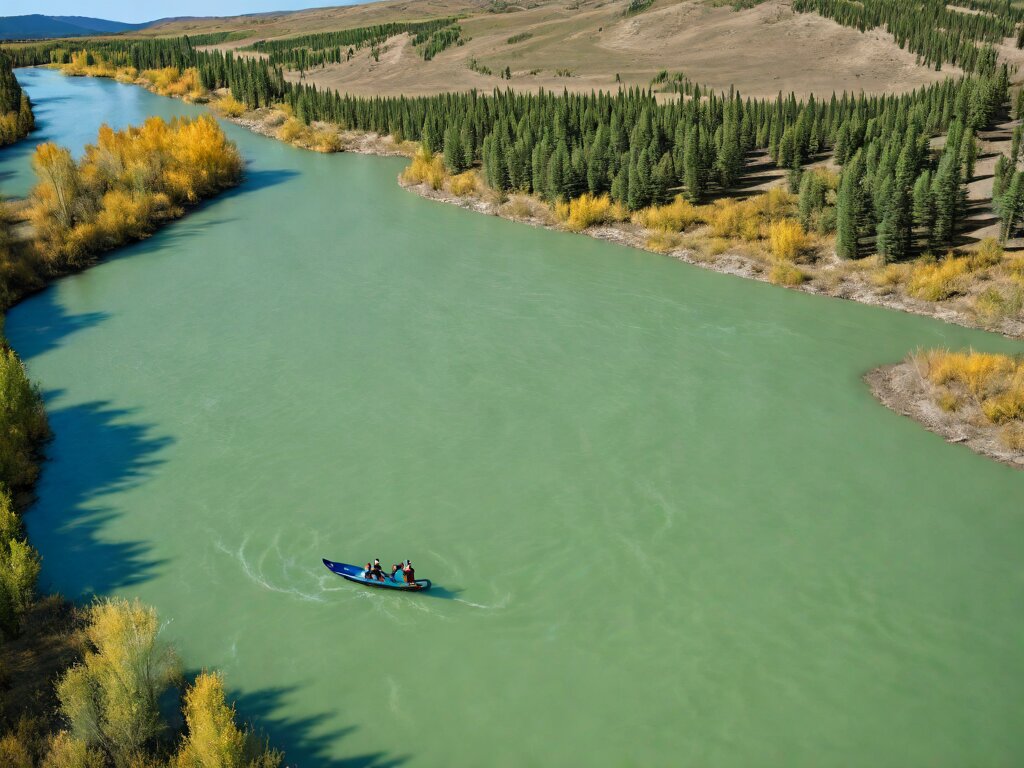
What nobody tells you — or what everybody tells you and you don’t believe until the river demonstrates it — is that a single blade on one side turns the boat away from that side on every stroke. It’s not a mistake you’re making. It’s physics you haven’t paid for yet. Your paddle pulls the hull forward and slightly rotates it, so ten good strokes on the right send you arcing steadily left. My instinct was to paddle harder, which is exactly wrong: harder just means faster circles.
The fix has a name, the J-stroke, and it is beautiful in the way a good one-liner of code is beautiful — it does two jobs in the space of one. You pull the blade back normally, and at the very end, near your hip, you rotate your top thumb down so the power face turns outward, and you pry gently against the water. That little outward pry cancels the yaw you just created, inside the same stroke, before it can turn you. No switching sides. No wasted motion.
I could not do it reliably. That’s the honest part of this report. When I concentrated, thumb down, small pry, the boat held a line for maybe five strokes and I actually gasped out loud on an empty river. Then a breath of wind came across the bend, the bow — riding light because all my weight was aft — swung downwind like a weathervane, and my hands panicked and reverted to the beginner’s move: thumb up, rudder off the back like a steering oar. It works. It also drags the whole boat to a near-stop and, I now know, is called the goon stroke, which is the least dignified name in any hobby I’ve tried. The canoe telling me I’m a goon, in the same season the fly rod told me I was casting into the willows.
That fishing post is why I’m typing this on a gravel bar. From the bank, months ago, I learned to read the seam behind a boulder — the line where fast current meets the slack pocket, where trout wait because holding position there is cheap. Sitting in a boat, that same seam has a name I didn’t have before: the eddy line. It’s a genuine shear boundary, water going downstream on one side and creeping back upstream on the other, and it’s turbulent enough to trip an unedged hull. I drifted across one by accident and felt the canoe get grabbed and twisted, and it was the exact structure I’d spent an afternoon aiming a fly at, except now it was trying to tip me into it.
So: no triumph today. I have a correction stroke I can execute one time in three, a light bow that surrenders to any puff of wind, and wet socks. But there was a stretch of maybe forty metres, no wind, thumb down, where the canoe went dead straight and silent — no drip, no gurgle, no bow wave — and I understood for the length of one held breath what “quiet leverage” actually means. Then the wind came back and I was a goon again.
Right. The outfitter is waving. I’ve had the boat longer than a coffee’s worth.