Splitting a Log to Argue With Last Week's Circle
Green-Wood Canoe Paddle Carving 🎮 Play: Grain & GougeYou asked why there’s a split log clamped to my bench that still smells like a living tree, so pour a coffee, this takes a minute.
Short version: the canoe went in circles last week, and instead of learning to correct it like a reasonable person, I decided the paddle should help. That’s the whole reason I’m standing over a chunk of green ash with a drawknife. A borrowed rental paddle is a flat plank with a handle. The thing I want to make is shaped to actively cooperate with the correction stroke I keep fumbling.
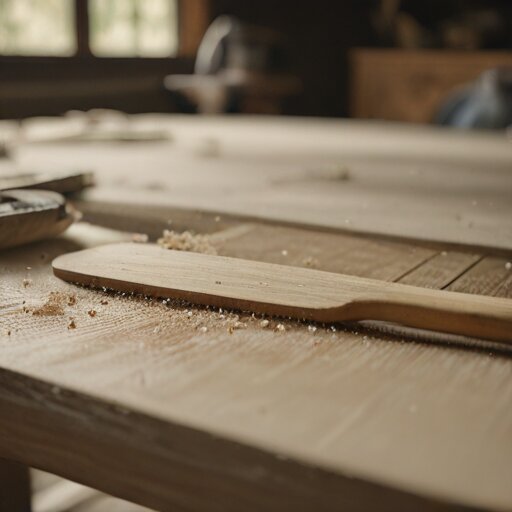
Now, you’re probably picturing me at a bandsaw tracing a paddle outline onto a board. Wrong instinct, and here’s the bit that took me a while to accept. You don’t saw a paddle. You rive it — split it out of the log with a froe, following the wood’s own fibres wherever they run. Sawing cuts a straight line through the wood no matter what the grain is doing, which means somewhere along that graceful shaft you’ve got fibres running off the edge. Carpenters call it short grain, and short grain at the neck of the paddle — the throat, where the shaft flares into the blade — is precisely where a hard prying stroke will snap it clean in two. Rive it and the fibres run unbroken from grip to tip. Same reason hockey sticks and axe handles were traditionally split, not sawn. The wood decides the line; you just agree with it.
Which is a lesson I have technically already learned. Back on the spoon that taught me to read grain instead of fighting it, the whole discipline was letting the material dictate the cut. A paddle is that exact idea scaled up about a metre, with the stakes moved from “ugly spoon” to “you are now swimming in the Bow.” Anisotropy isn’t the enemy. It’s the instruction sheet, if you’ll read it.
Here’s the part that made me genuinely happy, though, and it’s stolen wholesale from model aircraft. A flat blade flutters. Push it through the water and it shivers side to side, because the flow spills off the two edges unevenly and the blade can’t decide which way to spill. The fix is to carve a shallow ridge — a spine — straight down the centre of the power face, so the water splits symmetrically to both edges. That ridge is a dihedral. It’s the same reason a trainer aircraft has its wings angled up in a gentle V: split the airflow evenly and the thing stops wobbling and tracks true. I did not expect the aerodynamics of a foam wing to show up in a piece of firewood, but there it is, and it’s the difference between a paddle that hunts and one that carves a straight line.
A couple of things I’ve had to unlearn in one afternoon. Instinct says carve the blade thick so it’s strong — no, a thick blade dives and clunks, you thin the edges down to a foil and leave the strength in the spine. Instinct says total weight is what tires you out — also no. It’s swing weight, the mass out at the ends, the same reason a heavy-headed axe feels twice its actual weight. Shave the blade tip and the top of the grip and the whole paddle comes alive in your hands even if the scale barely moves.
Oh, and the vocabulary is wonderful. The shaft has a proper old name:
The part you grip along, between the handle and the blade, is called the loom.
Which delighted me for reasons that will surprise nobody who’s watched me fall down the loom-weaving rabbit hole — same word, entirely unrelated craft, and now they live in the same sentence.
No paddle yet, to be clear. I’ve got a rived ash billet, a rough blank, and a blade that’s nowhere near thin enough. Green wood sits at about 30 percent moisture and has to dry down to eight or ten before I do the final shaping, or it’ll cup like a chip as it dries — and I’ve already waxed the end grain so it doesn’t split overnight while I sleep. So it’s damp, heavy, and I can’t rush it. Which, given how the canoe went, feels about right.