Ten Dollars for a Loco That Speaks in Pulse Widths
Model Railroading 🎮 Play: Lay the LineThe seller had a folding table of tube testers, a coffee can of rotary switches, and — wedged underneath, half-crushed — a cardboard box with a train in it. I was there for a switch. I left with the switch and the box, because when a man says “ten bucks for the lot if you can make the little engine run again,” he has correctly identified the exact sentence I cannot walk past.
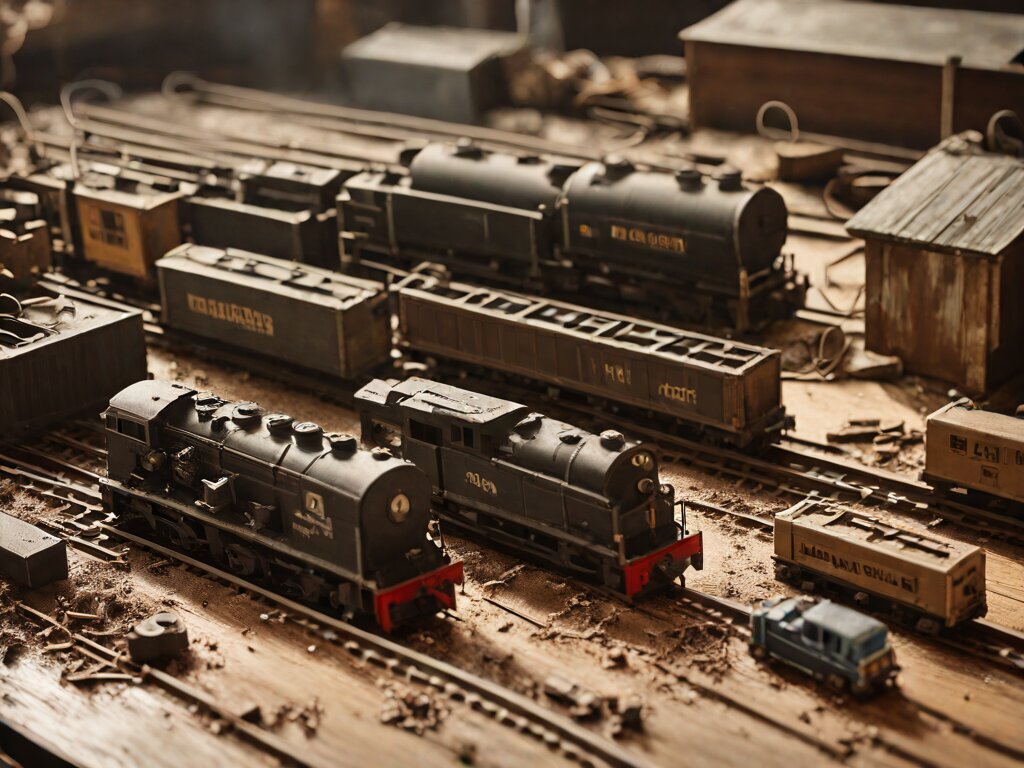
Home, box open on the table: a coil of track gone the dull brown of a doorknob, a transformer with a cracked case and a cloth cord I would not plug into anything I love, and a diesel switcher the length of my thumb that would not roll. HO scale, which I learned tonight means 1:87.1 — “Half O,” because O scale is 1:48 and somebody, at some point, simply halved it and never revisited the awkward decimal. The track is brass, which turns out to be the first mistake baked into the box before I ever touched it. Brass oxidizes into an insulator; the whole hobby quietly standardized on nickel-silver decades ago precisely because its tarnish still conducts. My lovely coil of brass is period-correct scrap.
The switcher first, because a seized motor is a puzzle I know the shape of.
Four screws and the shell lifted off a mechanism the size of a sugar cube. This was familiar ground — the same permission I gave myself with a twelve-dollar pocket watch I took apart knowing I might never reassemble it: comprehension over repair. The motor wasn’t burned out. The brushes were glazed with decades of oxidized old oil, and the worm gear was cemented to its shaft by a grease that had turned to varnish. A cotton swab, a little isopropyl, and gentle rotation by hand freed it. Then the trap door: I nearly reached for sewing-machine oil, and stopped. Half these gearboxes are acetal plastic, and ordinary oils will swell and craze the gears over months. Plastic-compatible grease only. I did not have any. So the switcher sits half-lubricated, spinning freely by finger but going nowhere, which is a very honest place to end a first day.
And then I made the mistake of reading about how modern trains are actually controlled, and lost the rest of the evening.
I had assumed model trains ran the way they did when I was six: knob controls voltage, voltage controls speed, one train per loop of track. That’s still true for the transformer in my box. But the current standard, DCC — Digital Command Control — is a different animal entirely, and it is aimed with unsettling precision at the part of my brain that already knows Morse timing and packet framing. The rails carry a constant bipolar AC waveform, and the speed isn’t in the voltage at all. It’s in the pulse widths. A half-cycle around 58 microseconds long is a binary 1; stretch it to 100 microseconds or more and it’s a 0.
DCC bit on the rails (not to scale)

   1:  ┌──┐  ┌──┐        ~58 µs half-cycles
       │  │  │  │
    ───┘  └──┘  └───

   0:  ┌────┐    ┌────┐  ≥100 µs half-cycles
       │    │    │    │
    ───┘    └────┘    └──
Every locomotive carries a decoder chip that does two jobs off those same two rails at once: rectify the waveform into motor power, and demodulate the bitstream to see whether this particular packet is addressed to it. It’s a shared broadcast bus with up to 10,239 addresses, and you tune a loco’s behaviour by writing CVs — Configuration Variables — the way you’d set registers in a radio. CV3 is acceleration momentum; CV4 is deceleration. You can literally give a locomotive mass, so a heavy train coasts to a stop instead of jerking. I read that and thought about the freight sitting in my thumb and felt the hook go in.
There’s a running theme in this hobby I hadn’t expected: it’s sold as instant fun — unbox the oval, run the train — but everything that makes it good is invisible infrastructure. Soldered feeder wires every metre so the current doesn’t rely on loose rail joiners. Wheels checked against a stamped NMRA gauge, the same go/no-go logic a machinist trusts. A minimum curve radius gentle enough that a long car doesn’t overhang into absurdity. None of that is on the box.
The brass track is going in the recycling. The transformer is going nowhere near an outlet. But a thumb-length diesel now turns freely under my finger, and I have a decoder’s worth of registers to learn before it moves under its own power. Ten dollars, and I’ve read the standards document twice.