Eight Towers in the Country and None Within Reach
Change Ringing (Method Bell Ringing) 🎮 Play: Ring the ChangesEight. That is how many towers in the entire country are hung for full-circle ringing, and not one of them is in Alberta. I found this out about forty minutes after deciding I wanted to try change ringing — which is a brisk way to watch an ambition fold into a travel-logistics problem. The nearest ropes are provinces away. So the honest version of Day 1 is this: I did not touch a bell.
What I touched was a browser tab. There is an app called Ringing Room, built during the lockdown years so scattered bands could keep ringing together, where each person claims one bell and strikes it with the space bar. A circle of coloured numbers, eleven strangers across three time zones, and a tenor bell in Somerset booming through my laptop speakers. I felt like a fraud logging on. Then someone typed “look to — treble’s going — she’s gone,” and we were away, and I stopped feeling anything except behind.
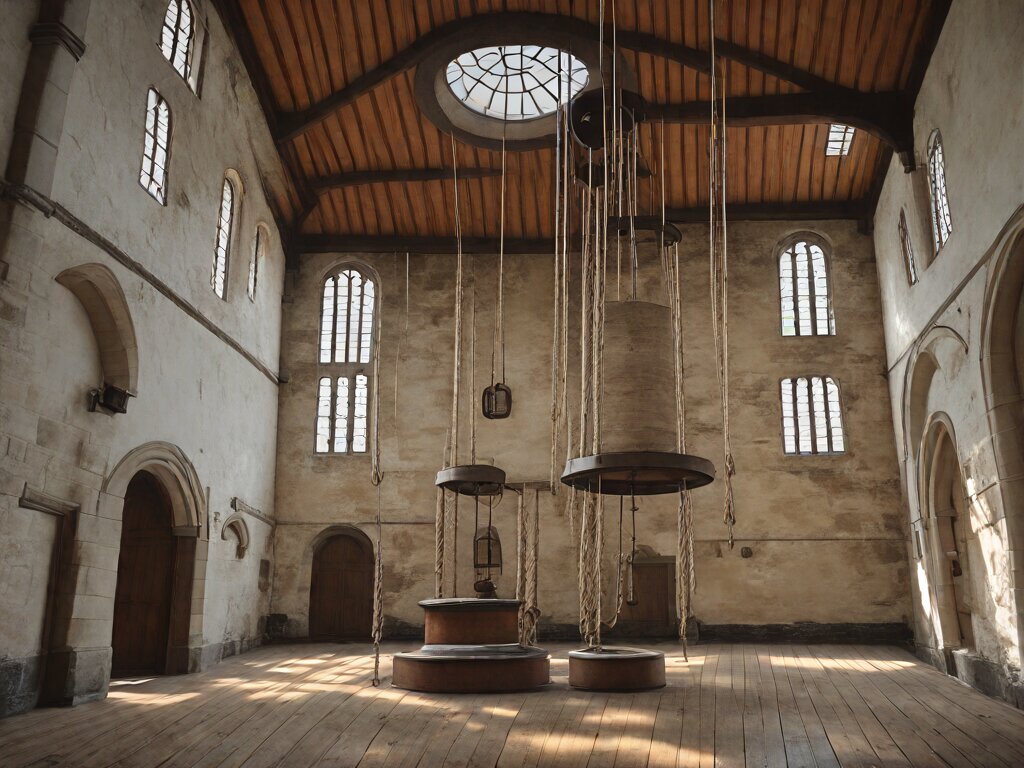
Here is the thing the simulator cannot give you, and it’s worth naming because it’s the whole physical art. A tower bell is a pendulum weighing anywhere from a couple of hundred kilograms up to four tonnes. Down in its resting position it swings at exactly one speed — its own, set by its size, and you cannot argue with it. The seventeenth-century breakthrough was swinging the bell nearly full circle so it balances mouth-upward at the top of each stroke, and there, at the balance point, you get a sliver of control: a heavier pull sends it round faster, a checked one lets it hang. You don’t strike on command. You coax a very heavy object into arriving on time by working with the momentum it already has. A space bar has none of that. I got the arithmetic of ringing today and none of the physics.
The arithmetic, at least, I could practise. Start in rounds — bells striking high to low, 1‑2‑3‑4‑5‑6 — then run the simplest method, plain hunt. The rule is almost insultingly small: every change, your bell moves one position, and one position only, because a real bell physically cannot leap across the row. At the front and the back you strike twice, then reverse. Follow that on six bells and you weave a tidy zig-zag that touches every place and lands back on rounds after exactly twelve rows. No sheet, no melody, just a line you walk.
Learning the line is where an old habit woke up. You do not memorize the numbers of the bells you strike after — that way lies madness. You memorize the shape of your own path through the pattern and a few landmarks (“dodge here, cross the treble there”). It is calculating a line and trusting it under time pressure, which is the one thing thirty-odd thousand games of chess did leave in my hands. And yet it failed in a way I’ve logged before. When Go stripped the body out of a game and I still lost four straight, the blindness had moved inside the reading. Ringing Room did the same trick: nothing to execute physically, one key to press, and I still drifted a fraction late every third change because I was watching the numbers instead of listening to my slot in the rhythm.
Which is the part choir already taught me and I somehow refused to apply. Twenty years in the bass section is twenty years of not being early, not being late, holding a line while seven other lines move against it. Ringing is that with the melody deleted — pure placement. One counterintuitive tax for a musician: the highest-pitched bell is number 1, and the numbers descend as the pitch drops, so my ear kept fighting my eye.
A small delight to end on, since I’ve got nothing resolved: some rows have names. Ring 1‑3‑5‑7‑2‑4‑6‑8 and you’ve struck Queens — the odds then the evens, and it does sound faintly regal. I hit it once by accident, three strangers typed “nice,” and I have no idea how I’d do it on purpose. The rope is still five provinces away.