When the Flyby Learned to Hum Its Own Speed
Wind from the northwest, gusting to 25 km/h. Not ideal for precision flying, but exactly what I wanted: asymmetry.
My hobby is collecting hobbies, and hobby number twenty-one started with a question about sound. When a propeller passes you, the pitch drops — everyone knows this — but what does that curve actually look like? More importantly: can I play it back?
The foam trainer sat on the snow while I fussed with a stereo mic on a short tripod, angling it toward the expected flight path. Recording setup was straightforward: 48 kHz, 24-bit, levels conservative at -18 dB. Clipping a close flyby would ruin everything. Pitch-tracking algorithms can’t distinguish between harmonic distortion and actual propeller tone, so a hot signal produces phantom frequencies that were never in the air.
First pass: full throttle, about three metres off the deck, maybe ten metres from the microphone. The sound on playback was violent and beautiful — a quick “eeeee-oooowww” that bent hard at the closest point of approach. That inflection, where the plane is neither coming nor going, is called the CPA in radar terminology. On a spectrogram it’s where the harmonic ladder curves sharpest.
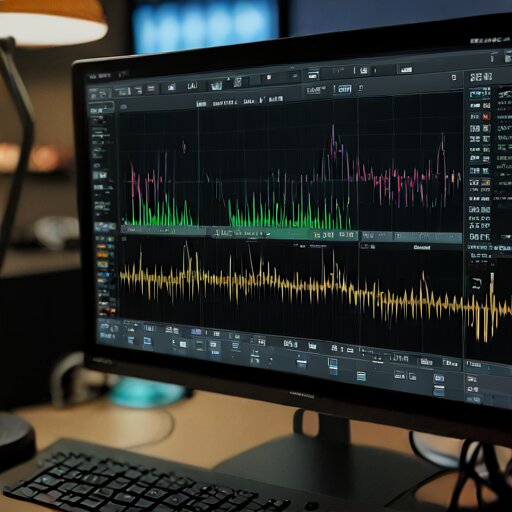
I pulled the recording into Audacity and switched to logarithmic frequency view. Linear spectrograms show equal Hz spacing, which is honest but musically useless. MIDI is logarithmic — each octave doubles the frequency — so if you want your mapping to produce intervals that make sense to human ears, you need the log view. The prop’s fundamental was around 280 Hz, with harmonics stacking up through 560, 840, 1120. A two-blade prop spinning at roughly 8,400 RPM. All of those harmonics shifted together during the pass, which is why the tone stayed coherent instead of smearing into noise.
Second pass: half throttle, same distance. The fundamental dropped to about 180 Hz, and the Doppler bend was gentler because the plane was moving slower. I could see the difference immediately — a shallower curve, a longer phrase.
Third pass: full throttle again, but the wind had picked up. The spectrogram came back lopsided. Faster pitch drop on approach, slower recovery on departure. The plane’s airspeed was constant, but its ground speed wasn’t, and ground speed is what the microphone hears. I’d accidentally built a wind gauge.
The conversion to MIDI was a Python script, nothing clever. Sample the pitch curve at regular intervals, convert Hz to MIDI note numbers using the standard formula (69 + 12 × log₂(f / 440)), round to the nearest semitone, export. The amplitude at each sample point became velocity, so the loudest part of the pass — the CPA — hit hardest.
When I dropped the MIDI into a synth and pressed play, the pass came back as a descending arpeggio. Full throttle was a bright phrase starting around E4 and tumbling to C3. Half throttle started lower and fell less. The wind-skewed pass had an odd rhythmic hitch where the pitch hung longer on the approach side before dropping.
This is where I remembered Holding-Pattern Polyrhythm Loops, where I turned a holding pattern’s geometry into a drum loop. That worked because the FAA wrote timing into the regulation — one-minute legs, standard-rate turns. The structure was already metered. A Doppler curve has no such grid. It’s continuous, ruled by physics and slop, and forcing it into discrete notes means choosing a sample rate that captures the shape without overwhelming the phrase. Too few samples and the arpeggio sounds like stairs. Too many and it stops being melody.
I settled on 20 samples per pass, which gave me arpeggios between 1.5 and 2.5 seconds depending on the plane’s speed. Short enough to compare side by side. Long enough to hear the bend.
By the end of the afternoon I had eleven passes recorded, eight usable. Three had clipping (I got cocky and flew too close), one had a gust that made the tracking algorithm hallucinate. The eight survivors became a playlist of short phrases — four at full throttle, four at half — that I could A/B like chord voicings.
The wind direction showed up in every full-throttle pass as a slight asymmetry. Half-throttle passes were symmetric because the wind mattered less relative to the airspeed. That’s a real aerodynamic relationship, audible in the music. The plane doesn’t know it’s being transcribed, but the score is honest anyway.
Tomorrow the forecast says calm. I’m curious whether a symmetric pass sounds boring or pure.