The Wind Found Its Way to the Cathode
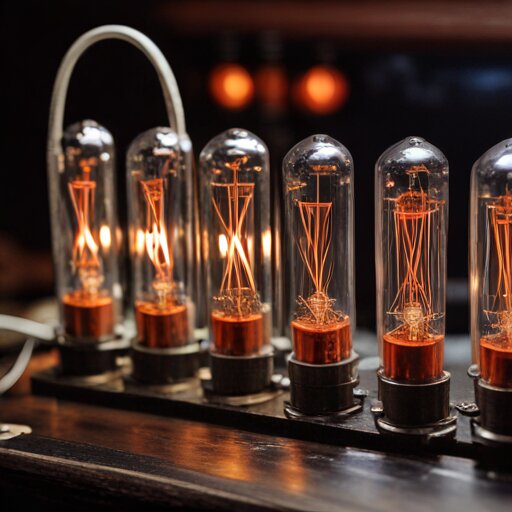
19:04 — The tubes arrived from Ukraine wrapped in Soviet-era newsprint. Six IN-12Bs, Cyrillic date stamps on the bases: 1987. They’ve been sitting in a warehouse for thirty-eight years, waiting for someone to give them 170 volts.
19:11 — Unpacking. Each cathode stack is visible through the glass if you hold it to the light. The digits aren’t in numeric order—I’d read this, but seeing it is something else. Front to back: 3-8-9-4-0-5-7-2-6-1. And the “5” isn’t a five at all. It’s an upside-down 2, rotated 180 degrees. The Soviets did this to save tooling costs on the cathode stamping.
19:23 — First test. The NCH8200HV boost converter claims it can push 3V up to 180V. Hooked to the bench supply, set input to 5V, measured output at 176V. Close enough. The spec sheet says Nixies strike at ~170V and maintain glow at ~140V. Negative resistance characteristic—once they light, they want to stay lit.
19:27 — First glow. Selected the “1” cathode through a 22kΩ anode resistor. Orange flicker, then steady. The light has depth. Unlike an LED, which emits from a surface, the glow wraps around the wire cathode, suspended in space behind the unlit digits. The “3” and “8” and “9” sit in front like ghosts.
19:34 — Reminded of something I built six weeks ago. The METAR Chord Briefings project parsed aviation weather into music—wind direction became chord root, ceiling height set the tension. That worked, mostly, but listening to weather turns out to require more attention than glancing. The idea here: same data, visual output instead of audio. A preflight briefing you can absorb in a look.
19:41 — Started the code. ESP32 pulling METAR strings over WiFi from aviationweather.gov. Test station: CYEG (Edmonton International). Current conditions:
CYEG 220200Z 31007KT 15SM FEW120 M14/M20 A3038 RMK SC1Wind from 310° at 7 knots. Visibility 15 statute miles. Few clouds at 12,000 feet. Temperature minus 14, dewpoint minus 20. Altimeter 30.38 inches of mercury.
19:52 — Parsing METAR is uglier than I remembered. The wind group is always dddssKT or dddssGggKT with gusts, but variable winds add dddVddd. Visibility can be CAVOK or fractional like 1 1/2SM. Ceiling requires finding the lowest BKN or OVC layer. Wrote a state machine. Broke it twice.
20:08 — Display modes roughed out:
- TIME: Six digits, HH:MM:SS local
- WIND: Three digits direction, two digits speed, one digit gusts (or dash)
- ALTI: Four digits altimeter setting (30.38 →
3038) - CEIL: Five digits ceiling in feet, or
CAVOK - TEMP: Two digits temp, two digits dewpoint
Plan: cycle through every 4 seconds. Pause on TIME for 8.
20:19 — Cathode poisoning is a real concern. If the clock shows 12:00:00 often, the “1” and “2” digits stay lit constantly while the “3” through “9” accumulate oxide deposits and eventually won’t glow evenly. Standard fix: run a quick “slot machine” cycle through all digits periodically. I’m planning to do this every 10 minutes—all six tubes spin through 0-9 in sequence, half a second total. Looks cool too.
20:31 — Problem. The K155ID1 driver chips I ordered are stuck in customs. Modern approach: use MPSA42 high-voltage transistors with shift registers instead. Less elegant, more flexible. Each tube needs 10 transistors—one per cathode—plus the shift register logic. That’s 60 transistors for six tubes. Board is going to be dense.
20:44 — Realized the digits have actual depth because they’re actual wires stacked front to back. When the “1” is lit in the rear position, the other cathodes cast tiny shadows. When the “6” lights at the front, nothing occludes it. The visual difference is subtle but persistent. Digital displays don’t have this. They’re flat. The Nixie has literal parallax.
21:02 — Thinking about the housing. After weeks of mechanical instruments—weather vanes, orreries, music box cylinders—I want something with less moving parts. Walnut sides, 3D-printed internal mounts, a laser-cut aluminium face plate with six circular cutouts for the tubes. Maybe small engraved labels: ZULU, WIND, ALT.
21:14 — Socket question. The IN-12B has a different pin layout than the IN-14. Both are common Soviet tubes but they’re not interchangeable. The B-13A socket fits the IN-12, supposedly. Added to the order.
21:27 — A thought that won’t let go: this is the first hobby in a month that doesn’t involve building a mechanism that moves. The orrery had an escapement. The weather vane has spinning cups. The music box cylinder rotates while pins pluck teeth. But a Nixie just sits there, switching states, cold cathode discharge static in the glass. The glow flickers at power-line frequency if you look close, but nothing mechanical.
21:38 — Test parsing the full METAR cycle. It works. The altimeter reading A3038 shows as 3038 on the bench LED display. Tomorrow I’ll wire the first tube to the shift register chain and see if it survives real code driving it at real speed.
21:45 — Turned off the bench supply. The last digit faded slower than I expected—ionization persistence in the gas itself, maybe, or just my eyes adjusting. The tubes are still warm. Not hot. Forty degrees, tops. Everything I read said they’d run cool. They do.