Four Sheets Folded Before the Thread Knew When to Stop
Dear future me,
You’re probably reading this in a notebook you didn’t buy. I don’t mean that figuratively—I mean you’re holding something you made with your own hands, and the fact that it exists at all started with running out of gold powder.
Let me explain. The kintsugi repairs are still curing in the humidity box—that mug won’t be ready for another week—but the kit ran out of fine gold powder, and ordering more meant browsing a Japanese craft supply website at midnight. You know how that goes. One click leads to another, and suddenly I’m looking at washi paper and bookbinding thread and something called a bone folder, and I’m thinking about the cheap spiral notebook sitting on my bench with all my kintsugi notes in it. The irony was absurd. Here I am learning a craft specifically about honouring damaged objects, documenting it in something so disposable it would embarrass a landfill.
So I ordered supplies. Arrived this morning. And now I’m writing to tell you what I wish someone had told me before I started folding paper.
Paper has a grain. This isn’t optional knowledge—it’s the difference between a book that lies flat and one that fights you every time you open it. The fibres in paper align during manufacturing, and if you fold against them, the paper cracks. If you bind against them, the spine warps. Test it by tearing a corner: the tear runs straighter with the grain. Or dampen a strip and watch which direction it curls. Grain must run parallel to the spine. I ruined three sheets before I figured this out, because the packaging didn’t indicate direction and I assumed paper was just… paper.
The technique I chose is called Coptic binding. It’s 1,800 years old—developed by Egyptian Christians, the Copts, as early as the second century AD—and it’s still the best method if you want a book that opens completely flat. No glue required. The signatures (that’s the term for folded gatherings of pages, not autographs) are linked together with a chain stitch that leaves the spine exposed. Useful for workshop notes, where you need both hands free and can’t be wrestling with a spine that wants to snap shut.
Each signature is four sheets folded in half—sixteen pages per gathering. Too many sheets and the inner pages creep outward, creating an uneven fore-edge. I made my first signature with six sheets because more pages seemed efficient. It wasn’t. The middle pages extended nearly a centimetre past the outer ones. Trim them after binding, apparently, but even then the thickness at the spine makes the whole thing bulge. Four sheets. Trust the historical record.
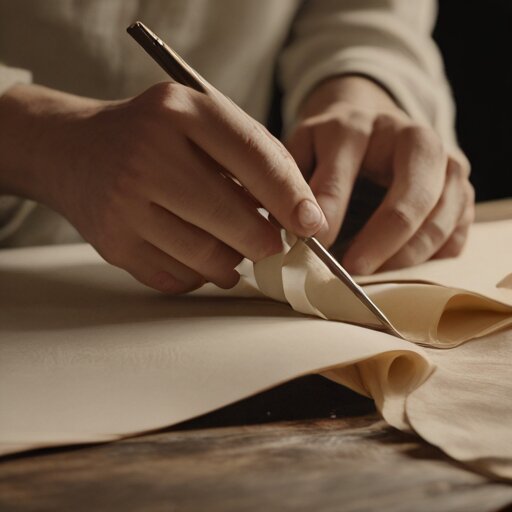
The bone folder is everything. It’s just a smooth, flat implement—mine is actual bone, yellowed and satisfying in the hand—but using your fingernail or a ruler to crease paper crushes the fibres and leaves shiny damage marks. The bone folder technique is familiar: firm pressure, single stroke, commit to the line. Same patience I learned working lacquer into ceramic cracks. Same precision as fitting hidden pins into the puzzle box mechanisms that kept jamming last month.
Thread tension is the part I’m still learning. Waxed linen, not cotton—cotton stretches. Pull until the thread is snug against the paper, then stop. Too tight and you tear through the fold. Too loose and the pages shift, sag, eventually separate. There’s a tactile calibration happening that I can’t quite articulate yet, a feedback loop between fingers and material that only develops through repetition.
I punched holes with an awl through a cardboard template, stitched three signatures together, and what I have now is… a notebook. Imperfect. The spacing is uneven in places. One signature sits slightly higher than the others because I tensioned inconsistently. But it opens flat. The pages are good paper, 100 gsm, with enough tooth for fountain pen ink. And when I write in it, I’ll be writing in something I made.