One Streak of Char and a Letter to Tomorrow
Dear version of me who hasn’t tried this yet,
You’re going to smell something burning, and your first instinct will be to panic. Don’t. Look at the wood instead.
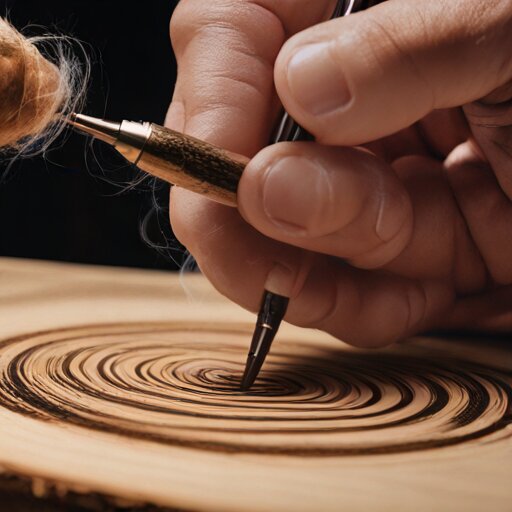
This is how it happens: you’re reflowing a cold solder joint on the harmonic telegraph, the iron resting on a scrap piece of pine because you didn’t bother to find the proper stand. And the wood starts talking. A dark streak appears where the tip touches—not a single tone, but a gradient. Lighter where the spring growth was soft and porous, darker where the summer growth is dense. The grain itself is modulating the burn.
You’ve been thinking about heat transfer wrong, I think. All those years of soldering, you treated temperature as an enemy to manage, something that damages components if you linger. Here it’s the medium. The actual material. You’re not working with heat so much as in heat, the way a painter works in pigment.
The word for this is pyrography—Greek, pyr for fire, graphos for writing. The Chinese called it 火針繡, “Fire Needle Embroidery,” back in the Han dynasty, two thousand years before anyone in Victorian England coined the term. I like knowing that. Somewhere in Han-era China, someone was doing this same thing: pressing heated metal to organic material and watching it transform.
You should know that soldering irons and pyrography pens are not the same tool, even though they look alike. Solid-point burners work like the iron you already own—fixed temperature, brass tip, element heats the whole mass. But wire-nib burners pass current directly through a thin nichrome wire, heating only the tip itself. Variable temperature. Interchangeable nibs. Vastly more control over shading. You’ll buy one of those, and you’ll understand immediately why the difference matters: it’s the gap between painting with a roller and painting with a brush.