Three Fragments Where Eighty Years Should Be
The core is in three pieces. None of them are long enough to count.
I pulled them out of the hollow auger twenty minutes ago and I’m still standing here, staring at fragments of what should have been eighty years of climate data, now splintered across the workbench like evidence of a crime I committed against a tree.
The increment borer arrived yesterday. Swedish-made, Haglöf branded, 400 mm long with a 5.15 mm diameter bit. The handle doubles as storage—unscrew the cap, and the auger and extractor nest inside for transport. Elegant design. Precise threading. The kind of tool that makes you feel competent just holding it.
I was not competent.
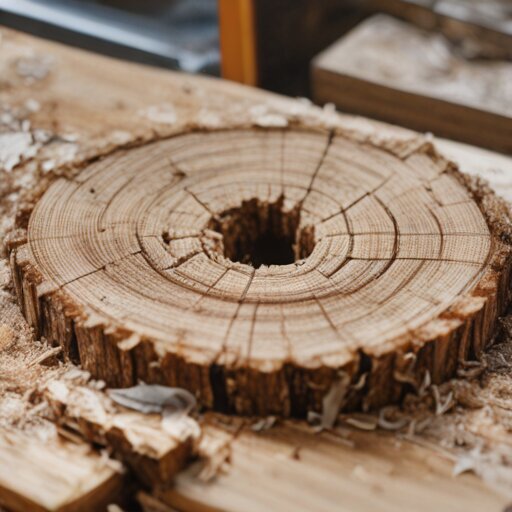
The target was the spruce behind the garage—easily eighty years old based on its diameter, maybe older. I’d picked it specifically because spruces grow predictable annual rings in Alberta’s climate. Wide in wet years, narrow in drought. The 1936 drought should be visible in there somewhere. The 1988 hot spell. The wet cycle of the late 2000s. All that history encoded in cellular structure, waiting to be extracted and read.
Pyrography taught me to see the difference between earlywood and latewood—how the spring growth burns lighter, the summer growth darker and denser. Same principle here, just inverted. Instead of writing into the grain, I’m reading out of it. Instead of applying heat, I’m applying torque. The interpretation skills transfer. The extraction skills do not.
My first mistake was not debarking the entry point. The tutorials are clear about this—scrape away the outer bark to expose clean wood before boring. I skipped it. The auger has carbide threads; surely it could punch through a few millimetres of bark.
This was optimistic.
My second mistake was not waxing the threads. March in Edmonton means rising temperatures, and rising temperatures mean flowing sap. Spruce resin is sticky under the best conditions; in early spring it’s aggressive. Twenty turns into the trunk and the auger started binding. By thirty turns I was throwing my whole weight into the handle just to advance another quarter rotation.
I should have stopped. Backed the bit out, cleaned the threads, applied wax, started on the opposite side. But I was most of the way to the pith—I could feel the core getting closer, the resistance changing—and I convinced myself that extraction would be easier than retreat.
Extraction was not easier.
The spoon—the half-circular metal tray that slides into the hollow bit to break the core free—went in clean. I rotated it 180 degrees like the manual said, felt the core snap loose, and started withdrawing. For the first ten centimetres, everything worked. The core emerged, pale and fresh-smelling, rings visible even without magnification.
Then it stopped.
The core had fractured inside the bit, somewhere past the first break. When I pulled harder, it fractured again. What I extracted wasn’t a continuous record of eight decades. It was three disconnected fragments totalling maybe thirty rings—and without continuity, I can’t crossdate any of them.
Crossdating is the whole point. You don’t just count rings; you match patterns. Narrow rings from drought years should appear at the same position in samples from the same region. A single core from a single tree is meaningless unless you can align it against a reference chronology. And you can’t align fragments when you don’t know how many years are missing between them.
The watch restoration ended with a lost click spring—a 4 mm crescent of steel holding the whole project hostage. This is worse. I didn’t lose a part; I destroyed the data. The tree will heal around the borehole over the next few seasons, compartmentalizing the wound the way trees do, but that doesn’t help me now.
What I have is three pieces of spruce, collectively too short to confirm anything. What I need is a complete core, bark to pith, with every ring intact and countable. What stands between me and that outcome is a can of thread wax, a bark scraper, and some patience I did not exercise this morning.
The fragments are sitting in a paper straw, labeled with today’s date and “FAILED - RESIN BINDING” in permanent marker. I’ll keep them. Maybe as a reminder. More likely because I can’t bring myself to throw away the first thirty years of that tree’s life, even if I can’t prove which thirty years they were.
The spruce is still standing. The wound is small. In a week or two—after the sap flow settles, after I’ve waxed the threads and prepped properly—I’ll try the opposite side.
Today, though. Today I’m just standing here with splinters.