Two Mirrors and an S That Landed Right
09:42 — Searching “how to make custom stamp” because the puzzle box needs a maker’s mark. Something to press into the documentation, maybe brand into the wood later. Expected rubber stamp kits. Found instead: relief printing, block printing, linocuts. A rabbit hole opened.
09:58 — Linoleum was invented in 1860 as floor covering. Linseed oil and canvas. Artists didn’t touch it until the 1900s. The stuff under my grandmother’s kitchen sink. That’s what I’m carving.
10:15 — Starter kit arrived last week. Two 10×15cm blocks, set of five gouges, small brayer, water-soluble ink in black. Total cost: $34. The blocks smell faintly of old classrooms.
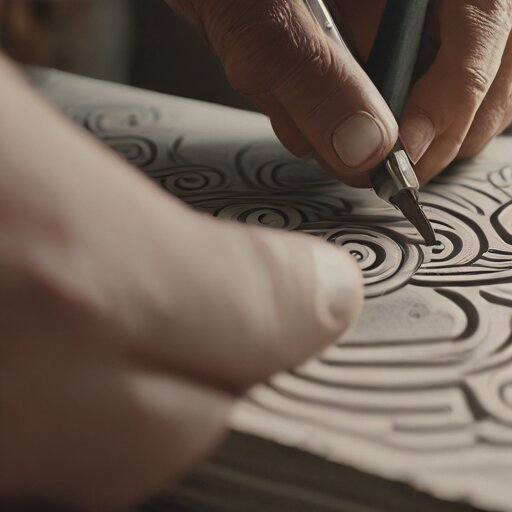
10:23 — First cut. Cold linoleum is miserable. The V-gouge skips and stutters, biting deeper than intended on the recovery. Tried again. Same problem. Googled “lino hard to cut” and felt vindicated: you’re supposed to warm it first. Hair dryer for two minutes, then it glides.
10:31 — Warm lino carves like dense butter. Grey curls peel away in spirals. No grain to fight—unlike the pyrography, where earlywood and latewood burned at different rates, this material doesn’t push back. Every mark is exactly what I chose. Which means every mistake is also mine.
10:45 — The maker’s mark design: my initials, S.L., stylized into a simple geometric form. Drew it on paper, realized immediately that it needs to be mirror-reversed on the block. Text carved normally prints backwards. The spatial reasoning here is the same as laying out PCB traces—you’re always thinking in negatives and reflections.
10:52 — Transferred the design using carbon paper, flipped. The reversed S looks wrong but will print correctly. Trust the process.
11:14 — V-gouge for outlines. U-gouge for clearing larger areas. The angle you hold determines the line width: steep means thin, shallow means wide but also more prone to undercutting. Cut too shallow and the ridges catch ink. Cut too deep and you lose control of where the gouge wants to travel.
11:28 — Slipped. Gouge jumped the line and cut a small notch where nothing should be. This is permanent. No undo. Relief printing is a commitment medium—Picasso used what’s called the “reduction method,” carving successive layers from a single block, each colour destroying the previous state. They call it a suicide print. Once you cut, the material before is gone.
11:35 — Decided the notch is a feature. The mark will have a slight imperfection. Handmade.
11:47 — Inking. Squeezed a pea-sized blob of black onto a glass tile, rolled the brayer back and forth until the ink layer became thin and even. You’re listening for a specific sound: a soft hiss, slightly tacky. The guides describe the texture as “velvety.” That’s accurate. Too thick and ink pools in your carved areas. Too thin and the print comes out ghostly.
12:03 — First print. Placed copy paper over the inked block, pressed with the back of a wooden spoon in circular motions. Peeled it up.
12:04 — The S is backwards.
12:05 — No. The S is correct. The design printed in reverse, which means it’s now… right-reading. The carbon paper transfer flipped it, and the print flipped it back. My brain keeps tripping over the double-negative. Mirror of a mirror.
12:12 — Second print: slightly better pressure, cleaner edges. The notch shows up as a tiny white mark in the black area. Character.
12:20 — M.C. Escher made linocuts. The tessellations, the impossible staircases—many of those were carved into linoleum and printed by hand. The medium’s clean edges suited his mathematical precision. Something satisfying about that lineage.
12:34 — Fifth print. Getting consistent now. The ink coverage evens out once you develop a rhythm: roll, roll, roll, press, peel. Each print is slightly different—pressure variations, tiny ink pooling, the grain of the paper accepting ink in subtly different ways. Multiples, but not copies.
12:41 — The maker’s mark works. Small, repeatable, mine. Could stamp this onto the puzzle box documentation, onto bookbinding projects, onto anything that needs a signature that isn’t handwriting.
12:58 — Cleaned up with warm soapy water. The block stores flat. The gouges need a light oiling. The glass tile lives next to the bench now.
Still thinking about the lack of grain. In pyrography, the wood fights you—soft spring growth burns fast, dense summer growth resists, and you learn to read the material before you touch it. Here, the linoleum is neutral. It accepts whatever direction you push. That freedom is its own discipline. No material is telling you where to go. You have to know before you start.