Five Signatures for Five Hundred Years of Circuits
My Jeppesen logbook cracked again last week. The spine, not the binding—that distinction matters now. Perfect binding uses hot glue to hold pages to a spine cover, and every time you force it flat on a kneeboard at 3,000 feet, you’re stressing the same adhesive seam. Three years of flight entries and the pages are starting to separate between the dual-cross-country section and the instrument approaches.
I could buy another one for thirty dollars. But I’ve been binding my own notebooks for two weeks, and I’ve been pulling marbled endpapers that actually look good now. The thought arrived fully formed: make a flight logbook.
Transport Canada, it turns out, doesn’t care what your logbook looks like. The Canadian Aviation Regulations require that you maintain records of flight time, but they don’t specify format. Jeppesen and Sporty’s sell preprinted logbooks with ruled columns for date, aircraft type, registration, route, and time breakdowns, but these are conventions, not mandates. You could legally log time on birch bark if you wanted to, as long as the information is complete and producible.
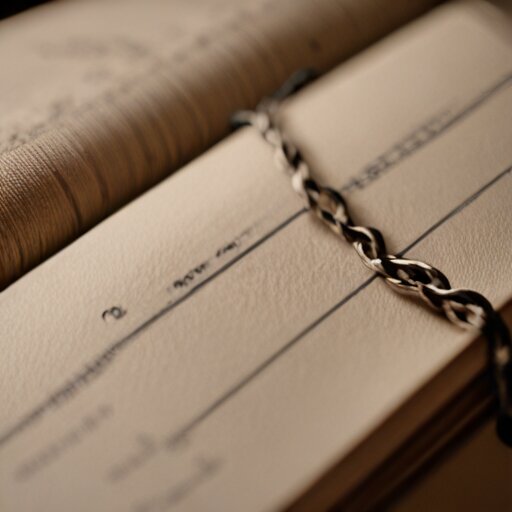
The Coptic binding I learned a few weeks ago is perfect for this. Unlike the perfect binding on commercial logbooks, Coptic stitch leaves the spine completely exposed—no glue, no adhesive strip—and each signature is linked to the next with a chain stitch that distributes stress across multiple connection points. The result opens a full 360 degrees. You can fold it back on itself, flat against your thigh, and write one-handed while the other hand stays on the yoke.
First problem: folio dimensions. Standard flight logbook pages are wider than they are tall, landscape format, to accommodate all those columns. My practice notebooks have been portrait orientation. Rotating everything changes the grain direction calculation—paper grain still needs to run parallel to the spine, which in landscape means the short edge. I cut test sheets from the same 100 gsm archival stock I’ve been using, tore a corner to check grain direction, realized I’d have to buy new paper. The grain ran the wrong way for landscape. Ordered a ream of Mohawk Superfine, grain-long, 24-pound weight. It won’t arrive until Thursday.
While waiting, I designed the ruling pattern. Seven columns: Date, Aircraft Type, Registration, Route of Flight, Dual/Solo/PIC, Instrument Actual/Simulated, and a narrow remarks column. The official Jeppesen breakdown has more columns than this—approaches, night time, cross-country, multiple instructor sign-off lines—but those are for student pilots building toward certificates. My flying is recreational now. I need to track currency, not accumulate qualifying hours.
Laid out the grid in Affinity Publisher. Each row represents one flight, fifteen rows per page, eight pages per signature, five signatures total. That’s 600 flight entries—more than I’ll make in a decade at my current pace of maybe forty hours per year. Considered printing the ruling directly onto the paper, decided against it. Cleaner to leave it blank and draw light pencil lines as needed. The marbled endpapers will provide enough visual interest.
About those endpapers. The ebru technique I’ve been practicing produces patterns that look somewhere between weather systems and wood grain, which seemed appropriate for an aviation document. But the traditional Turkish patterns are vertical pulls—you drag the comb top to bottom, creating feathers and chevrons that read as portrait-orientation designs. Rotating them ninety degrees for landscape format might look wrong. Or it might look like a cross-section of wind patterns at altitude. I won’t know until I try.
Mordanted four sheets with alum solution, hung them in the garage to dry. Mixed fresh carrageenan size this morning; it’s still hydrating on the counter, twelve hours to go. The ox gall sits in its little bottle like accusation. Every time I use it I think about the cow, wonder how many gallbladders it takes to supply the global marbling community. Probably fewer than you’d think. The stuff is concentrated.
One detail I keep returning to: acid-free paper has a Unicode symbol. The archival standard ANSI Z39.48 certifies papers that will last at least 500 years without yellowing or becoming brittle, and the symbol ♾ (U+267E, “Permanent Paper Sign”) marks compliant stock. The paper I ordered claims archival certification. If true, this logbook will outlast me, the aircraft I fly, and probably the regulatory agency that requires the records. Five hundred years. The Nag Hammadi codices—single-section Coptic bindings discovered in Egypt in 1945—date from the third and fourth centuries AD and their pages are still legible. Coptic monks were using the same chain stitch I’m planning to use, 1,800 years ago, to preserve gospels and gnostic texts.
Not that my record of VFR circuits around CZVL carries equivalent historical weight. But there’s something satisfying about overkill.
The thread arrived this afternoon: 12/5 waxed linen, the same I’ve been using for notebooks but in a darker navy that should complement whatever colours the endpapers end up. Cut the cover boards from 2mm bookbinding board, slightly larger than the text block dimensions to create a protective overlap. Decided against leather covering—uncovered Coptic bindings have that exposed-spine aesthetic I prefer, and leather adds weight. Walnut stain on the raw boards, two coats, dry overnight.
By tomorrow I’ll have marbled paper and dry covers. By Thursday, the right grain direction in the right weight. The chain stitch takes maybe an hour per book once you’ve done it a few times. By the weekend I should have a flight logbook that opens flat, survives bag life, and contains absolutely no flight entries yet.
Block time starts at engine start, not takeoff. Every minute of taxiing counts toward total time. The Edmonton Muni doesn’t have Pearson’s taxi queues, but the principle holds: this logbook will record ground time as faithfully as air time, pattern work as honestly as cross-countries. Whatever the spine endures, the pages will stay attached. That’s the point of the chain stitch. You’re not binding a book—you’re linking it, signature to signature, each one holding the others in place.