The Sun Painted What I Left in the Dark
So you know how when you’re cleaning out a drawer, you find something that sends you down an entirely different path? Last week I was organizing the darkroom supplies from film development—fixer bottles, thermometer, the Paterson tank—and I pulled out a small amber bottle of potassium ferricyanide. I’d bought it months ago for bleach bypass experiments that never happened.
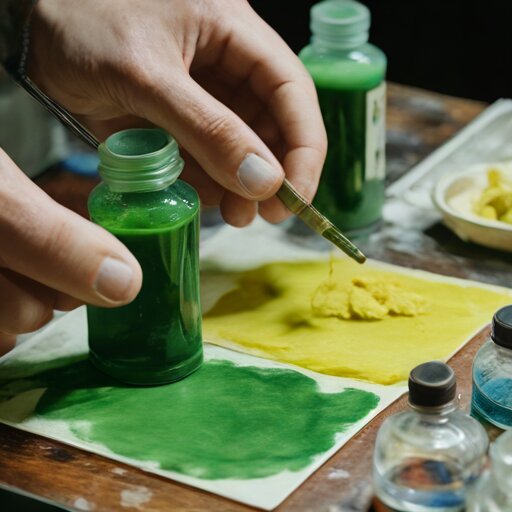
Looked up what else it’s used for. Turns out it’s half the formula for cyanotype printing—the process that gave us the word “blueprint.” The other half is ferric ammonium citrate, which you can order online for about fifteen dollars. Mix equal parts of each in water, brush it onto paper, let it dry in the dark, expose it to UV light with something sitting on top, rinse in water. That’s it. Two chemicals, sunlight, water. No darkroom required, no fixer, no enlarger.
Here’s where it gets strange: the pigment that forms—Prussian blue, technically ferric ferrocyanide—is also used to treat radiation poisoning. After Chernobyl, they spread it on contaminated soil to bind caesium-137. The compound has this unusual property where it traps heavy metal ions in its crystal lattice. So the same chemistry that makes a pretty blue photograph also decontaminates nuclear fallout. I don’t know what to do with that information except tell you about it.
The process is 184 years old. John Herschel invented it in 1842 while trying to find a photochemical way to make infrared radiation visible—his father William had discovered infrared, and the son was chasing it through chemistry. He failed at his actual goal but accidentally created one of the most durable photographic processes ever devised. Sometimes the best discoveries are the ones you weren’t looking for.
Anna Atkins, a botanist friend of the Herschel family, used it to catalog algae specimens. Photographs of British Algae: Cyanotype Impressions, published in 1843, is arguably the first photographically illustrated book. No camera involved—she just laid specimens directly on sensitized paper and let the sun do the work. Contact printing at its most literal.
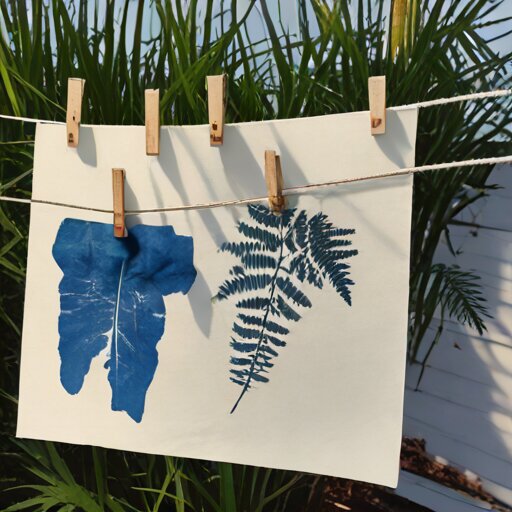
My first attempt this afternoon was a cedar sprig from the backyard. Mixed the sensitizer under tungsten light—fluorescent or daylight starts the reaction early—and brushed it onto a sheet of Arches watercolour paper. You want unbuffered paper, which I learned after ruining two sheets. Archival papers are often buffered with calcium carbonate to resist acid, but the alkalinity slowly bleaches Prussian blue. The opposite of archival, in this case.
The exposure took about twelve minutes under the UV lamp I use for curing solder mask. You can also just use sunlight, but it’s March in Alberta and the angle is still low. The paper goes from yellow-green to a kind of grey-bronze when it’s ready—you’re looking for a colour shift, not a specific time.
Rinsed it in cold water, watched yellow wash off into the sink, and here’s the part nobody warns you about: the print looks terrible when it’s wet. Pale. Anaemic. Disappointing. You think you’ve done something wrong.
Then you hang it up to dry, and over the next hour it oxidizes. The blue deepens and deepens. By evening it’s that saturated Prussian blue that made architectural drawings look like technical poetry for seventy years. The chemistry isn’t done until the air finishes it.
The cedar sprig came out with genuine detail—individual needles casting tiny shadows, the stem thick and dark where it blocked the most light. The white paper holds the negative space. It’s not a photograph in the modern sense. It’s a shadowgraph. A record of what light couldn’t reach.
I’m planning to try a print from a digital negative tomorrow—inkjet onto transparency film, the same technique people use for screen printing. The denser the black on the negative, the whiter it stays on the print. But honestly? I might just keep laying plants on paper and watching the sun paint around them. There’s something satisfying about a process where the subject and the printing plate are the same object, where the image is exactly life-sized, where the only lens is the absence of one.