The Hot Spot I Found and Then Immediately Lost
The galena weighs more than it should. That’s the first thing I notice when I lift it out of the box — a cube of lead-grey mineral about the size of a sugar cube, dense as a fishing sinker. Specific gravity 7.4, which means nothing until you hold it and realize this thumb-sized rock weighs over 40 grams. The seller on eBay called it “radio-grade galena” and charged fourteen dollars including shipping, which seems like a lot for a chunk of lead sulfide until you remember what it’s supposed to do.
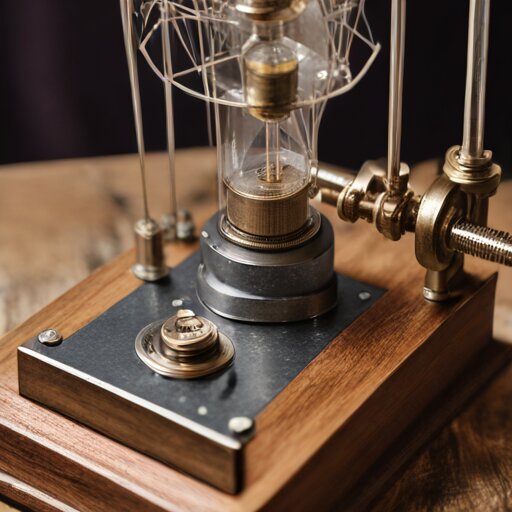
The crystal radio arrived separately, from a different seller in Ohio. A 1930s Philmore kit, mahogany base, coil wound on a cardboard tube, and a detector mechanism that looks like something from a steampunk prop shop: a small brass cup holding a fragment of galena, with a thin springy wire mounted on a swinging arm. The wire is the “cat’s whisker.” The whole assembly is designed so you can drag the wire tip across the crystal face, hunting for the spot where physics happens.
Here’s what the physics is: the junction between that wire and the crystal forms a crude semiconductor diode — the first one ever invented, actually, though nobody knew what semiconductors were in 1906 when Greenleaf Whittier Pickard patented it. The crystal rectifies the radio signal, converting alternating current into pulsing direct current, stripping off one side of the waveform so the audio modulation can be extracted. The same basic principle as the diode in every piece of electronics I own, but implemented with a rock and a piece of springy wire.
The trouble is that only certain microscopic spots on the crystal surface form working junctions. You can’t see them. You can’t predict them. You drag the whisker across the galena face, listening through high-impedance earphones, hoping to hear static or a station. When you find a hot spot, you stop moving. Then you breathe wrong, or a truck drives past, or the house settles, and you lose it.
I spent forty-five minutes tonight not hearing anything at all.
The earphones are period-correct — 2000-ohm Brandes “Superior” cans from the same Ohio seller, leather headband cracked but functional. Modern earbuds won’t work; their 32-ohm impedance is too low to match the circuit. A crystal radio produces maybe a few microwatts of audio power at best, all of it scraped directly from the radio waves hitting the antenna, and that power has to move a diaphragm. High impedance, high voltage, low current — the earphones need to be efficient, not loud.
My antenna is thirty metres of wire running from my office window to the garage, the same wire I use for 40-metre amateur work. Overkill for AM broadcast reception, probably, but I wanted to eliminate variables. The problem wasn’t the antenna.
The problem was my hands.
When I finally heard something — a burst of static that shifted pitch as I moved the whisker — I froze. Held my breath. The static resolved into a voice, male, selling mattresses. 880 kHz, probably, which would be CHED Edmonton. The signal was faint, buried under hiss, but present. I’d found a hot spot.
Then I reached for my notebook to write down the frequency, and the whisker bounced.
Gone.
Fifteen more minutes of hunting before I found another spot. This time I didn’t move at all. Just listened. The mattress ad ended and a country song started, something about trucks or drinking or both. The fidelity was terrible — AM broadcast quality through a passive detector with no amplification, the audio equivalent of looking through wax paper — but the song was unmistakably there. Energy that had left a transmitter tower in downtown Edmonton, propagated as electromagnetic waves at the speed of light, induced a current in my wire antenna, and was now vibrating the diaphragm of earphones that hadn’t been manufactured since the Eisenhower administration. No batteries. No wall power. Just physics.
I thought about the slide rule I found in my grandfather’s desk — how the wear patterns on the aluminium told a story about what he’d spent his life computing. The galena in front of me has similar marks. Tiny scratches in the crystal face from decades of cat’s whisker contacts, each one a session of someone hunting for the same hot spots I’m hunting now. Lead sulfide has perfect cubic cleavage, and you can see where previous owners cleaved fresh faces when the old ones stopped working. A record of frustration written in mineral fracture.
The connection to shortwave listening is obvious in retrospect. Three nights ago I was tuning the bands with an SDR dongle, rediscovering the joy of passive reception after decades of pressing transmit. Tonight I’ve gone further back — to the original passive receiver, the one that predates vacuum tubes, the one my great-grandmother might have built from a kit in 1923. There’s no software-defined anything here. Just wire, crystal, and the sensitivity of human hearing, which can detect sound power down to 10⁻¹⁶ watts per square centimetre. The crystal radio only works because our ears are astonishingly good at extracting signal from noise.
The country song faded into another ad. I was still holding my breath, afraid to disturb the whisker. My neck hurt from hunching over the detector. This is not, I think, a hobby that rewards impatience. The watch I took apart last month had a kinked hairspring that needed tactile precision to diagnose; this has the same requirement, but spread over minutes instead of seconds. You have to hold still while the universe delivers radio waves to your antenna.
Tomorrow I want to try cleaving a fresh face on the galena. The crystal structure should split cleanly along the cubic planes, exposing new semiconductor surface. Fresh hot spots. Or maybe I’ll just keep hunting on the scarred face I have, learning its geography, finding the places where a 1930s radio operator left scratches that mean this one worked.
The mattress ad came back around. I held still and let it play.