The Blank Remembered It Was Glass
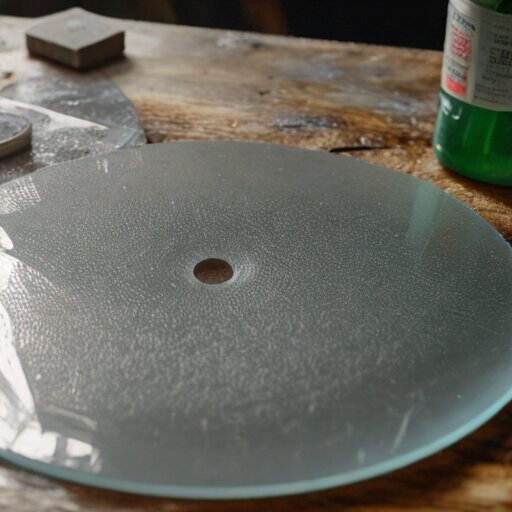
At 2:17 PM I was optimistic. By 4:30 PM I had a crack running from the centre of my mirror blank to its edge, a garage floor covered in grey slurry, and the growing suspicion that whoever wrote “a 6-inch mirror takes 40 to 80 hours” was not measuring the same hours I use.
This started last week when I was complaining on a forum about the optical quality of my telescope — the same one I’ve been using for the lunar lithophanes, which have been steadily revealing every flaw the optics produce. Someone replied with the four most dangerous words in any hobby forum: “Why not make one?”
Looked it up. Discovered that amateur telescope making predates modern commercial telescopes entirely — Russell Porter was teaching people to grind their own parabolic mirrors in Vermont in the 1920s, and the techniques haven’t changed much since. The Stellafane mirror classes still run. The Springfield Telescope Makers are still active. You can grind a diffraction-limited optical surface with your bare hands, a second piece of glass, and abrasive grit.
I ordered a 6-inch Pyrex blank, a matching tool blank, and a pound of #60 silicon carbide before I finished reading the thread. Same grit I used in the rock tumbler two weeks ago, which should have been my first warning — that process took four weeks and the rocks didn’t care if I scratched them.
The blank arrived yesterday. 152mm diameter, 25mm thick, flat on both sides, dense enough that it landed on my palm heavier than expected. Pyrex, specifically, because borosilicate glass has a lower coefficient of thermal expansion than plate glass — the mirror won’t distort as much when temperatures change. This matters when you’re trying to hold a surface accurate to a fraction of a wavelength of light.
A fraction of a wavelength. The target tolerance is somewhere around 50 nanometres. I can barely measure millimetres consistently.
The first step is “hogging out” — rough grinding to establish the basic curve. You measure progress by sagitta, the depth at the centre of the bowl you’re creating. My target sagitta for an f/8 mirror is about 1.2mm. The idea is to charge the tool with grit and water, place the mirror on top, and push it back and forth in overlapping strokes while rotating both pieces randomly. From geometry, the only shape that fits tightly when moved randomly against another surface is a sphere. The parabola comes later.
I set up on a wooden barrel in the garage, mirror on top, tool clamped to a lazy susan. Mixed the grit with water — about half a teaspoon per “wet,” which is one unit of work, lasting until the grit breaks down. Sprayed the tool. Started grinding.
The noise was worse than expected. A wet, grinding shriek that I could feel in my teeth. The slurry turned grey immediately as the grit started breaking down and mixing with glass particles. After three minutes my forearms ached from the pressure.
Then I heard it. A different sound. A click, almost musical, followed by a subtle change in the feel of the stroke.
I lifted the mirror. The crack ran from approximately centre to about 40mm from the edge, clean and straight, like someone had scored it with a glass cutter.
The post-mortem is obvious in retrospect. The barrel I was using wasn’t level — one corner sat about 3mm higher than the others. The tool was rotating freely on the lazy susan but the axis wasn’t quite vertical. When I applied pressure on the forward stroke, the mirror was flexing slightly against the tilted tool, and glass doesn’t flex. Glass stores stress until it doesn’t.
I also suspect I charged too much grit on the first wet. The Stellafane guide says half a teaspoon for a 6-inch mirror; I estimated “about that much” by eye instead of measuring. More grit means more cutting, but it also means more points of concentrated pressure, more uneven loading across the surface.
The blank cost $38. Shipping was another $15. Three weeks to arrive. Twenty minutes of actual grinding before failure.
Here’s what I know now: the grinding stand needs to be dead level. The tool needs to be secured better than “clamped loosely to a lazy susan.” The grit needs to be measured, not estimated. And I should have read past the first three pages of the Stellafane guide before starting — page seven has a section on common causes of thermal and mechanical shock.
I ordered another blank. It ships Monday. In the meantime I’m rebuilding the grinding stand with a spirit level built into the base and a proper pivoting mount for the tool.
The crack is still sitting on the workbench. I keep looking at it.