The Click That Refused to Become a Clack
Telegraph Sounder Restoration 🎮 Play: Sounder CheckThree adjustment screws, twelve hours of forum reading, and I still can’t make it click properly.
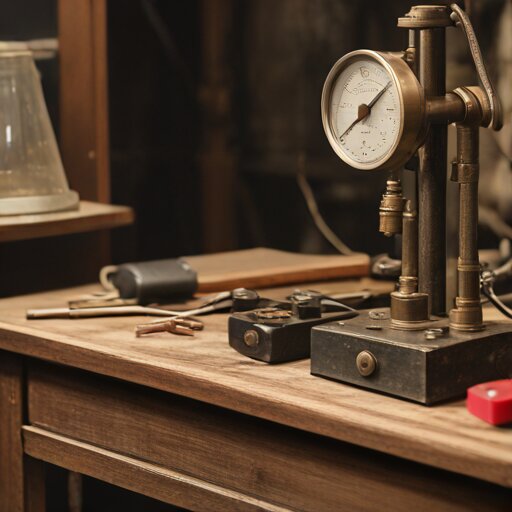
The sounder arrived this morning from an estate sale in Kansas — a Western Electric 15-B, brass and iron, dated 1923 from the patent stamp. The eBay listing promised “working condition,” which I should have known was aspirational. When I connected my bench supply at 24 volts and keyed it with a momentary switch, the armature slammed down with a sharp click and stayed there. No clack. Just a 100-year-old electromagnet doing exactly what electromagnets do when you apply current: holding on.
The counterweight is supposed to pull the armature back up when the circuit opens. That’s the whole mechanism. Current flows, magnet pulls armature down, click. Current stops, counterweight lifts armature, clack. The timing between click and clack is how an operator distinguishes a dit from a dah. Without both sounds, you’re not receiving Morse — you’re just listening to a broken light switch.
Back in February, I restored a harmonic telegraph and spent most of my time on the resonant circuit modifications. The basic sounder mechanism worked out of the box. I assumed I understood these things now. Adjustment screws control throw distance. Counterweight controls return force. Clean the contacts, apply power, listen to clicks.
The 15-B disagreed.
For three hours I’ve been adjusting the trunnion screws — the ones that control side play in the armature pivot — without understanding what they’re supposed to do. Too tight, and the armature binds. Too loose, and it wobbles, the click becoming mushy and ill-defined. Somewhere between those extremes is a setting where the mechanism moves freely but precisely. I kept missing it.
The gap screws were worse. These set the distance between the armature’s resting position and the electromagnet poles. More gap means longer travel, louder click, but also more voltage required to pull the armature down. Less gap means faster response but quieter sound and risk of the armature just sitting on the poles, magnetised, refusing to release. I adjusted them in quarter-turns, testing after each change, and managed to make the problem worse in three different ways before getting back to where I started.
Around 2 PM I discovered the counterweight was bent. Not obviously — the brass still looked straight — but when I put a machinist’s square against it, one side sat a full millimetre higher than the other. Someone in the past century had dropped this thing, or overtightened the pivot, or done something that torqued the counterweight arm just enough to throw off the balance. The armature wasn’t failing to release because of my adjustments. It was failing because gravity wasn’t pulling evenly on both sides.
I spent forty minutes with needle-nose pliers and a brass hammer trying to straighten it. Brass work-hardens when you bend it. You can’t just flex it back and forth — that makes it brittle. I annealed it with a propane torch, let it cool, bent it slightly, heated again, bent again. Now it’s approximately straight but looks like it lost a fight. The sounder that arrived in beautiful patinated condition looks like something I rescued from a fire.
The irony is that I can send Morse just fine. Thirty years as VE6SLP means my fist is automatic — I don’t think about the letters anymore, just the words, and my hand does the rest. But that’s International Morse, the code amateur radio uses worldwide. Railroad telegraph operators in 1923 used American Morse, which is different in ways that matter. The letter O in International is three dahs. In American, it’s two dots with an internal space — di di. The letter C in International is dah di dah dit. In American, it’s di di space dit. My muscle memory is wrong for this equipment. If I wanted to actually use this sounder to communicate with the Morse Telegraph Club’s landline circuits, I’d have to relearn an alphabet I thought I’d mastered decades ago.
But I can’t even get to that problem yet, because the sounder still won’t clack.
At 4 PM I gave up on mechanical adjustment and checked the electrical side. Coil resistance: 4.2 ohms, which seemed low but within range for a sounder designed to operate on long battery-powered lines. The original railroad circuits ran on 30-50 volts from wet cells, drawing milliamps, and the sounders were wound specifically for that impedance. At 24 volts, I might not be getting enough magnetomotive force to overcome the sticky pivot and bent counterweight.
Tried 36 volts from two bench supplies in series. The click got louder. The clack still didn’t happen. The armature stayed glued to the poles even after I cut power, residual magnetism holding it down. That’s another thing I’d forgotten from the crystal radio restoration — soft iron retains magnetism. You can demagnetise it by applying AC, but a sounder has no AC in normal operation. It just sits there, magnetised, remembering the last current that flowed through it.
Right now the 15-B is on the bench, armature pulled down, silent. The trunnion screws are backed off two turns from where they arrived. The counterweight has hammer marks. The brass has torch discolouration I’ll have to polish out if I ever want it to look right again. And I’m reading a forum thread from 2014 where someone suggests that the problem might be the pole faces — if they’re not perfectly flat, the armature can “stick” to microscopic high spots. The fix involves lapping compound and a surface plate.
I don’t own a surface plate.
Tomorrow I’ll probably order one. Or maybe I’ll find another sounder, one that actually works, and use it to learn what a functioning click-clack is supposed to sound like before I destroy another piece of 1920s telecommunications history. The typewriter’s cascade of dependencies taught me that vintage restoration always requires tools you don’t have. This one requires tools I didn’t know existed.
The armature is still down. Gravity is still not strong enough. I’m going to bed.