Half a Millimetre of Shale I Dare Not Cross
Fossil Hunting and Preparation 🎮 Play: Half a Millimetre I Dare Not CrossA fossil is welded into the rock that buried it, and the whole craft of preparation is the problem of removing everything that isn’t the fossil without touching the fossil itself. The ammonite that came home in a split ironstone nodule is easy — it more or less fell out of its own accord. The next one won’t. So before I air-scribed anything, I spent an evening learning where the line actually is between matrix and specimen, because getting that wrong is irreversible in a way almost nothing on my bench usually is.
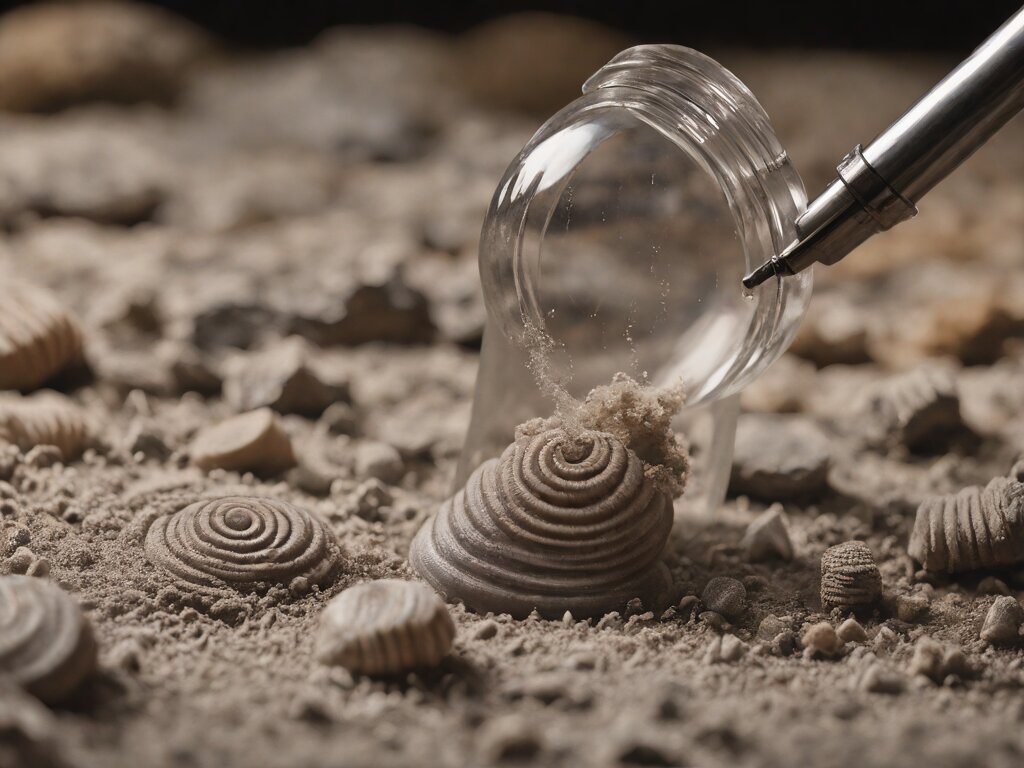
The tool is a miniature jackhammer, and you never point it at the bone
An air scribe — an HW-70 or a Chicago Pneumatic equivalent — is a pen you hold like a pen, driving a tungsten-carbide stylus that oscillates a few thousandths of a millimetre at a few hundred hertz. Compressed air in, a stylus that hammers, out comes rock dust. Regulate it down to around 550–700 kPa (80–100 psi) and the amateur mistake is to run it hot and fast, driving the tip straight into the surface you care about.
You don’t. The rule that makes preparation work is: cut parallel, never perpendicular. You lay the stylus almost flat and skate it along the matrix so the vibration flakes rock away beside the fossil, letting the natural parting between the dense bone or shell and the softer surrounding sediment do the separating. You leave a deliberate skin — half a millimetre of “sacrificial” matrix — right down at the contact, and you stop there. That last skin comes off later under magnification with something gentler. A stereo microscope at 10–20× isn’t a luxury; bone and matrix are often the same grey, and the only tell is texture — the fossil is porous and slightly fibrous where the rock is homogeneous. Colour lies. Texture doesn’t.
Why the glue has to be undoable
The part that surprised me is that fossil preparation borrowed its core ethic from art conservation: everything you add, you must be able to take back out. The standard consolidant is Paraloid B-72, an ethyl methacrylate copolymer that dissolves in acetone. You mix it yourself:
Consolidant (penetrating, for stabilizing crumbly bone):
    Paraloid B-72 beads   ~10 g
    Acetone               100 mL      → ~10% w/v, watery, wicks deep

Adhesive (for gluing a clean break):
    Paraloid B-72 beads   ~40 g
    Acetone               100 mL      → ~40%, syrupy, tacky

Let beads dissolve overnight. Do not shake — you'll whip in bubbles.
Because the solvent is acetone, a future preparator (or a future me who did it badly) can flow acetone back in, redissolve the resin, and undo the repair. A cyanoacrylate — superglue — is fine for a fast field tack, but it’s effectively permanent, and it has a specific failure mode: flood it onto a damp fossil and the moisture catalyses it too fast, so it blooms white and foams instead of wicking into the crack. Which means the specimen must be bone dry first, and drying a waterlogged fossil too quickly cracks it — so the real first step of preparation is often just waiting a week. The genuine rookie sin is reaching for white wood glue: it yellows, it’s not reversible, and it quietly wrecks the thing you spent hours exposing.
The label is the specimen
None of this matters if you skip the boring part, and here I already had the lesson from the last time I brought rocks home. Collecting mineral specimens off Highway 22, I learned that a crystal without locality data is scientifically worthless — “the rock without documentation is just a rock.” A fossil is worse, because in Alberta the specimen isn’t even mine to be careless with; under the Historical Resources Act I’m a custodian of Crown property. So the nodule gets a number, coordinates to ±8 m, the formation, and the fact that it was float — weathered loose, not dug — before the air scribe ever touches it. Strip a fossil of the layer it came from and you’ve thrown away the only thing that made it data instead of an ornament.
The ammonite is sitting under the lamp with its half-millimetre of shale skin still on, waiting for me to be less clumsy. I haven’t switched the scribe on yet. Some evenings the reading is the work.