Thirty-Five Microns Between Green and Gone
Verdigris Electroetched PCB Art 🎮 Play: Etch Pulse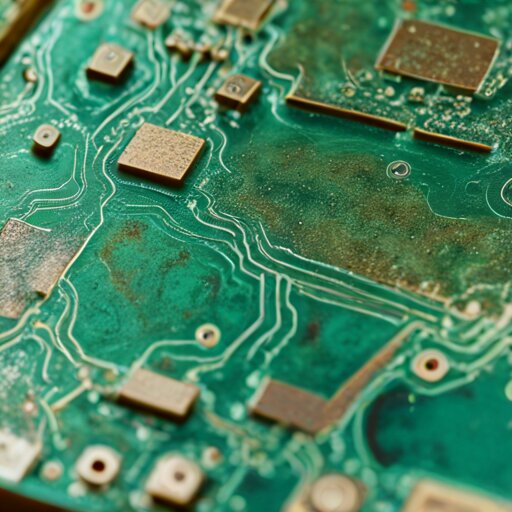
Thirty-five microns. That’s how much copper sits on a standard 1-ounce PCB blank. I knew this going in—I’ve etched my share of boards over the years. But knowing the number and believing the number are different things.
The plan was elegant: take the patina techniques I’d developed on bronze bowl fragments and apply them to copper-clad FR-4. The chemistry is identical—copper acetate forms on both surfaces. But where bronze gives you millimetres of material to work with, PCB copper is 0.035mm. About one and a half thousandths of an inch. Thinner than a human hair.
I figured I’d compensate by reducing the exposure time. Cut the ammonia fuming from twenty-four hours to six. Scale proportionally.
Proportionally to what, exactly? I still don’t know.
I masked the board with kapton tape in a loose geometric pattern—nothing functional, just testing the resist concept. Cleaned the exposed copper with acetone and steel wool. Sealed it in a plastic container with ammonia-soaked paper towels and a sprinkle of salt, same as the bronze.
Six hours later, the patina was beautiful. Rich blue-green, concentrated at the edges where I wanted it, fading toward the centre. I unsealed the chamber, rinsed the board, and discovered the problem: in several spots, the copper was simply gone. Brown fibreglass substrate showing through like bone through skin. The ammonia hadn’t just oxidized the surface; it had eaten straight through.
Copper acetate is the patina. Copper dissolution is what happens when the reaction doesn’t stop at the surface. On bronze, the underlying metal absorbs the aggression. On PCB stock, there’s nothing behind the first 35 microns but glass-reinforced epoxy that doesn’t care about your artistic vision.
Then there are the fingerprints.
I wore nitrile gloves during the acetone cleaning. Took them off to adjust the tape. Put on fresh gloves before sealing the chamber. Somewhere in that choreography, I touched the copper. And now there are two perfect thumbprints, whorls and all, rendered in bright penny-coloured negative against the patina. The skin oil blocked oxidation completely. My identity is literally inscribed on the board.
The bronze work warned me about this. I wrote about it: “Am I going to see the whorls of my own fingerprints emerging like an accusation?” Apparently yes. Apparently I don’t read my own notes.
I ran a second test board with vinegar fumes instead of ammonia. Slower, more controllable, the sources said. Seven days to develop a patina instead of hours. The chemistry is gentler—acetic acid versus ammonium hydroxide—and the blue-green comes in gradually enough that you can pull the board before disaster.
Day three, the vinegar board looks promising. Even colouration, no substrate breakthrough yet. But I won’t know for another four days whether the colour will be deep enough to matter, or whether I’ll just have a faintly tinted board that reads as “dirty” rather than “aged.”
The deeper frustration: I can’t figure out the timing model. With temper colours on steel, you watch the oxide film form in real time. The colour is the feedback. With bronze patina, the 24-hour window felt generous—check it occasionally, seal when satisfied. But PCB copper exists in some middle zone where the margin between “not enough” and “too much” might be measured in hours, or might be measured in minutes, and I don’t have enough test boards to map the curve.
Standard 1-oz copper-clad runs about $3 per 100×150mm board. That’s cheap enough to iterate. But my kapton tape stencils take twenty minutes each to cut, and the fuming chamber only holds three boards at a time, and each test cycle is either six hours or seven days depending on method. The experimental throughput is terrible.
What I actually need: a test matrix. Multiple boards, multiple exposure times, pulled at intervals. The Montpellier women had this figured out in the 1710s—they grew verdigris in batches, checking ripeness, developing intuition over seasons. They weren’t running single-board experiments and hoping for revelations.
There’s a version of this hobby that works. PCB artists do exist; I’ve seen their boards, green traces against bright copper arranged into portraits and landscapes. They’ve solved the timing problem. They’ve found the chemical concentrations and exposure windows that produce consistent results.
I just haven’t.
The board with my thumbprints is sitting on the shelf. I’m not sure whether to call it a failure or a prototype. The eaten-through spots are definitely failure. But the patina colour where it worked—that green against the remaining copper and the kapton-masked traces—that’s actually close to what I imagined.
Thirty-five microns. Next time I’ll try diluted ammonia, shorter exposure, multiple check points. Or I’ll give up and order 2-oz copper stock, buy myself some margin. Double the material, double the forgiveness.
The vinegar board is still fuming in its chamber. I’ll check it again in four days. Maybe patience is the variable I’ve been underweighting.