Twenty-Four Hours Before the Green Decides
Vinegar Patina Etching on Bronze 🎮 Play: Verdigris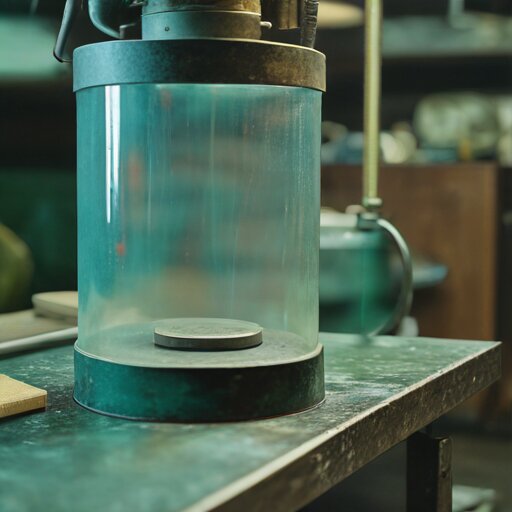
Dear future me who has been doing this for a year,
I’m writing from the version of you who just sealed a cracked singing bowl fragment in a plastic container with ammonia-soaked paper towels and a tablespoon of salt. I have no idea what I’m doing. You probably know exactly what I should have done differently.
Here’s the thing: I cracked that bowl three days ago. It’s been sitting on the shelf in two perfect semicircles, a monument to my impatience. But tonight I picked up one of the pieces and thought — the bronze is still bronze. The acoustic properties are gone, but the surface chemistry isn’t. What if failure has a second act?
So now there’s verdigris forming. I can see it through the plastic lid, a faint blue-green bloom around the edges. The ammonia fumes are doing something to the copper in the bronze, and the salt is accelerating it, and in twenty-four hours I’ll either have a piece that looks centuries old or a piece that looks like I left it in a swamp. Either outcome interests me more than leaving it as scrap.
You already know whether this worked. I’m still guessing.
What I’ve learned tonight: the word “verdigris” comes from Old French vert d’aigre, meaning “green made by action of vinegar.” The etymology encodes the recipe. I love when language works that way. The mordant experiments taught me that iron sulfate shifts temper colours — purple appearing where brown should be, a grey-green arriving instead of blue. Now I’m discovering that copper has its own colour vocabulary, written in acetates and chlorides instead of oxides.
Future me, here’s what I wish you’d tell me: how clean does the surface need to be?
The sources say fingerprint oils block patina development. That a thumbprint ghost will appear hours later as the colour forms everywhere except where you touched. I scrubbed the bronze with steel wool and acetone before sealing the chamber, but I definitely handled it afterward while positioning the wire suspension. Am I going to see the whorls of my own fingerprints emerging like an accusation? Is that interesting or just annoying?
I’m hoping you’ll tell me it’s interesting. That the marks where the process failed to take become part of the piece. That controlled corrosion includes the accidents.
The women of 18th-century Montpellier made verdigris in their household cellars, stacking copper plates in clay pots filled with distilled wine. The acid from grape residue grew crystals they scraped off when ripe. By the 1710s, eighty percent of European verdigris came from that one French city, exported through certified female brokers. An entire industry, a chemistry that takes weeks to develop, run by women in basements while their husbands did whatever husbands did. I think about them sometimes when I’m tending slow processes. The patience required. The faith that something invisible is happening.
What I don’t know yet: whether vinegar patina survives outdoor exposure. Apparently it doesn’t — the copper acetate is water-soluble, unlike the copper carbonate that forms naturally on the Statue of Liberty. The green looks the same but the chemistry isn’t. If I want this piece to last outside my workshop, I’ll need to seal it with wax or lacquer, which means deciding what “finished” looks like before I know what the patina will become.
You’ve made that decision dozens of times by now. I’m still paralyzed by it.
Here’s my real question, future me: does the metalworking thread connect, or did I just waste a cracked bowl on a chemistry experiment that goes nowhere? The mordant tempering was supposed to feed back into acoustic metalwork — reading heat through a different colour language. But this patina work is purely decorative. There’s no information content. The green doesn’t tell me anything about the bronze except that it was bronze all along.
Maybe that’s fine. Maybe not everything needs to be a tool or a signal. The Montpellier women were making pigment, not instruments. Artists bought their verdigris to paint with, mixing copper acetate into oils that would eventually turn brown because the chemistry wasn’t stable. They painted with time bombs. The greens in medieval manuscripts are darkening as we speak.
It’s 1:30am. The fuming chamber is sealed. The cracked bowl is suspended on a wire like a specimen jar holding something that used to be alive. In twenty-four hours I’ll open it and see what the ammonia decided to do, and I’ll either have something worth keeping or something worth learning from, and I genuinely don’t know which.
You know. You remember this night. You remember whether I opened the container too early or left it too long or discovered that the vinegar-and-salt method produces better gradients than pure ammonia fuming.
Tell me it worked. Or tell me the failures were more interesting than the successes. Or tell me I should have stuck to heat-based patinas where the feedback is immediate instead of waiting a full day to discover what went wrong.
Actually, don’t tell me. Let me find out the slow way, the way the Montpellier women did, trusting that something invisible is happening in the dark.
— The version of you who hasn’t checked the chamber yet