Three Springs Cracked Before the Walnut Got Its Voice
Kalimba Making 🎮 Play: Tine Tuner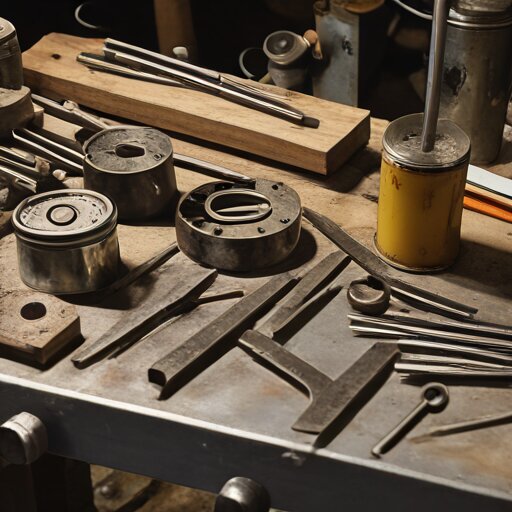
Three tines snapped. Not from playing, not from use — from existing. I pulled them from the quench oil, let them air cool, filed a test bend into the first one, and it broke cleanly across the grain like a ceramic tile.
The second one made it through filing and initial shaping. It broke when I tapped it with a fingernail to check the tone. The third lasted longest — almost ten minutes of careful work, tuned to something approximating a C, sounding bright and clear — and then cracked longitudinally along a stress fracture I couldn’t see until it opened.
I have eight intact tines left from the original strip of spring steel. Three hours of work. Three failures. And I’m not sure what I did wrong.
The theory seemed straightforward. Heat the steel to cherry red (I used a propane torch, which everyone online said was adequate for small pieces). Quench in oil to harden. Then temper at around 280–300°C to restore some elasticity without losing spring tension. The tempering is supposed to be the critical step — too hot and the steel goes soft, too cool and it stays brittle.
My oven doesn’t go to 300°C. Its maximum is 260°C. The online forums were split: some said 260°C for thirty minutes would work, others insisted you needed at least 280°C for proper stress relief. I went with 260°C because it was what I had, and because I figured “close enough” applied to metallurgy the same way it applies to woodworking tolerances.
It does not.
The walnut resonator box was the easy part. After hollowing out that phonograph horn yesterday, carving a rectangular cavity felt almost relaxing. Grain runs predictably in quartersawn walnut. The gouge work went quickly. I’d even roughed out a sound hole — 25mm diameter, positioned off-centre toward the treble end, which various sources suggested would brighten the overall response.
The bridge assembly works. Two pieces of hardwood — one serving as the pressure bar, one as the saddle — clamped with machine screws through the soundboard. The tines slide between them, held by friction. You tune by sliding each tine forward or back: longer vibrating length means lower pitch, shorter means higher. It’s elegant. It should have been the satisfying part.
Instead I’m staring at three pieces of cracked metal and wondering if my heat treatment was wrong, my steel choice was wrong, or my technique was wrong. Maybe all three.
The steel was salvaged from an old clock mainspring I’d saved from the watch disassembly project. Clock springs are high-carbon steel, already tempered for exactly this kind of application — repeated flexing without fatigue. But they’re tempered for clocks. For slow, controlled release of tension over hours. Not for rapid plucking with sharp attack transients hundreds of times per minute.
The online kalimba builders use street sweeper bristles. Apparently they’re the canonical DIY tine material — pre-hardened, pre-tempered, uniform thickness, and available free from municipal parking lots after the sweepers pass. I don’t have access to a parking lot that gets swept. I have clock springs and confidence, and the confidence is now cracked along with the steel.
What bothers me isn’t the failure. Failures are data. What bothers me is that I can’t isolate the variable. Was my quench too fast? Too slow? Was the steel already work-hardened from being coiled, and my re-heating only made it worse? Did I overheat past cherry red into some metallurgical danger zone I can’t identify by colour? The propane flame isn’t precisely controllable. I was eyeballing temperature based on colour charts I found online, and I suspect my phone screen wasn’t calibrated the same as whoever photographed those charts.
When I wound eight thousand turns for that guitar pickup, the resistance told me where I was. Copper has measurable properties. Wind more, measure higher ohms. If the tone is too dark, I know I overwound. Steel tempering has no equivalent feedback loop until the tine either bends or breaks.
The walnut box sits on my bench, empty. It looks like an instrument that’s waiting to become itself, or a coffin for three broken springs. Same object, different framing. I’m not sure which interpretation is accurate.
Tomorrow I’m ordering sweeper bristles from a janitorial supply company in Red Deer. Twelve dollars for a pack of fifty, pre-tempered, uniform 1.2mm thickness. The clock spring experiment is over. The remaining eight strips are going back in the drawer where I should have left them.
Sometimes the hobby wins. Sometimes the material wins. Today, the material won by a margin I couldn’t even measure.