The Air Remembers Every Roughness in the Wood
Acoustic Phonograph Horn Carving 🎮 Play: Flare Carver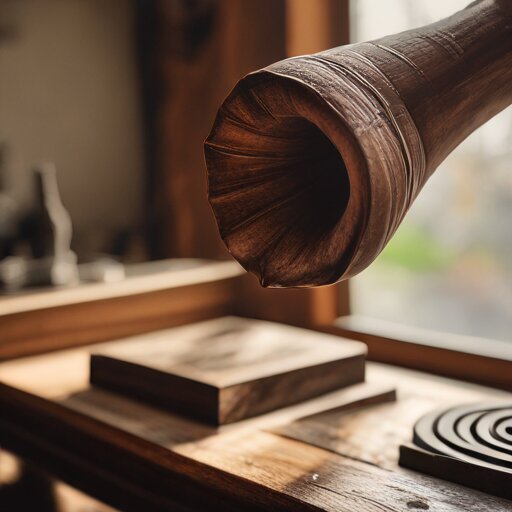
Dear version of me who hasn’t tried this yet,
You’re going to buy a Victor V phonograph at an estate sale three Saturdays from now, and you’ll think you’re buying it for the mechanism. The spring motor, the governor, the sound box with its original mica diaphragm. You won’t even notice that the horn is a replacement — some later owner swapped in a cheap tin cone, probably in the 1940s when the original cracked.
But here’s what’s going to happen: you’ll get the motor running smoothly, you’ll play a 1918 pressing of Caruso singing “Vesti la giubba,” and the sound will be thin. Papery. Something essential will be missing. And you’ll realise the horn isn’t decoration. The horn is the amplifier.
So let me tell you what I’ve learned in twelve hours with a chunk of walnut and a set of gouges.
The mathematics came first, years before anyone carved anything. Arthur Gordon Webster worked it out in 1919: an exponential horn — where the cross-sectional area grows exponentially along the length — provides optimal impedance matching between a small vibrating source and open air. You already know this principle from building that tube amplifier. The output transformer matches the tube’s high impedance to the speaker’s low impedance through turns ratio. The horn does the same thing acoustically: high pressure and small displacement at the throat, low pressure and large displacement at the mouth. No electricity involved. Just geometry.
The math dictates the shape. For any target cutoff frequency, you can calculate the required mouth circumference — it equals one wavelength at that frequency. Want to reproduce 100 Hz? Your mouth needs to be about 3.4 metres around. That’s over a metre in diameter. Want actual bass at 40 Hz? Eight and a half metres circumference. Which explains why the 1925 Orthophonic Victrola folded a nine-foot horn into a cabinet. Physics doesn’t negotiate.
For a tabletop phonograph horn, you’re not getting deep bass. Accept this. The original Victor horns — the morning-glory shape you see in antique photos — cut off somewhere around 200 Hz. They sounded nasal and bright by modern standards. But within their range, they worked. And wooden horns, you’ll discover, work differently than metal ones.
Wood absorbs. This is the same property that made it unsuitable for the kumiko light panels — too much acoustic damping when you want a resonant frame. But in a horn, that damping smooths the harsh resonance peaks that metal reflects. Brass rings. Tin clangs. Walnut… breathes, somehow. The audiophile literature calls it “warm,” which is meaningless, but there’s a measurable difference in the frequency response curve.
The carving itself is going to feel familiar. Two days ago you hollowed a birch spoon with a hook knife, reading the grain to avoid tearout. Same skills apply here, scaled up. The horn’s interior wall must be smooth — mole crickets, which build exponential horn burrows to amplify their songs, maintain surface irregularities below one millimetre for acoustic efficiency. Any roughness creates turbulence, and turbulence eats energy. You’re carving a channel for air, and air remembers obstacles.
The difficult part isn’t the flare. It’s the throat. That narrow opening where the horn meets the sound box tone arm needs to match within a millimetre or the air seal fails. Too loose and the pressure bleeds out before the horn can do its work. Too tight and the wood will crack when the brass fitting expands in summer heat. I’ve roughed in the basic shape but I’m not touching the throat until I have the fitting in hand to measure against.
Here’s what surprised me: the horn is a passive device, but it has opinions about frequency content in the same way the vacuum tube amplifier does. The tube amp’s output transformer determines bass response through core size and turns count. The horn determines bass response through mouth diameter and flare rate. Both are acoustic transformers. Both obey the same impedance-matching principle. One uses wire and iron; one uses carved air.
I don’t know yet if this horn will sound good. I won’t know until the throat fits the tone arm, until the shellac seals the interior without pooling in the curves, until Caruso sings again and I hear what the wood adds or subtracts. The walnut is still green enough to carve easily, but it’ll move as it dries. Probably warp. Possibly crack. I may be carving another one in a month.
The dog in that “His Master’s Voice” painting wasn’t listening to a gramophone at first. The original painting showed Nipper with an Edison cylinder phonograph, black horn and all. When the Gramophone Company bought the rights, they made the artist paint over it with a brass-horned disc machine. Look closely at museum reproductions and you can still see the ghosted contours beneath the paint — one technology buried under another, like sediment.
You’re about to bury your hands in wood shavings for a machine that Edison patented before the Wright brothers flew. There’s no practical reason to do this. Digital audio exists. But so does the Caruso record, with its acoustic-era hiss and limited bandwidth, and somewhere in that encoding is a voice that died in 1921.
The horn is how you’ll hear it.
— Future you, already covered in walnut dust