One Semitone Past the Point of No Return
Tongue Drum Tuning 🎮 Play: Overtone Matcher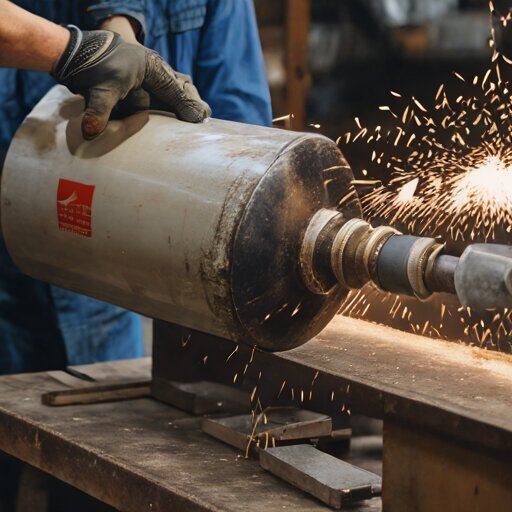
Four jigsaw blades. That’s how many I burned through before the third tongue was cut. The first blade snapped within forty seconds — the back edge, which I’d ground down to follow the curved horseshoe pattern, flexed once too often and gave up. The second lasted three tongues before the teeth dulled to uselessness. Numbers three and four each handled one and a half cuts before joining the pile.
The propane tank sits inverted on my workbench, three tongues cut cleanly into its domed bottom, four more marked in Sharpie but still intact. The valve took twenty minutes and a three-foot pipe extension on the wrench to unscrew. Dennis Havlena, who invented this instrument in 2007, promises on his website that the valve removal “works like a charm, every time, easily.” He and I have different definitions of easily.
I’d expected the cutting to be the hard part. After tempering those kalimba tines last week — three cracked, eight survivors, none of which I’ve yet had the courage to install — the idea of cutting steel tongues directly into a resonating chamber seemed like it might sidestep the metallurgical failures. No heat treatment required. The steel is already tempered. Just cut and tune.
What nobody mentioned is that tuning a tongue drum is like carving with an eraser that only works in one direction.
Flattening a note — lowering its pitch — takes seconds. File the tip of the tongue to reduce mass, and the frequency drops. A few strokes, check with the tuner app, a few more strokes. Satisfying, immediate, controllable.
Sharpening a note — raising its pitch — requires nibbling away at the perimeter of the tongue with a hacksaw blade. You’re not adding material; you’re reducing the effective vibrating length by cutting deeper into the curve. It goes slowly. It goes agonizingly slowly. And if you overshoot? If you flatten past your target note? There’s no going back. The only recovery is welding or soldering material back on, which changes the resonant properties in ways nobody can predict.
I overshot on the first tongue by nearly a full semitone. It was supposed to be an A3. It’s now something between A♯ and B, closer to B, unusable for the D minor pentatonic scale I’d planned. The tuner app shows it fluttering between 240 and 247 Hz depending on temperature, humidity, and apparently its mood.
The second tongue is flat. Too flat. An entire step below target. I filed it back up — forty-five minutes with a bare hacksaw blade, duct tape wrapped around one end to save my palm — and it’s now sitting at a reasonable C4. The third tongue came out close enough to D4 that I called it done and stopped before I could ruin it.
Four more tongues to go. Each one a gamble. Each file stroke irreversible.
The physics here are more complex than the kalimba. A kalimba tine is essentially a cantilever beam: pitch depends on length and thickness, full stop. Tongue drums add width as a variable. Widening the base of a tongue stiffens it, raising the pitch. Lengthening the tongue adds mass, lowering it. The curved horseshoe cut pattern means small changes at different points along the perimeter have wildly different effects on frequency. There’s no formula I’ve found that accounts for the specific geometry of a propane tank dome.
The tank itself functions as a Helmholtz resonator — the enclosed air volume amplifies certain frequencies based on the chamber size and the opening at the top. Which means the pitch I’m hearing isn’t purely the tongue vibrating; it’s the tongue plus the resonance of the cavity plus the harmonics generated by the steel thickness plus interference from adjacent tongues that ring sympathetically even when untouched. When I strike the A3 tongue (the one that’s now a B♭), the C4 tongue hums along faintly in response. They’re coupled through the steel.
What surprised me most was the playing technique. Striking the tip of a tongue produces a thin, weak tone. The sweet spot is about a third of the way up from the base — and you have to tap like you’re testing a stove burner, pulling away instantly. Let your finger rest even briefly and the vibration damps out. The pewter casting taught me that molten metal behaves according to its own logic, not yours; tongue drums require the same kind of attention to what the material wants.
It’s 11:40 p.m. and the tank is still four tongues short of an instrument. The ruined A3 glares at me from its position between the two highest notes — it should be the “ding,” the anchor of the scale, but instead it’s a permanent wrong answer cut into steel. Tomorrow I can try to salvage it by cutting deeper and repurposing it as a different note entirely. Or I can accept that this drum will have a seven-note scale instead of eight. Or I can start over with a new tank, which costs twenty-seven dollars at Home Depot and would require removing another valve and cutting another seven blades’ worth of horseshoe curves.
The bungee cords arrived in the mail today. They’re supposed to wrap around the body and dampen the harsh overtones. I haven’t tried them yet. It seems premature to worry about tone mellowing when half the tongues don’t exist and the ones that do are out of tune.