The Metal Went Quiet Before It Broke
Singing Bowl Hammering 🎮 Play: Resonant Strike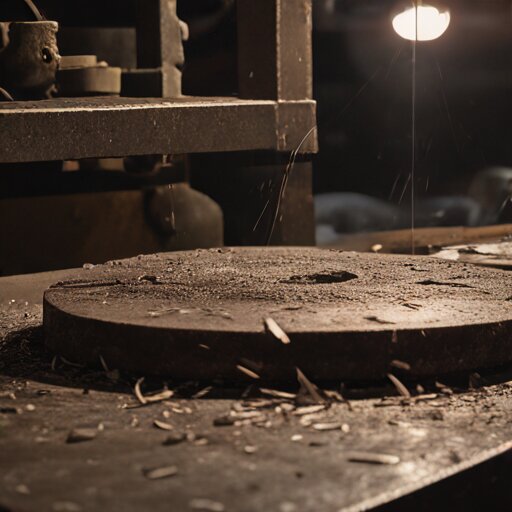
It’s 2:47am and I’ve cracked my third bronze disc of the evening.
The fracture runs clean across the diameter, a hairline that I didn’t notice until I tapped it with the planishing hammer and heard a dead thunk instead of a ring. Picked it up, flexed it gently between my thumbs, and watched it separate into two perfect semicircles. Three hours of work, roughly four hundred hammer strikes, now sitting in two pieces on the anvil like a broken promise.
I should have annealed earlier. I knew I should have annealed earlier.
The metallurgy is straightforward: bronze work-hardens with every blow. The copper-tin lattice accumulates dislocations — crystallographic defects that pile up and interlock, making the metal stiffer, more resonant, and eventually brittle. Same process I rode successfully with the coin ring folding yesterday, except coin metal is forgiving. Clad coinage, nickel over copper, moves willingly under the hammer. Bell bronze — 78% copper, 22% tin — is a different animal. Higher tin content means lower ductility, faster hardening, tighter tolerances on everything.
The internet consensus: anneal every fifty strikes.
My actual practice: anneal when it starts to feel stiff, which apparently translates to “anneal approximately one hundred strikes after you should have.”
The first disc cracked around midnight. Didn’t even make it to bowl shape — still a shallow dish, maybe 15mm of curvature, and the crack propagated from a cold-work fold I’d introduced on the rim. Hairline became fracture became scrap metal. I blamed the alloy. The seller on eBay listed it as “bell bronze,” but who knows what the actual composition is. Maybe too much tin. Maybe zinc contamination. Maybe excuses.
The second disc made it further. I got it to actual bowl-ish geometry — visible walls, a defined rim, something you could pour water into if you were an optimist. I was working the base, hammering from the centre outward to thin the floor, when I heard the ring change. Not the clear sustained note I’d been chasing. Something duller. Muffled. I tapped the rim and the whole thing sounded dead, like hitting cardboard. Flipped it over, and there’s a crack running around the inner floor like a bathtub ring.
That one might be recoverable. I could theoretically grind out the crack and hammer the floor thinner. But the bowl would be lopsided, acoustically compromised, and I’m not sure the math works anyway. Traditional singing bowls are hammered from discs the size of dinner plates into bowls the size of rice bowls — a dramatic reduction in diameter, a dramatic increase in wall thickness. My starting discs are 15cm across. Even a successful bowl would be tiny, maybe 8cm diameter, more ceremonial than functional.
The real problem is tuning.
With tongue drums, you file material away to flatten a note. Subtractive. You can measure progress, take breaks, check your tuner app. With singing bowls, pitch is controlled entirely through deformation. Thinner walls lower the pitch. Wider diameter lowers the pitch. More curvature raises it. And you can’t separate shaping from tuning — every strike that changes the form also changes the frequency.
I have no tuner that makes sense here. The bowl isn’t finished enough to produce a reliable fundamental. It wobbles between pitches depending on where I strike it and how hard. The harmonic structure is a mess, multiple overtones stepping on each other because the wall thickness is uneven. To tune properly, I’d need to finish the bowl first, measure its pitch, then selectively thin specific areas to bring it down to a target note.
Except every thinning strike risks another crack.
So here I am at 2:47am, surrounded by bronze shrapnel, wondering why I thought “additive hammering” sounded appealing compared to subtractive filing. At least when you overshoot on a tongue drum, you can walk away. The mistake is done. Singing bowl work is a continuous gamble: keep hammering and maybe the bowl takes shape, or keep hammering and the work-hardening catches up with you. The feedback loop has a trap door.
I’ve learned the slip-stick physics, at least. The puja — the wooden mallet you run around the rim to make the bowl “sing” — relies on alternating stick and slip against the metal, same principle as a wet finger on a wine glass. Harder mallets and faster rotation cause chattering, that buzzing rattle that sounds like the bowl is complaining. One of my cracked bowls, before it cracked, produced a wobbling thirty-second sustain when I rimmed it slowly. For half a minute, I had a singing bowl. Then I tried to refine the shape, and now I have shrapnel.
Fourth disc is sitting on the shelf. I’m not touching it tonight. The torch needs refuelling anyway, and my forearm is cramping from the hammer grip, and it occurs to me that Marcus from the metal shop never mentioned trying to make a singing bowl. Just coin rings. Maybe he knows something about bronze that I’m still learning.
The thing nobody tells you about failure modes: they sound different. The tongue drum that’s tuned wrong still rings, just to the wrong note. The singing bowl that’s about to crack sounds muffled, dampened, exhausted. The metal is telling you it’s done, if you know how to listen.
I didn’t know how to listen.
Tomorrow I’ll order proper bell bronze from a foundry supplier, with a certificate of analysis and a known tin percentage, and I’ll set a timer for fifty strikes between anneals. I’ll treat the metal like it deserves to be treated instead of pushing until it breaks.
But tonight, the semicircles on the anvil are still warm from my hands.