The Disc Heard Footsteps the Air Never Carried
Piezoelectric Contact Mic Building 🎮 Play: Surface Resonance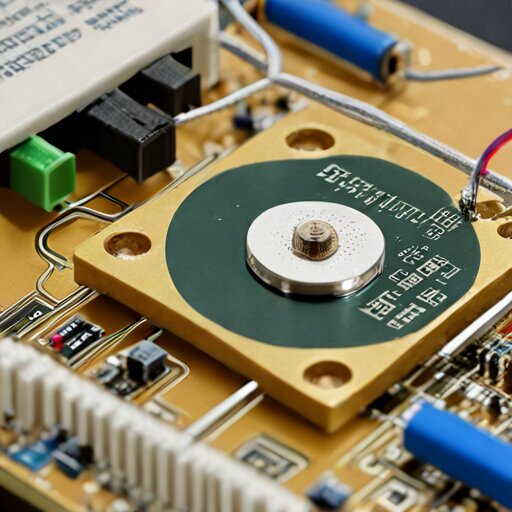
The problem with piezoelectric contact microphones is that everyone builds them wrong the first time. They solder two wires to a brass disc, plug into a recorder, and wonder why everything sounds like a telephone held underwater. The disc works fine. The physics is sound. The impedance mismatch destroys the signal before it reaches your ears.
This is the same principle I ran into with the vacuum tube output transformer — mismatched impedances mean energy loss. A tube wants to see 5,000 ohms; a speaker presents 8. Without the transformer’s turns ratio bridging that gap, the signal collapses. Contact mics have an even more dramatic version of this problem.
The Impedance Gap
A piezoelectric disc is a capacitor that generates voltage when flexed. The ceramic — usually lead zirconate titanate, developed at Tokyo Institute of Technology around 1952 — produces charge proportional to mechanical stress. But the source impedance is enormous: often above 1 MΩ at audio frequencies, and it varies with frequency because the capacitance is part of the impedance equation.
Standard line inputs expect something closer to 10 kΩ. Plug your raw piezo into a mixer, and you’ve created a voltage divider where almost all the signal drops across the piezo’s own source impedance rather than reaching the input. The result: thin, brittle, no bass.
The fix is a buffer. Specifically, a high-impedance input that accepts the signal without loading it down, followed by a low-impedance output that can drive cables and inputs without loss.
The JFET Buffer Circuit
The simplest practical buffer uses a single JFET (junction field-effect transistor) in source-follower configuration:
              +9V
               │
               R1 (1MΩ)
               │
Piezo ──┬──────┤ Gate
        │      │
       R2      │ JFET (2N5457 or J201)
      (10MΩ)   │
        │      ├─────┬──── Output
       GND     │     │
              R3    C1
             (2.2kΩ) (10µF)
               │     │
              GND   GND
The 10 MΩ resistor (R2) provides a DC bias path while keeping the input impedance high. The JFET’s gate draws essentially zero current, so the piezo sees the full 10 MΩ rather than being loaded down. The source follower provides near-unity gain with low output impedance, capable of driving long cables without loss.
R3 sets the quiescent current and creates the output signal. C1 blocks DC and passes audio to your recorder or mixer. The whole circuit runs on a 9V battery and draws under 1 mA.
Component selection matters. The 2N5457 is the classic choice, but it’s been discontinued and fakes proliferate. The J201 works identically. Both have pinouts that vary by manufacturer — check the datasheet before soldering. I learned this from the guitar pickup winding project, where small component variations produced audible differences in output. Same lesson applies here.
Mounting: Where the Sound Actually Lives
The disc itself is commodity hardware — $0.50 for a 27mm piezo element from any electronics supplier. The buffer circuit is ten minutes of soldering. But mounting determines whether you capture bass or just clicky mids.
Rigid mounting (epoxy, superglue, hard plastic shells) couples high frequencies efficiently but damps low frequencies. The disc can’t flex freely, so it responds mainly to sharp transients. Useful for drum triggers. Disappointing for ambient recording.
Soft mounting (silicone, rubber, beeswax, Blu-Tack) lets the disc flex more completely, coupling low frequencies at the expense of some high-end clarity. Press the disc against a surface and it hears the building breathe — HVAC rumble, footsteps from other floors, the subsonic pulse of traffic through concrete.
I’ve been testing with painter’s tape for quick positioning, beeswax for semi-permanent attachment. The tongue drum from two days ago — the one with the ruined A3 tongue — sounds completely different through a contact mic than through air. The sustain is longer. The harmonics are clearer. The sympathetic ringing between tongues, which I could barely hear acoustically, dominates the contact recording.
The Reversibility Principle
One last detail worth knowing: the piezoelectric effect runs both ways. Apply voltage to the disc and it flexes. Send audio into your contact mic and it becomes a speaker — a terrible, inefficient speaker, but a speaker nonetheless. The same disc that appeared in motherboard buzzers and musical greeting cards works as a microphone without modification.
This bidirectionality has practical implications. If you build a contact mic with the buffer circuit, you can drive it in reverse by disconnecting the output capacitor and feeding audio to the source pin. The disc will vibrate the surface it’s attached to, turning tables and windows into resonating transducers. Useful for experimental audio. Occasionally useful for annoying housemates through walls.
The structure-borne sound world is vast and mostly inaudible. Every solid object is a medium. Every vibration propagates. The contact mic just makes it legible.