Thirty-One Hertz Between One Tine and the Other
Tuning Fork Metallurgy 🎮 Play: Harmonic Forge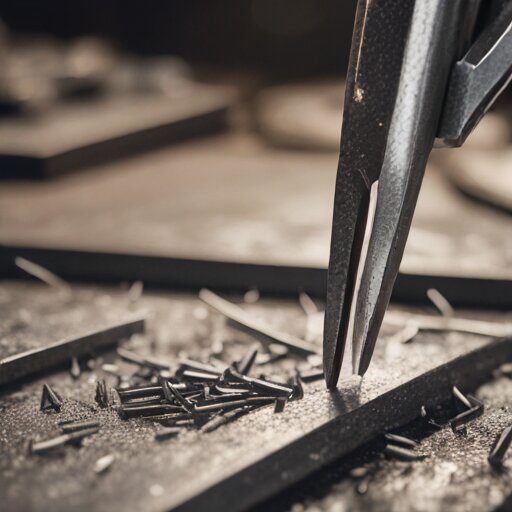
The tuner app says 387 Hz. It should say 440.
I’ve filed approximately two millimetres off the tips of both tines, checking after every stroke, and the frequency has gone down when every source I consulted promised it would go up. Mass reduction should raise pitch. That’s elementary physics. Less mass, same stiffness, higher resonant frequency. Except here I am at 11:30pm with a tuning fork that started sharp at 461 Hz and has somehow drifted flat by seventy-four hertz despite my removing material from exactly the location everyone says removes material to raise pitch.
The fork isn’t even usable as a wrong note. 387 Hz lands between G4 (392 Hz) and G♭4 (370 Hz), close enough to neither that it sounds like a mistake regardless of context.
I made three forks tonight. One is flat. One is bent. One cracked during quench. The O1 tool steel I ordered specifically for this — cold-work steel, oil-hardening, supposedly ideal for applications requiring a “good balance of wear resistance and toughness” — has a 33% survival rate so far, and even the survivor isn’t correct.
The bent one happened during heat treatment. I forged the blank from 6mm square stock, drew out the tines to roughly 75mm each, and split the fork in the middle with a cold chisel. So far, so good. The annealing cycle went fine. I let it air-cool overnight wrapped in vermiculite. But when I reheated to cherry red for hardening — that’s when the warp appeared. One tine bent outward by maybe fifteen degrees, enough that the fork looks drunk. I tried straightening it while hot, which introduced a twist I couldn’t correct. The tines now vibrate in different planes, which means they don’t cancel properly at the stem, which means the whole point of the fork shape is compromised.
That’s the thing I didn’t appreciate until tonight: tuning forks work because the two prongs vibrate in opposite directions, creating a nodal point at the base where there’s almost no motion. You can hold the stem without damping the sound. But that only works if both tines are symmetric — same length, same mass, same stiffness, same alignment. My bent fork rings for about half a second before the energy bleeds out through my fingers. A proper fork sustains for thirty seconds or more.
The cracked one is simpler to explain. I quenched too fast, or the oil was too cold, or there was a stress riser in the steel I didn’t see. Hairline fracture right at the junction where the tines meet the stem. It rang once — a beautiful, clear 440 Hz, dead on target — and then the crack propagated and now it buzzes like a broken speaker. I could probably anneal and try again, but the steel remembers. The kalimba tines taught me that much: heat treatment failures leave invisible damage that shows up later as sudden, inexplicable breakage.
The 387 Hz fork is the mystery. I’ve reread the physics three times. Frequency is proportional to the square root of stiffness over mass, inversely proportional to length squared. Filing the tips removes mass and negligibly changes length — frequency should rise. Filing the base of the tines, near the crotch, reduces stiffness more than mass — frequency should fall. I filed the tips. The frequency fell.
The only explanation I can construct: I filed unevenly. One tine is now lighter than the other, which means they ring at slightly different frequencies, which means I’m hearing a beat pattern that the tuner app interprets as a single lower note. Two signals close together average down in perceived pitch. The fork isn’t flat; it’s doubled.
I tested this theory by damping one tine with my thumb and striking the other. 429 Hz. Switched tines. 398 Hz. A difference of thirty-one hertz — nearly a full semitone. No wonder the app is confused. No wonder I’m confused.
So now I need to file the lighter tine heavier, except that’s impossible — you can’t add steel — which means I need to file the heavier tine lighter to match, which will lower both frequencies further away from my target. The math says I’d need to shorten both tines significantly to bring the frequency back up, but shortening changes the fork’s harmonic structure in ways I can’t predict.
With tongue drums, at least the mistakes are visible. File too far and you’ve permanently lowered the pitch, but you know it immediately. With tuning forks, the failure modes hide. Asymmetry masquerades as flat pitch. Internal stress presents as muffled tone. The feedback is lagged and encoded in harmonics I don’t have the equipment to analyse.
Tomorrow I’ll try forging thicker blanks, to give myself more margin for error. Maybe grind instead of file, for better symmetry control. Maybe accept that the first five or ten forks are calibration, not product.
The 387 Hz fork is still sitting on the bench, not A and not G and not anything. It rings when I tap it. It sustains. It’s technically functional in every way except the one that matters.