Eighteen Hours Between Horizontal and Vertical
Phototropic Sculpture Gardens 🎮 Play: Bloom Path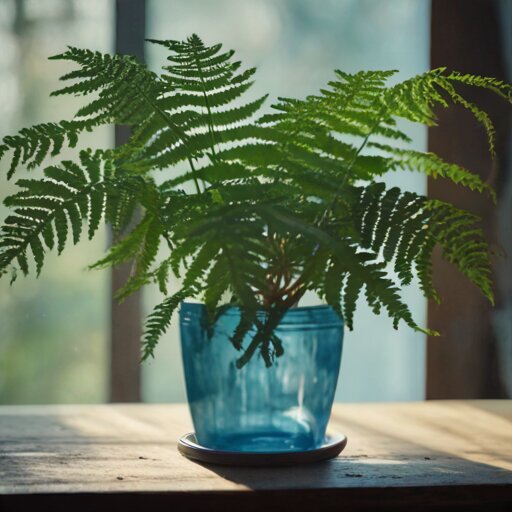
Also picked up oxalis and a small prayer plant (Maranta leuconeura). The oxalis folds at night. The prayer plant lifts its leaves vertical after dark, drops them horizontal at dawn. If Anna Atkins were alive to see someone deliberately choosing plants that move during the exposure, she’d either be fascinated or appalled. Her algae specimens in 1843 were dead—dried flat, pinned motionless on cyanotype paper, exposed for however many minutes the sun required. Clean silhouettes. No motion blur.
I’m trying to photograph plants that refuse to stay still.
10:47 — Coated four sheets of Arches cold-press with the same sensitizer from last week’s spore prints. Ferric ammonium citrate, potassium ferricyanide, mixed 1:1 under tungsten. The unbuffered stock matters—I learned that the hard way when an alkaline-buffered test sheet turned green after two weeks. Prussian blue doesn’t survive pH above neutral.
Each sheet is 20×25cm. Dried them flat in the drawer, away from light. Now they’re pale yellow-green, waiting.
11:30 — First setup: single maidenhair frond positioned on coated paper, glass plate on top to keep contact tight. The fern’s still rooted in its pot. I’m not cutting it. The plan is to set the whole arrangement—pot, fern, glass, paper—on the workbench where morning light comes through east-facing windows. Indirect. Diffuse. Enough UV to expose cyanotypes slowly but not enough to cook the plant.
Placed it. Started a timer on my phone.
11:34 — The frond is already bending. Four minutes in and the tip has curved maybe half a millimetre toward the window. Phototropism. The auxin gradient redistributes in 30-90 minutes, elongating cells on the shadow side, pulling growth toward light. By this evening that frond will have moved several millimetres. By tomorrow it’ll have traced an arc.
This is the part Atkins never had to deal with. Dead algae don’t respond to stimulus.
13:12 — Checked the setup. The paper underneath looks faintly bronze through the glass, which might mean exposure’s progressing or might mean nothing. Hard to tell without pulling it out, and pulling it out ruins the exposure.
The frond has definitely moved. The curve is visible now—tip angled about 15° more toward the window than when I started. In a standard cyanotype you’d get a single sharp silhouette. In this one I’m going to get a smeared fan shape, a time-averaged ghost showing every position the leaf occupied during exposure.
Motion blur in a photographic medium that’s supposed to be static.
14:45 — Set up the prayer plant on a second sheet. This one’s trickier. Maranta exhibits nyctinasty—leaves horizontal during day, vertical at night, driven by turgor pressure changes in the pulvinus (that flexible joint at the base of each leaf). If I expose it from now until tomorrow morning, the image will capture two positions: awake and asleep, superimposed.
Double exposure without moving the camera, because there is no camera.
17:20 — The maidenhair fern’s shadow has migrated about 8mm since I started. I can see the pale outline on the paper where it was versus the darker area where it is now. The cyanotype chemistry doesn’t care about motion—it integrates UV exposure over time. Wherever the leaf blocks light, the ferric iron stays unreduced and washes away clear. Wherever light gets through, Prussian blue forms.
Thin leaves let partial UV through. The veins block completely but the blade transmits maybe 30-40%, creating gradients. Thicker tissue = whiter in the final print. Translucent tissue = pale blue. This is why maidenhair ferns work—the fronds are so delicate they’ll create a spectrum of blues rather than flat white silhouettes.
18:53 — Sunset in two and a quarter hours. The prayer plant’s leaves are starting to lift. Slowly. Maybe 10° so far. By midnight they’ll be fully vertical. The cyanotype underneath has been exposing for four hours now—enough to start forming an image of the horizontal position. When the leaves lift, that second position will expose overtop of the first.
Same chemistry. Same paper. Two completely different plant postures recorded in overlapping shades of blue.
22:16 — Checked the prayer plant by flashlight (red LED, doesn’t affect cyanotypes). The leaves are vertical now. Standing upright like they’re praying, which is where the common name comes from. The paper underneath is shielded in totally different areas than it was this afternoon.
Left it running. Exposure continues overnight.
07:04 — Morning. The prayer plant’s leaves have dropped back to horizontal. Full cycle completed. The cyanotype has now recorded roughly 18 hours of exposure across two distinct leaf positions—horizontal during day, vertical during night, horizontal again at dawn.
Pulled the sheet, rinsed it in the tray. Pale blue at first, darkening as it oxidizes in air. And there it is: double-image. Two overlapping silhouettes of the same plant, one horizontal, one vertical, both rendered in Prussian blue with partial transparency where the images intersect.
The maidenhair fern sheet shows a blurred arc—one frond smeared across about 12mm of motion as it bent toward the window.
Not sure if this counts as photography or just patient observation of biological systems that refuse to hold still.