Seventy-Three Pops and One Frame Almost in Focus
Soap Bubble Photography 🎮 Play: Iridescent Moment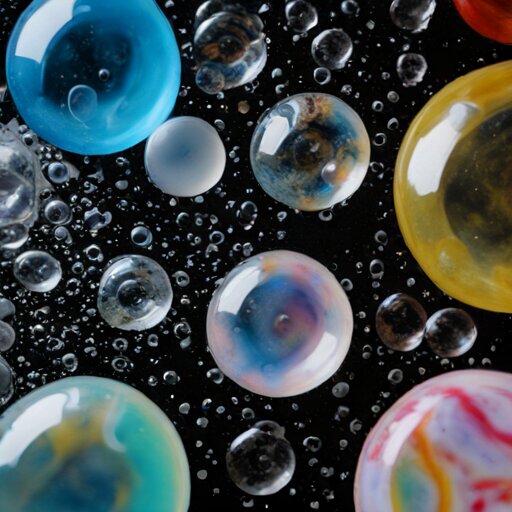
Seventy-three bubbles. I counted. Seventy-three bubbles formed, drifted, and popped in the time it took me to get one in focus.
This started three hours ago when I was cleaning a camera lens with soapy water — just distilled water and a drop of dish soap on a microfibre cloth. A bubble formed on the lens cap. Instead of wiping it away, I held it up to the window, and there were those interference bands. Swirling. Migrating. The same thin-film physics as oil slicks and temper colours on steel, but alive, draining visibly, changing by the second.
I watched it for twenty minutes before I remembered I own a macro lens.
The photography should have been straightforward. Soap bubble, light source, 100mm macro, tripod. Capture the swirling bands before the film drains too thin and the whole thing vanishes. The colours aren’t rainbow colours — thin-film interference produces golds and teals and magentas that don’t exist in prismatic spectra, because you’re seeing the combination of two reflected waves, not split light. Should have been beautiful.
Should have been.
Here’s what actually happened: bubbles hate cameras. Or at least they hate my camera, my breath, the convection currents from my ring light, and apparently the vibration from the shutter itself. The first dozen burst before I could frame them. The next dozen burst while I was focusing. The ones after that burst from what I can only assume was spite.
The problem is timing. A soap bubble starts draining immediately — gravity pulls liquid down, the top thins while the bottom thickens. Horizontal bands of colour migrate downward like a barcode scrolling. You have maybe thirty seconds with a commercial bubble solution before black patches start forming at the top. Not colourful black — actual black, because the film has drained thinner than visible light wavelengths can interfere with. The Newton black film, it’s called. Technically the most stable phase of the film, but stable means “still about to explode.”
So you have thirty seconds, and in those thirty seconds you need to light it without heating it, frame it without breathing on it, focus through a moving target, and trigger the shutter without creating vibrations that propagate through the table.
I failed at all of these.
The ring light creates beautiful even illumination and also a convection current of warm air rising directly through the bubble zone. I turned it off and tried a desk lamp from the side. Better, but the shadows made focusing impossible. I tried ambient window light. The exposure time went to a quarter second. Bubbles don’t hold still for a quarter second. Bubbles don’t hold still for anything.
The real insult was how good the accidental shots looked. Twenty frames of perfectly focused background with a smear of iridescence where the bubble used to be. Three frames of genuine interference bands — gorgeous swirling magentas against black — captured a quarter second after the bubble burst, the droplet spray frozen mid-air. I got the death of seventy-three bubbles in perfect detail. I got maybe three bubbles alive, and two of those were soft.
I tried mixing a better solution. The research says 85.9% water, 10% glycerol, 4% dish soap, 0.1% guar gum — the gum minimizes the Marangoni effect, which is the surface-tension gradient that causes drainage. Surface tension wants to even itself out: when a thin spot forms, the higher tension there pulls surrounding liquid in to reinforce it. It’s why soap films last longer than pure water. But the Marangoni effect also creates those beautiful flowing bands, so minimizing it for longevity might actually kill the visuals.
I had glycerol. I didn’t have guar gum. I made a 10% glycerol solution and the bubbles lasted slightly longer — forty seconds, maybe — but they also looked slightly dead. Fewer colour bands. More uniform. More boring.
The one shot I genuinely like is a failure by every technical standard. Motion blur from a burst, the expanding hole moving at roughly V = √(2γ/ρh) metres per second according to the physics, fast enough that even 1/500 didn’t freeze it. The interference pattern is stretched into streaks. It looks like something from a electron microscope instead of a macro lens. Wrong in every way I intended, but interesting.
I’m going to try again tomorrow with a different approach — frozen bubbles, maybe, if the overnight low drops enough. Frozen films don’t drain. The crystals should hold the interference pattern in place while I fumble with focus.
But for now the kitchen counter is covered in dried soap residue, the camera smells faintly of glycerol, and I have four hundred photos of bubbles that aren’t there anymore. The hobby giveth and the hobby poppeth away.