Two Millimetres of Stem Between Spinning and Standing Up
Precision Spinning Top Turning and Gyroscopic Balancing 🎮 Play: BloomspinA top that balances on your fingertip is not necessarily a top that spins. I learned this the expensive way around two in the afternoon, when a little cocobolo top I’d spent an hour turning sat perfectly plumb on its steel tip, obedient as anything — and then, spun, walked itself across the bench in a widening spiral and dropped off the edge onto the concrete.
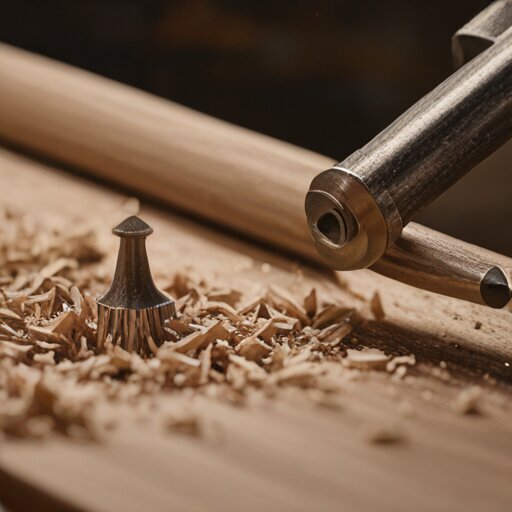
The culprit is a distinction I’d never had to care about at a lathe before. Static balance means the centre of mass sits on the geometric axis — hang the thing from a thread and it hangs straight. Dynamic balance is stricter: the spin axis must also be a principal axis of inertia, the mass arranged symmetrically around it so that rotation produces no sideways torque. A top can pass the first test and flunk the second. My blank had a knot on one flank, denser than the clear wood opposite, and that quarter-gram of surplus hardwood tipped the principal axis a hair off the geometric one. Statically flawless. Dynamically, a wobble that compounded every revolution until it flung itself onto the floor.
Getting the geometry concentric is the same centring discipline as turning a pen around a brass tube, except a pen never has to survive a few thousand rpm and be judged on it afterward. Chasing out that hidden heavy spot, though, is something else — it’s poising a watch balance wheel scaled up fifty times. Watchmakers shave micrograms off a balance rim until it has no preferred resting angle, for exactly this reason. I ended up doing the crude version: spin, watch which way it drifts, scrape a whisker off the opposite rim, spin again.
Why I’m at this bench at all is the thread running through a week of flinging things. The boomerang and the disc were both spinning wings I could compute and then, reliably, throw wrong; gyroscopic precession decided where they went and my shoulder kept betraying the arithmetic. A top is that identical physics with the axis stood vertical and nothing to launch. Precession rate runs as Ω = mgr / (Iω): spin it faster — bigger ω — and it precesses slower, until a well-made top stands so still it looks stopped. There’s a term for that state. The top is sleeping. A brass top sleeping on a sheet of glass is genuinely eerie: thousands of rpm, and it sits there like a forgotten paperweight.
Long spin is a moment-of-inertia bargain. Push mass out to the rim to bank more angular momentum, and keep the contact point tiny and hard so you bleed less of it to friction. That’s why serious tops are brass or tungsten on a ceramic ball, and why the old wooden ones are lignum vitae — a timber so dense it sinks and so resinous it lubricates itself, the same wood shipwrights once cut into propeller-shaft bearings. The one I turned from an offcut out-spun everything else on the bench and I’m not entirely over it.
The object I actually came for, though, was the tippe top, and it is a small monster of counterintuition. Squat truncated sphere, stubby stem: spin it hard and it tilts, lurches up onto its equator, and then heaves itself over to stand on the stem — raising its own centre of mass as it goes. It looks like theft. It isn’t. Sliding friction at the contact patch does the lifting and quietly pays for it out of spin. The frictionless model gives the wrong answer flat out; you need dry sliding friction — the Contensou problem — before the mathematics will cooperate.
Two things about it stuck with me. It does not reverse its rotation: flip it and it’s still turning the way you launched it, because angular momentum has to be conserved. The top only rearranges which way is up, never which way it turns. And whether it inverts at all is a machining question, not a spinning one. The centre of mass must sit just below the sphere’s centre, inside a narrow window, with the right ratio between its two moments of inertia. My first stem stood too tall, the mass rode too high, and it declined — spun beautifully, refused to flip. Two millimetres off the stem, a slightly deeper truncation, and the second one hauled itself over on the third throw. A German nurse named Helene Sperl patented this creature in 1891; six decades later there’s a photograph of Pauli and Bohr crouched over one, two of the finest minds of the century looking frankly stumped.
Mine works maybe one throw in four. I can recite why the window exists. I don’t yet trust that I understand why it sits exactly there, and I’m not going to pretend a first afternoon closed that gap.