Two Millimetres of Bend Between Straight and Coming Home
Returning Boomerang Carving and Tuning 🎮 Play: Comes Back to YouA boomerang that fails to return is not broken. It has simply flown straight, which is exactly what a Kimberley hunter wanted forty thousand years ago and precisely what I don’t. The whole craft, once the plywood is cut, is coaxing that straight-flying stick into a wing that changes its own mind mid-air and comes home. That coaxing has a name — tuning — and it lives in millimetres of bend and degrees of twist. Here is how it actually works.
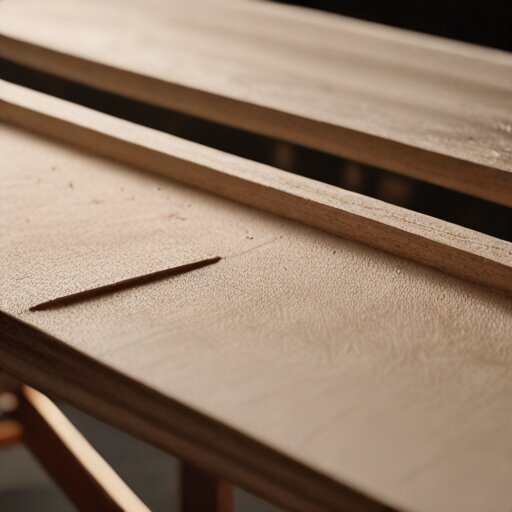
Start with the section. Each arm is a genuine aerofoil — rounded, thick leading edge; thin, tapered trailing edge — and on a returning boomerang every arm’s leading edge points the same rotational way. For a right-hander that means the leading edges chase each other anticlockwise. Get one arm backwards and that blade fights the other two; the thing shudders and dives. The template I traced sits on the top face only. The bottom stays dead flat, like a wing’s underside. Sand the top.
Why the loop happens is the good part, and it’s the same gyroscopic-precession puzzle the disc taught me last week, stood upright. Thrown near-vertical and spinning hard, the blade sweeping toward the top of the arc briefly sees tip speed + forward speed; the blade at the bottom sees tip speed − forward speed. More airspeed, more lift, so the top of the spinning disc lifts harder than the bottom. That imbalance is a torque trying to tip the boomerang over sideways — but a fast-spinning disc has too much angular momentum to just tip. It precesses instead, and the response emerges ninety degrees around the rotation: the plane of flight turns steadily left, carving the circle back to you.
So the two things I can carve are how much lift the disc makes and where the imbalance sits. Two knobs:
- Dihedral — the arms bent gently upward from the centre, like a shallow, permanent salute. More positive dihedral tightens the return and lifts the whole flight; too much and the boomerang climbs, stalls near the top of its arc, and flutters down like a dropped leaf instead of driving back.
- Twist (pitch) — each blade tip rotated a degree or two. Trailing edge up (positive incidence) adds lift and layover; trailing edge down settles it. This is the fine adjustment. A degree is a lot.
You bend both into 5-ply birch with heat. I use a heat gun on low, warming a patch until the phenolic glue lines go pliable — maybe fifteen seconds — then hold the bend against a curved caul until it cools. Baltic birch takes a set and keeps it. Overheat it and you delaminate; you’ll hear a faint tick as a ply lets go, and that arm is done.
The procedure is stubbornly empirical, which suits a first day:
1. Throw. Watch ONE failure mode only.
2. Diagnose:
   - Doesn't come back, dies wide  -> add dihedral (bend arms up ~2 mm at tip)
   - Comes back but too high/hovers -> reduce twist (trailing edge down slightly)
   - Returns left of you, short     -> reduce dihedral OR add layover in the throw
   - Crashes nose-first, no arc      -> you threw it flat. Not the boomerang. You.
3. Change ONE thing. Small.
4. Re-throw. Repeat.
That last line is the humbling one. Half my “tuning problems” this afternoon were release angle. The boomerang wants to leave the hand nearly vertical, ten to twenty degrees of layover off plumb, aimed forty-odd degrees to the right of the breeze, and — the part no ply bend fixes — spinning. Spin is the whole return; forward throw is almost incidental. I kept muscling it for distance and watching it sail off and quit, because a slow-spinning wing has too little angular momentum to precess through a full circle before gravity wins.
There’s a pleasing echo of keeping the centre of pressure behind the centre of gravity from the rocket bench, except a rocket’s whole job is to not turn and a boomerang’s whole job is to turn, controllably, exactly once around. Same stability algebra, opposite sign.
My best throw of the day came back waist-high and I flinched instead of catching it — a spinning ply disc arriving at your sternum concentrates the mind. The tuning notebook says: two millimetres more dihedral on the short arm, and stop throwing it like a fastball. I’ll believe the second note when my wrist does.