I Knew Every Algorithm and Still Lubed It to Death
Speedcubing 🎮 Play: CubelapseThe corner cubie is somewhere under the fridge, and I have decided, at 11:40 on a Sunday night, that it can stay there until morning. This is not how I expected day one to end. Day one was going suspiciously well right up until I destroyed the cube.
The whole thing started at the chess club, where a girl maybe fourteen was blind-solving a cube against her phone between rounds, muttering letter strings that scanned exactly like notation. She handed me the scrambled thing and a printed layer-by-layer sheet, and forty minutes later I’d solved it — slowly, seven-year-old’s method, cross then corners then the middle then a lot of praying — and I could not put it down. So I did the predictable adult thing and ordered a proper magnetized cube with two little syringes of silicone lubricant, because if a hobby has a mechanical rabbit hole I am going to fall down it head first.
My first mistake was assuming the hard part would be the memorization. That part I can do. Full CFOP eventually wants 57 algorithms to orient the last layer and 21 more to permute it, all named like chess openings — the T-perm, the Y-perm, the G-perms that everyone online seems to regard with the same dread I reserve for the Najdorf. Holding a catalogue of named sequences in my head is home turf. Every one of those algorithms is a commutator or a conjugate underneath — a setup, a little cycle, then the setup undone in reverse — which is the same do/undo structure you use to move three pieces while leaving everything else untouched. The cube is a non-abelian group wearing a toy costume. Ernő Rubik built it in 1974 to teach exactly this to architecture students, then reportedly needed a month to solve his own object. I found that genuinely comforting around move sixty.
The lube was the disaster.
Speed cubes use two viscosities, and the distinction matters: a thick lube on the core and springs to slow the mechanism down and give it a controlled, damped feel, and a thin, fast lube on the plastic contact surfaces where the pieces slide past each other. The correct dose is a pinhead. One drop. Maybe two. The internet said “less than you think,” and I, a person who has never once used less than I think, gave it a generous ribbon of the thick stuff straight into the core and worked it in.
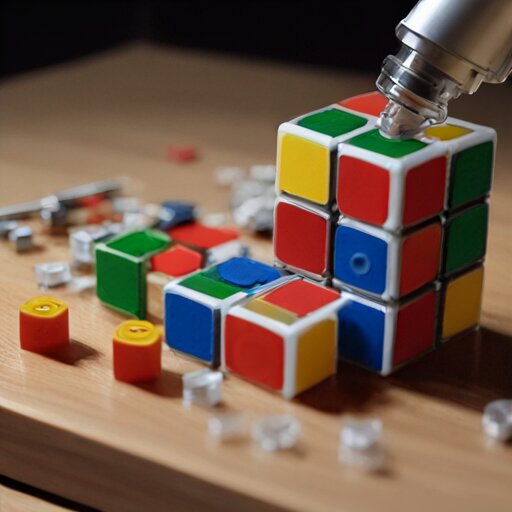
The cube turned to pudding. Every face slopped past its detent, magnets be damned, layers rotating a lazy ten degrees too far and sitting there wobbling. Trying to correct the mush, I over-tightened the tensions, and on the very next solve — mid-turn, forcing a corner that no longer wanted to align — the cube popped. A corner cubie fired across the kitchen, took one bounce off the cabinet, and vanished into the two-centimetre void beneath the refrigerator that swallows everything.
Here is the part I actually want to be honest about, because the equipment failure is just slapstick. Even before I turned my cube into a beanbag, I’d hit the real wall, and it’s a wall I’ve walked into before. I can read a cube. Standing there I can spot the pair I need, know which algorithm comes next, narrate the plan. Then my hands do it in stutters — turn, freeze, hunt for the next piece, turn — because I have zero lookahead. The people who go fast never stop turning; they’re reading the next pair while their fingers finish the current one, the way you calculate a line while your hand is still completing the previous move. It’s the identical gap I ran into hanging off plastic holds last week, where I could trace the whole sequence from the mat and then my forearms filed a formal objection. Knowing the moves and being the moves are stored in different places, and the second warehouse is a lot harder to get into.
So: no times worth recording, a cube I have to fully disassemble and de-gunk tomorrow, and one corner piece under an appliance I am not strong enough to move alone tonight. A did-not-finish in the most literal sense the sport offers. The girl at the club made it look like breathing. I made it look like a plumbing accident.