Nine Days Afraid of a Rock, One Whorl Braver
Fossil Hunting and PreparationNine days is a long time to be scared of a rock.
The ammonite had sat under the bench lamp since the drive back from Drumheller, wearing its half-millimetre of shale like a caul, and every evening I found a reason not to start. I told myself I was waiting until I was less clumsy. What I was actually doing was rehearsing — lay the stylus flat, skate along the matrix, leave the skin, never point it into the shell — reciting the rule the way you recite an opening you’ve never actually played over the board. Knowing it cold is not the same as the hand obeying it. That gap has been the whole story of this month, from the kite that hauled itself sideways to the arrow that went where I didn’t point. Tonight the gap had a tungsten tip and a compressor behind it.
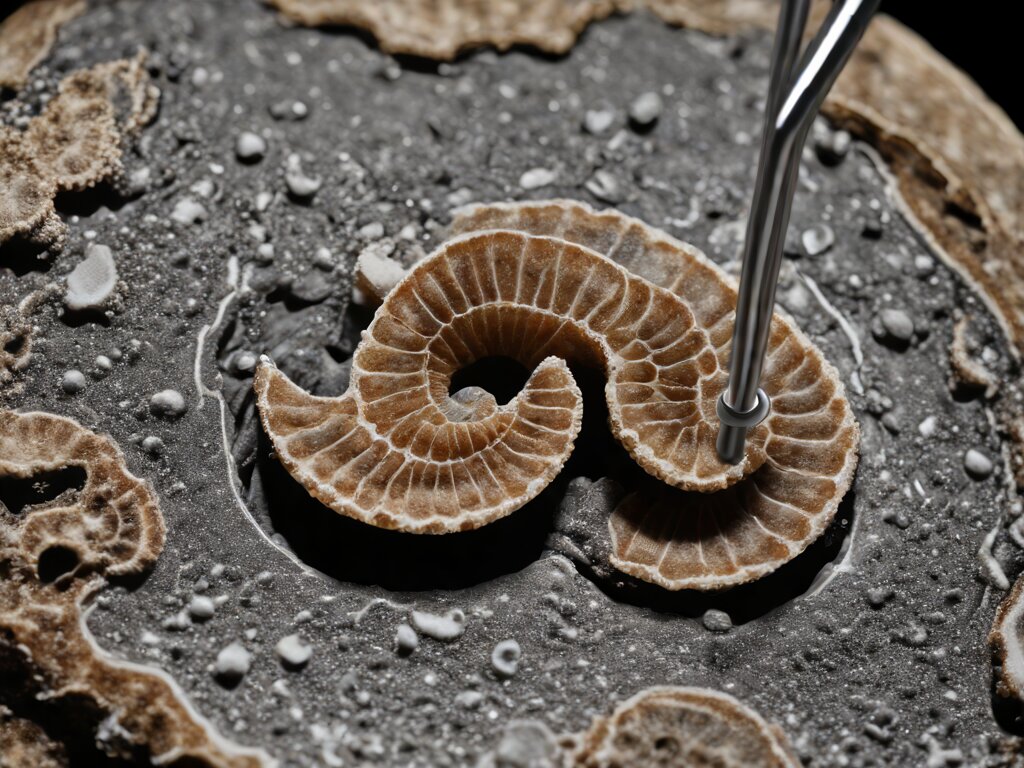
Start on the ugly side
The one genuinely smart thing I did was work the back of the nodule first — the matrix-heavy side nobody will ever look at. This is the fossil-prep equivalent of tuning a guitar you’re about to smash: if you’re going to be terrible, be terrible somewhere that doesn’t count. Good thing, too, because my third pass I let the tip drop from flat to about thirty degrees, and it bit. A little crescent gouge, maybe a millimetre long, straight into shale I could afford to lose. The stylus doesn’t cut so much as hammer — a carbide needle oscillating a few thousandths of a millimetre a few hundred times a second — and the instant the angle goes wrong it stops flaking beside the rock and starts drilling into it. There is no undo. You feel the commitment in your teeth.
Twenty minutes in, my forearm was the tell. Not tired — pumped, the same tight, blood-starved ache the climbing gym served up when I couldn’t close my hand around a jug. Holding a vibrating pen steady is a static grip, and a static grip under load fatigues fast. The cruel joke is that the physio who sent me to that gym did it to decompress a back wrecked by hunching under this exact lamp, and here I was, chin down, shoulders rounded, undoing the prescription one flake at a time. I set a phone timer for ten minutes and stood up straight every time it went off. It helped my back and wrecked my momentum, which is roughly the trade the whole hobby seems to run on.
Colour lies, texture doesn’t
Under the scope the naked-eye problem inverts. Shell and shale in this piece are the same wet grey, and I spent the first while chasing colour when colour tells you nothing. The honest signal is texture — the shell reads porous and faintly fibrous, and it throws the task light back differently than the flat, homogeneous matrix. That’s exactly the discipline of reading a movement under a loupe: learn to trust the magnified surface over what your unaided eye insists is there.
Then, on the outer whorl where I’d taken the shale down thin, a sliver lit up blue-green. Aragonite nacre — the same stuff that, in gem grade from southern Alberta’s Bearpaw shale, gets called ammolite and sold by the carat. This is a scrappy roadcut float, not gem material, but for a second there was a hair of iridescence catching the lamp, microns thick, the sort of thing one careless pass turns to grey powder. I did not push my luck. I stopped there.
The last skin is still on. I’ve read enough now to know the scribe can’t take it cleanly — that final half-millimetre wants air abrasion, a micro-sandblaster throwing sodium bicarbonate at eighty psi, powder chosen soft enough (Mohs ~2.5) to erode matrix and skate off shell. I don’t own one. So the ammonite is back under the lamp, one whorl brighter than it was this morning, a gouge on its bad side, and a promise on its good one that I’m not equipped to keep yet. My back has opinions about all of it.