Four Centimetres of Line Between Straight and Sideways
Ripstop Sport Kite Building and Precision Flying 🎮 Play: Figure Eight, Hold It SteadyThe kite pulled left. Not drifted — pulled, hard and consistent, hauling itself off toward the poplars at the west edge of the field like it had somewhere to be and I wasn’t invited. Every launch, same story: up, bank left, dive, dirt. I stood in a cow pasture near Bragg Creek for the better part of an hour convinced my hands were the problem, because on day one of a new motor skill my hands usually are the problem.
They weren’t, this time. That took me embarrassingly long to accept.
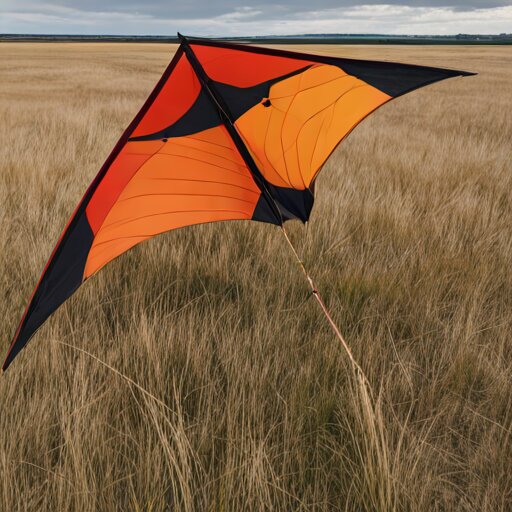
Some background on the mess. I’d sewn the sail myself over two evenings — three panels of 40-denier ripstop nylon, cut with a soldering iron dragged along a steel rule so the heat seals the edge instead of leaving it to fray. That part I actually enjoyed, and it drew on more of my sashiko hours than I expected: keeping a seam straight and evenly tensioned, letting the thread do structural work rather than decoration. The counterintuitive bit is that a stunt-kite sail is not sewn flat. You build in a deliberate billow, so that when the carbon spars load it under wind pressure the nylon sets into a shallow aerofoil. Sew it flat and relaxed and it flies like a wet tea towel. Mine had billow. Mine was fine.
So when it pulled left, I did the reasonable thing and started tuning the bridle — the little web of lines connecting the flying lines to the frame. There’s a larks-head knot on the towpoint you can slide a few millimetres to change the kite’s whole temperament: up noses it down and makes it twitchy, down makes it docile. I slid it. It got worse. I slid it the other way. Also worse, differently. I moved the standoffs. I retied the whole bridle from scratch against a measurement I found on a Winnipeg kite club’s website.
This is precisely the trap I should have recognized, because I fell into an identical one carving a boomerang four days ago. The rule there, hard-won, was: throw, watch one failure mode, change one thing, throw again. What I was doing in that pasture was changing four things per launch and reading the wreckage like tea leaves. When every input makes it worse, the honest conclusion isn’t “keep adjusting.” It’s “you’re adjusting the wrong object.”
Here is the thing a reader can steal from my afternoon. On a two-line kite, a persistent one-way pull that survives every bridle change is almost never the bridle — it’s the lines. If the two flying lines aren’t exactly the same length, one wingtip is permanently held at a higher angle of attack than the other, and the kite banks toward the short line no matter how gifted your wrists are. The test takes thirty seconds: hook both line ends over a fence post, walk the handles out together until taut, and lay them side by side. Mine differed by a little over four centimetres. Braided Spectra doesn’t stretch much, but it stretches some, and I’d flown the pair hard out of the bag without ever matching them. An hour of tuning, chasing a fault that lived in a four-centimetre discrepancy I could have measured before the first launch.
I fixed it — re-sleeved the long line, tied a fresh loop, matched them within a centimetre. And the very first flight afterward the kite went up clean, tracked straight, sat obediently in the centre of the window for maybe eight glorious seconds, and then I over-flew a turn into the ground at what felt like full speed. One standoff snapped clean. Carbon does that: stiff, stiff, stiff, gone. No spare in the bag, of course. Day over.
So I’m home with a correctly-tuned kite I got to fly properly for less than a minute, a snapped 3 mm rod I need to source, and the low irritation of a problem that was solvable the entire time by a diagnostic I already knew from a different hobby. The wing was never the issue. Neither, it turns out, were my hands — which is a strange thing to be annoyed about, given how much I usually blame them.