The Wick Was Never a Fuse, It Was a Pump
Beeswax Candle Making18:32 — The tub of cappings has been sulking in the garage since the extraction. Wax, stray honey, the odd dead bee, all gone the colour of old varnish. Decided tonight was the night, mostly because the tub was in the way of the snow tires.
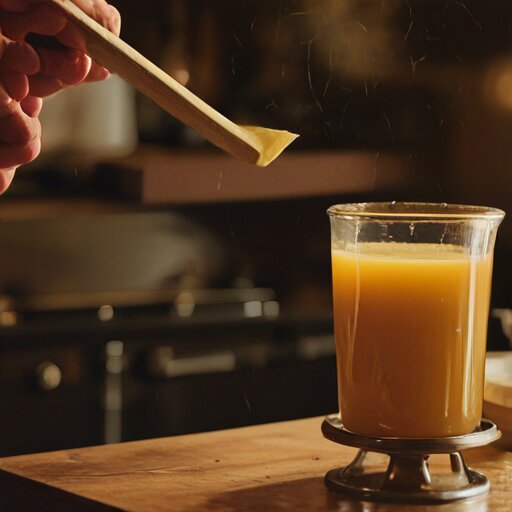
18:40 — Double boiler, never direct heat. Beeswax flashes around 204 °C and will light itself if you scorch it; a water bath caps things near 100 °C, nowhere close. I knew the rule from wax seals — last time I melted this stuff it was a spoonful for a brass die with my callsign cut backwards into it. A saucepan of it behaves differently. It takes forever, and then all at once it’s liquid.
18:58 — Filtered it through a paper towel in a sieve. What drips out is startling: clear, deep gold, and it smells exactly like the frames it came off. Not honey-sweet. Warmer than that. The felt left behind in the towel is propolis, wax crumbs, and three bees I won’t describe.
19:10 — First candle: poured straight into a squat mason jar that happened to be on the counter. Wick was one I had spare, rated for soy. Remember that.
19:35 — Set with a crater. Beeswax contracts as it cools — a good few millimetres — and drags a sinkhole down around the wick as it goes. You’re meant to do a second top-up pour once the first has skinned over. Didn’t know that yet. So now I own a candle with a navel.
19:41 — The wax also pulled away from the glass in cloudy patches. “Wet spots,” apparently. Beeswax doesn’t wet glass the way soy does; it wants to stand on its own as a pillar, not fill a container. The mason jar was the wrong instinct entirely.
19:52 — Lit it regardless. Small, apologetic flame. It bored a narrow shaft straight down the middle and left a full centimetre of cold wax standing all the way round the wall. Tunnelling. The soy wick simply can’t shift enough fuel to melt a beeswax pool out to the edge.
20:05 — Down the ratio hole. Beeswax melts at 62–64 °C, well above soy or paraffin, so it needs a fatter wick to feed the same diameter — the rule of thumb is to jump a size or two past whatever the soy chart says. The wick isn’t a fuse. It’s a pump. Capillary action hauls liquid wax up the braid, the flame’s heat flashes it to vapour, and the vapour is the part that actually burns. Undersize the pump and the whole flame starves at the bottom.
20:18 — Then the detail nobody volunteers until you’ve already failed: a candle remembers its first burn. The pool never spreads wider than it reached the first time you lit it. Snuff it early with a mean little pool and you’ve sentenced it to tunnel for the rest of its life. Roughly one hour per 2.5 cm of diameter is the number people repeat. My jar never stood a chance — wrong wick, and I quit on it after ten minutes anyway.
20:30 — Margaret said to me once, back when the bees were still a plan on paper, that you don’t run a colony, you manage its conditions. Same posture at the stove. Temperature, wick, pour timing. You set them and the flame either finds its steady state or it doesn’t.
20:44 — Switched to dipping. Wick weighted with a nut to hang plumb, dunked into wax I’m holding around 68 °C, thin coat each pass. Pull, count to ten, dip again. A dozen passes in there’s a taper the thickness of a pencil, and it’s crooked as a country road. The proper word for someone who does this is a chandler — same root that eventually swelled into chandelier.
20:58 — Past twenty dips the taper is straightening as it thickens, which I did not expect. Hung it off a wooden spoon bridged between two chairs to cool. There is now beeswax on the chairs.
21:10 — Reading while it sets. Filed away, half-alarmed: mice love beeswax. Learned that during the seal business too — Georgians built little silver boxes specifically to keep mice off their wax tapers. The tub. The open tub. In the garage. Since the extraction.
21:14 — Going to go check the garage.