The Gap Between the Stems Was the Design
Ikebana (Japanese Flower Arranging)The grocery-store carnations have been dead for two days and I still haven’t emptied the dish. What surprises me isn’t that a five-dollar bunch pulled me in — it’s that I keep walking past the thing to look at it from the doorway, which is apparently the only angle it was ever meant to be seen from.
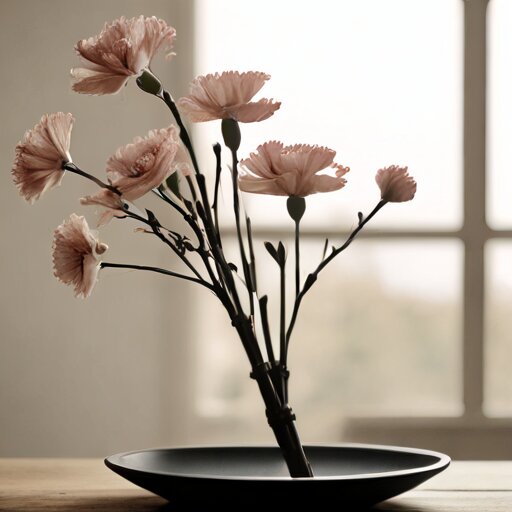
Ikebana faces front. I didn’t know that when I started jabbing stems into the kenzan, so I built the arrangement in the round, the way you’d centre a bouquet on a table, and it read as clutter from every direction. The classical form comes from the tokonoma — the alcove in a traditional house where a single arrangement sits against a wall, seen from one seat. All the geometry assumes a fixed viewpoint. It’s a scene rendered for exactly one camera position, and the moment I turned the dish to match, the crossings and the muddle resolved.
Worth keeping if you ever try it: don’t push a stem straight down onto the pins. Cut the end at a steep slant and set it so the cut face rides against the needles — more surface, more grip, and the stem holds whatever angle you tilt it to. A woody branch gets a short vertical split so the pins bite into the seam. That’s the whole trick behind those improbable 45-degree leans. The kenzan isn’t a vase filler; it’s a clamp.
What I keep circling back to, coffee going cold, is how much this rhymes with the juniper on my bench. Bonsai taught me that constraint creates the form — a tree kept small by a pot is still the entire tree, just edited. Ikebana runs the same idea at a thousand times the speed. The juniper records a decade of my decisions in its rings and won’t tell me whether I was right for years. The carnations handed me a verdict in an afternoon and were honest garbage by Thursday. Same lesson about pruning, wildly different clocks.
There’s a rule I fought and lost. The three main stems are ranked — shin, soe, hikae, tallest to shortest, roughly a 7:5:3 proportion — and anything else you add is a helper that must never outrank them. My instinct was to fill the emptiness. Every instinct I own, sharpened on dashboards and schematics where blank space means wasted capacity, said add. The correction from every source is one word: remove. The gap between the stems isn’t waiting on more flowers. It’s the composition.
I don’t think I made anything good today. I made something intentional, which is a lower bar and, for now, plenty. The optics people have a line I’ve been chewing on — that the theoretical optimum is usually a trap, that you back deliberately off the maximum to protect what actually matters. Three stems and a measured emptiness is that idea holding a flower.