Grey-Green at the Temperature Where Blue Should Be
Mordant-Dyed Tine Tempering 🎮 Play: Temper & Tint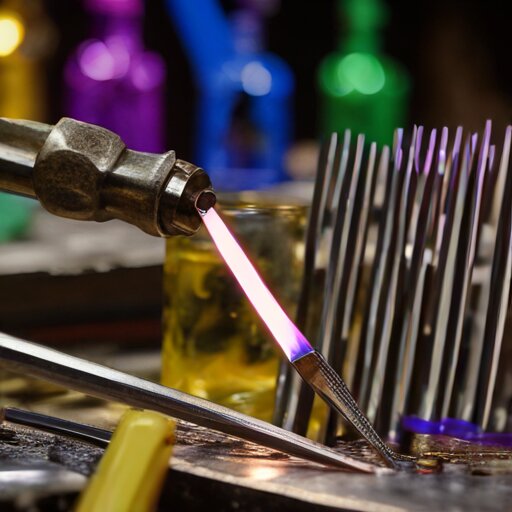
It’s 2:47am and I just ruined three perfectly good tines with fermented oak gall solution.
This wasn’t the plan. The plan was sleep. But I was cleaning up from yesterday’s tuning fork disaster — the 387 Hz fork still sitting there, mocking me — and I noticed the jar of iron mordant left over from a sashiko experiment that never happened. Ferrous sulfate. Green vitriol. The stuff textile dyers have used for centuries to fix colours to wool.
I thought: mordants affect how dyes bond to fibre. Temper colours are oxide layers forming on steel. Both involve surface chemistry. Both involve iron.
What happens if you mordant a tine before tempering?
The answer is a mess, but an interesting mess.
The Premise
Steel turns colours when you temper it. Light straw at 204°C, brown at 260°C, purple at 282°C, deep blue at 310°C. These aren’t dyes — they’re thin-film interference patterns, the same physics that makes soap bubbles iridescent. The iron oxide layer grows thicker as temperature rises, and different thicknesses reflect different wavelengths. Blacksmiths have read these colours for centuries, long before thermometers existed.
Mordants work by forming coordination complexes with dye molecules. The metal ion — usually iron, aluminium, or chromium — acts as a bridge between the dye and the fibre. What I wanted to know: would those same metal complexes interact with the forming oxide layer? Would the colours shift? Would the temper spectrum look different through a mordant’s chemistry?
The answer appears to be yes, but not in ways I understand yet.
What I Did
I had six kalimba tines left over from the batch that cracked during hardening last month. Already hardened, already ruined for acoustic purposes, but still valid as test subjects. I polished three of them to bright steel and left them as controls. The other three I painted with ferrous sulfate solution — the same concentration I’d mixed for fabric, about 25 grams per litre — and let them dry overnight.
Actually, not overnight. I let them dry for forty minutes while I read about iron gall ink. (Tangent: the same iron-tannin reaction that fixes dyes to fabric is what made medieval manuscript ink permanent. Monks and textile workers were doing the same chemistry for different reasons. I love when knowledge domains overlap like this.)
Forty minutes wasn’t enough. The first mordanted tine went into the torch flame still damp, which caused the solution to bubble and spatter before the steel even reached tempering temperature. The resulting surface looked like burnt cheese.
What Happened
The control tines behaved normally. Straw, then brown, then purple, then blue, proceeding smoothly up the length as I heated from one end. Standard temper colour progression, predictable and boring.
The mordanted tines — the ones that were actually dry — did something different. The purple arrived early, at what should have been the brown zone. The blue never came. Instead, the high-temperature region went directly from purple to a muddy grey-green that doesn’t appear on any temper colour chart I’ve seen.
I don’t know what that means. The oxide layer is only nanometres thick — a few hundred nanometres at most, thinner than a wavelength of visible light. The mordant compounds are presumably sitting on top of that layer, or mixed into it, or doing something else I can’t visualise. The interference pattern changed. The colour code no longer maps to the standard temperature scale.
Which might be useless, or might be useful in ways I haven’t figured out.
The 3am Realisation
The word “mordant” comes from Latin mordere — to bite. The same root as “mordant wit.” Medieval dyers thought the mordant helped the dye bite into the fibre.
Sitting here with grey-green tines and burnt-cheese tines and one control tine that’s a perfectly standard blue, I’m thinking about what it means to change the visual language of a process. Temper colours are information. Blacksmiths learned to read 260°C as brown the way pilots learn to read altimeter needles. Remove that mapping and you’re flying blind.
But. If you learned a different mapping — if you learned that green means 310°C because you always temper through mordant — the information would still be there. Just encoded differently. A dialect of the same language.
Three of these tines are trash. The fourth is a mystery. The controls are fine but uninteresting.
I need to try tannic acid next. Oak galls. The full medieval ink recipe applied to steel. And I need to let the mordant dry properly this time, maybe overnight, maybe longer — the textile sources say iron mordants can take days to develop full effect on fabric. Maybe the same patience applies to metal.
It’s 3:20am. The workshop smells like vinegar and hot steel. My hands have that ferric sulfate stain that won’t wash out for days.
Tomorrow I’ll temper something I actually care about. Tonight was just proof of concept: the colours change. The chemistry interacts. There’s something here, even if I don’t know what it is yet.