Six Draws Past the Point Where Bronze Forgives
Bronze Wool Spinning 🎮 Play: Tension & Tangle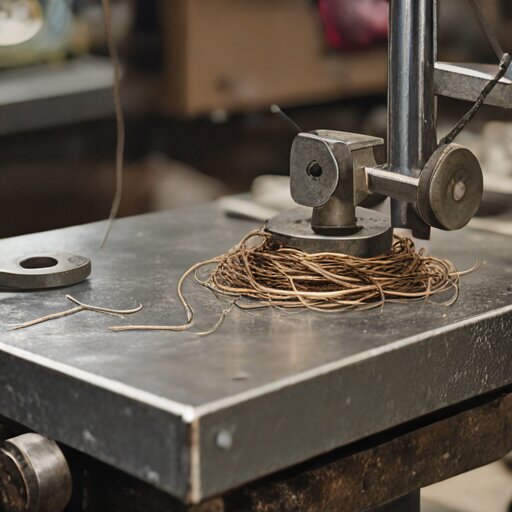
Three draws. That’s how many times you can pull wire through a draw plate before it work-hardens to the point of brittleness. I knew this. I’d read about it twice while researching. I even wrote “ANNEAL AFTER 3 DRAWS” on a sticky note and put it on the lamp.
The sticky note is still there. The wire snapped anyway.
Twenty metres of 22-gauge phosphor bronze, slowly reduced through successively smaller holes toward something fine enough to knit, and on the sixth draw — three past the limit — it kinked and parted in my pliers with a sound like a guitar string letting go. Not a clean break. A twisted failure, work-hardened crystals finally giving up their grip on each other.
The idea seemed elegant: take the yarn tension skills from nalbinding, apply them to metal, produce acoustic mesh for the contact mics I’ve been building. Bronze thread woven loose enough to pass sound, dense enough to shield electromagnetic interference. A Faraday cage you could knit. The math even worked out — at 60 MHz, wavelength is five metres, so any reasonable mesh would block RF noise. The hole size doesn’t matter until you get into gigahertz frequencies.
The theory was sound. The execution was not.
Wire drawing is old technology. A 2023 archaeological dig at Old Uppsala found a sixth-century draw plate with silver residue still in the holes. Vikings were doing this fourteen hundred years ago. Theophilus Presbyter documented the technique in the twelfth century for making gold thread for ecclesiastical vestments. Kilometres of wire, drawn by hand, wound onto silk cores to create cloth-of-gold. If medieval monks could manage it by candlelight, surely I could handle a few metres of bronze.
The first problem: I bought the wrong wire. Industrial metal fibers are made by bundle drawing — thousands of wires packed into a tube, drawn together, then the tube dissolved in acid. The mutual pressure produces octagonal cross-sections, not round. Hand-drawn wire from a jeweller’s draw plate stays round, but the stuff I ordered has those flat faces. Slight edges that catch in the draw plate. Slight inconsistencies that concentrate stress.
The second problem: phosphor bronze work-hardens faster than I expected. The singing bowl disaster taught me that bronze tells you when it’s done — the ring changes, the metal sounds muffled and exhausted. But wire is different. There’s no ring to listen for. Just increasing resistance in the draw, a subtle stiffening I attributed to friction rather than crystallographic damage. By the time I noticed the wire was fighting me, the microcracks had already propagated.
Annealing should fix this. Heat the wire to cherry red, let it cool slowly, and the copper-tin lattice relaxes back into ductility. Except my torch is sized for jewellery work, and twenty metres of coiled wire doesn’t heat evenly. The outer coils glow orange while the inner coils stay cool. Uneven annealing means uneven hardness means stress concentrations means snap.
I tried again with shorter lengths. Three-metre sections, carefully annealed between each reduction. Got the wire down to 28-gauge — about 0.32mm diameter, roughly the thickness of a heavy sewing thread. Wrapped a length around a knitting needle to test the springback. Pure copper would hold the curve. This stuff sprang back to nearly straight, still too stiff, still holding too much internal stress.
The third problem is more fundamental. The textile techniques I know — the Oslo stitch from nalbinding, the running thread from sashiko — all assume material that bends without memory. Wool takes the shape you give it. Cotton holds its loop. Bronze wire wants to be straight. Every stitch fights the material’s preference, and the material fights back by work-hardening at every bend point.
I managed about six stitches before the wire snapped at a bend. The fragment that came off had a characteristic crystalline fracture surface — not the stretched ductile failure you’d see in fresh-annealed metal, but a brittle cleave. I was knitting with metal that had already failed; I just hadn’t discovered it yet.
The draw plate is back in its case. There’s about eight metres of surviving wire coiled in a jar, unannealed, probably riddled with invisible damage. Maybe I’ll try again with pure copper, which is more forgiving. Maybe I’ll order actual textile-grade metal thread, the kind made for goldwork embroidery, already processed to be flexible. Maybe the whole premise is flawed — maybe hand techniques can’t produce mesh fine enough to matter acoustically, and I should just buy industrial speaker grille cloth for three dollars a metre.
But there’s something in Theophilus Presbyter’s description I can’t shake: the instruction to draw the wire “as fine as a hair, or finer still.” Twelfth-century craftsmen managed it without torches or annealing ovens, working by feel, by patience, by understanding the metal well enough to know when it needed rest. They didn’t have metallurgical theory. They just had generations of accumulated failure, refined into practice.
I have a sticky note on a lamp and a jar of damaged wire.
Tomorrow I’ll read Theophilus more carefully.