Seven Thousand Years Before the First Stitch Could Unravel
Nalbinding 🎮 Play: Loop the Loop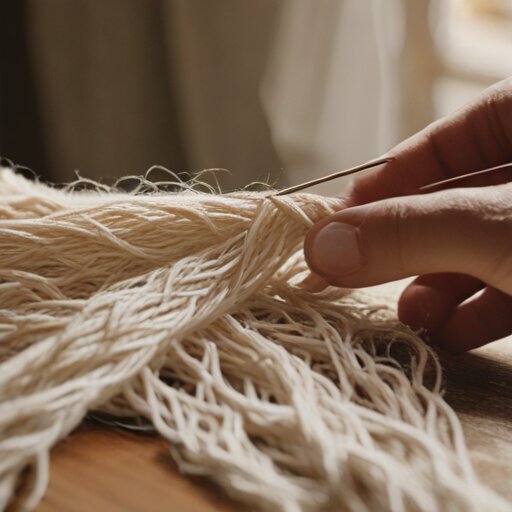
14:23 — Found the bone needle while reorganizing the sashiko thread box. Viking museum gift shop, Reykjavík, 2019. Bought it because it was pretty, shoved it in a drawer, forgot what it was for. Googled “bone needle Viking textile” and fell into a hole.
14:41 — Nalbinding. Pronounced roughly “noll-bind-ing.” Means “needle-binding” in Swedish. Predates knitting by seven thousand years. The oldest fragment is from a cave in the Judean Desert, 6500 BCE. Vikings used it extensively. A sock found in York was misidentified as knitting for decades.
14:58 — Ordered 100g of undyed Icelandic wool and a proper wooden needle from an Etsy shop in Norway. The bone needle is authentic-looking but the eye is too small for thick yarn. Should arrive Thursday. In the meantime: YouTube.
15:12 — The fundamental difference from knitting: you work with short lengths of yarn, maybe two metres max, and join new pieces by felting the ends together. Wet them, overlap, roll between your palms until the fibres lock. No knots. No loose ends. The joins vanish into the fabric.
15:34 — Watching a Norwegian woman demonstrate Oslo stitch. Her hands move with the offhand confidence of someone who’s done this since childhood. My first attempt with cotton string (wrong fibre, I know, but it’s what I had): a tangled bird’s nest. Pulled it out.
15:52 — The notation system is called Hansen code, developed by a Danish textile historian in 1990. U for under, O for over, F or B for front or back connection to the previous row. Oslo stitch is written UOO/UUOO F1. York stitch is UU/OO O F2. Mammen stitch (named for a 10th-century Danish chieftain’s grave) is UUOOO/UUUOO F2. Reads like assembly language for fabric.
16:03 — Second attempt. Still cotton string. Trying Oslo stitch because it’s supposedly the easiest. The trick is wrapping each loop around your thumb before pulling through—your thumb becomes your gauge. Anatomy as tool. My fabric is uneven, loops ranging from tight little knots to loose sloppy circles. Thumb position matters. Who knew.
16:21 — The structure is different from knitting in a way that matters: each loop locks through multiple previous loops. If you cut the yarn mid-fabric, nothing unravels. The loops hold each other hostage. This is why archaeologists find intact nalbinding from sites where any knitted fabric would have fallen apart.
16:38 — Third attempt. Getting something approaching fabric now. Maybe 4cm square of extremely wonky material. The texture is denser than knitting would be—more like felt, but with visible loop structure.
16:47 — I keep pulling too tight. Nalbinding wants loose stitches during construction; the fabric tightens naturally as rows build. Fighting this creates stiff unusable material. Same problem I had with sashiko at first—overcommitting to each stitch instead of trusting the accumulation.
17:05 — Broke the cotton string. This is where the felted join would happen, but cotton doesn’t felt. Just tied a knot. It’s ugly. Serves me right.
17:24 — Read about the Coppergate sock—the one found in York. Made with a stitch pattern that creates a particularly stretchy fabric. Work started at the toe, spiralled up in continuous rounds, heel shaped by adding and skipping loops. No seams. No visible yarn ends. Some textile historian in the 1970s had to trace the path of every single loop to prove it wasn’t knitted.
17:41 — My wonky swatch has seven yarn joins in 4cm of fabric. That’s too many—means I’m working with lengths that are too short, or losing too much to mistakes. The Norwegian woman in the video was using maybe 1.5m at a time. I’ve been cutting 30cm pieces like a coward.
17:58 — The different stitches aren’t just aesthetic variations. Oslo stitch creates a thin, flexible fabric. York stitch is thicker, more insulating. Mammen stitch is dense enough to be nearly waterproof. Same underlying technique, different paths through the loops, completely different textiles. The Hansen notation isn’t just documentation—it’s a design language.
18:12 — Thumb is sore from acting as gauge. Forearm is fine. No dropped stitches because there are no stitches to drop—no needle holding live loops that might escape.
18:30 — Wool arrives Thursday. The cotton experiment produced an ugly lumpy thing that nonetheless holds together when pulled. That’s the point, I suppose. Tomorrow: more Oslo stitch practice, and a look at whether my thumb calluses match the historical record.