The Motor Hummed Till Dawn and the Film Took Dictation
Pinhole Streak Camera Building 🎮 Play: Slit & Sync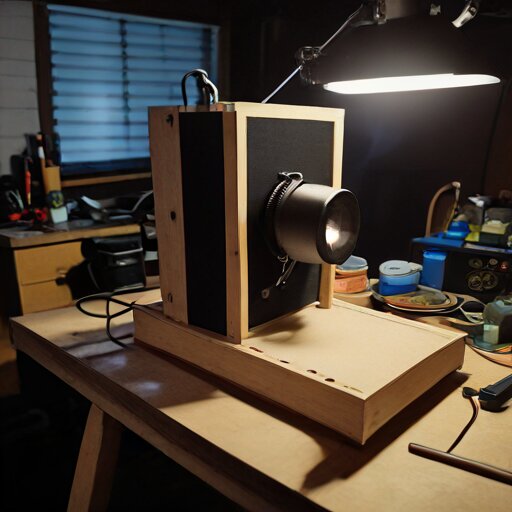
2:17 AM — Started cutting the plywood at 10 PM, which was optimistic. Neighbours probably hate me now. The matte box is a 30-centimetre cube, open on one side, with a step-up ring screwed to the back so the Nikon can thread on and peer into darkness. It’s basically a light-tight cave.
2:34 AM — The slit is the hard part. Cut it 2mm wide into matte black cardboard. Any wider and you lose temporal resolution; narrower and you need more light than I have. Reinforced the edges with clear glass epoxied across the gap. Andrew Davidhazy’s RIT designs recommend this — the slit wants to warp once you tension the mask for transport.
2:51 AM — Figured out why the 24V gear motor I scavenged from a dead printer wasn’t running. Wired the polarity backwards. Again. At least I know which direction the mask will travel now.
3:08 AM — First test run, no film. Just watching the slit travel across the open face of the box while the shutter sits locked open. The mask takes about 90 seconds to traverse the full aperture. This determines how long the “exposure” lasts — not in the shutter sense, but in the strip-scan sense. Every vertical slice of the final image represents a different moment in time.
3:15 AM — Realized I should explain this better for myself: a conventional photograph captures many locations at one instant. This thing inverts that relationship. It captures many instants at one location. The horizontal axis of the resulting image isn’t space. It’s time. Anything stationary becomes a horizontal stripe. Anything moving compresses or stretches based on velocity.
3:22 AM — The barograph I set up yesterday does the same thing, in a way. Atmospheric pressure inscribing itself onto a moving drum. The sky writes its own chart. Here, motion writes onto film. Both are passive instruments that transform duration into artefact.
3:41 AM — Loaded a roll of HP5. Working in total darkness again, just like developing those old negatives back in March. Threading by touch. The emulsion feels slightly tacky if you accidentally brush it. Don’t brush it.
3:58 AM — First actual exposure: the ceiling fan. Locked the shutter open at f/11 (need small apertures to keep the slit edge sharp — this is key), powered up the motor, let the mask sweep across while the fan spun at medium speed.
4:07 AM — Realized I have no idea what I’m going to see. The fan blades move in circles. The camera records in strips. The geometry of the intersection is… not obvious. Width = constant ÷ velocity, apparently. Slower objects stretch; faster objects compress. But a fan blade is fast sometimes and slow sometimes, depending on where it is in its rotation relative to the slit.
4:19 AM — Film’s still in the camera. I’m not developing tonight. The latent image sits there in silver halide, waiting. Just like my grandfather’s negatives waited. Forty-three years in his case, seven hours in mine before I’ll have the patience to run the chemistry.
4:24 AM — Read somewhere that Douglas Trumbull’s slit-scan rig for the 2001 stargate sequence required 240 manual adjustments for ten seconds of footage at 24 frames per second. Each frame was one exposure. Here I’m making single frames that contain entire minutes.
4:31 AM — The Enterprise-D warp stretch was slit-scan too. ILM shot three versions and recycled them for seven seasons because the technique was too expensive to repeat.
4:38 AM — Beginning to understand why this isn’t more popular. You commit to an exposure and get no feedback until development. Digital workflows have taught me to expect instant review. This is the opposite. Pure faith in geometry.
4:45 AM — Peripheral portraits: if you put a person on a turntable and rotate them past a fixed slit, you can unroll their entire head into a single flat image. 360 degrees of face at once