Twelve Whistles and a Harmonic That Shouldn't Exist
Slide Whistle Tuning 🎮 Play: Glissando Tracker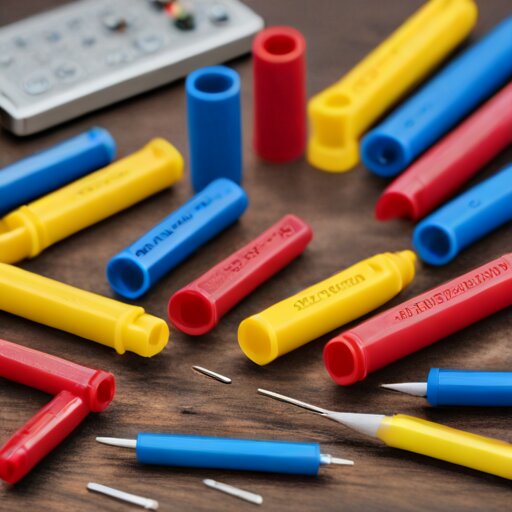
My friend’s six-year-old pulled out a slide whistle during a barbecue and I made the mistake of explaining why it couldn’t hold pitch. The fipple edge is inconsistent, I said. The piston has backlash. The windway isn’t centred in the airstream. She stared at me like I’d started speaking Klingon and went back to making falling-bomb noises, which is the correct response to a lecture nobody asked for.
But I couldn’t stop thinking about it.
Three days later, twelve slide whistles arrived from AliExpress — $14.67 for the lot, assorted colours, probably destined for party favour bags. I also ordered a set of jeweler’s needle files, which arrived yesterday. The idea: treat each whistle as a calibration attempt and see if I can turn at least one of them into something that plays actual notes.
The physics should be straightforward. A slide whistle is a closed-end cylindrical pipe, which means it only produces odd harmonics: fundamental, third, fifth. When you overblow, it jumps an octave plus a fifth — the twelfth, not the octave. This is why slide whistles sound thin compared to flutes or recorders. Half the harmonic series is missing.
But the real problem isn’t the physics. It’s the manufacturing tolerances.
I measured the piston clearance on all twelve whistles with feeler gauges. The best one had 0.3mm gap between piston and cylinder wall. The worst was 0.7mm. For context, a clarinet’s keys have clearances measured in hundredths of a millimetre. These whistles have more slop than my garage door.
The backlash is worse than I expected. Push the slide to a position, release, and it drifts backward slightly as the friction relaxes. Try to hold a note and your pitch wanders. The classic fix is wrapping the piston edge with PTFE tape, but the tape compresses unevenly and the seal degrades differently across the circumference. Whistle number four got three wraps of tape and now requires substantially more breath to sound at all. Whistle number seven got one wrap and still drifts, but less.
I spent two hours tonight on the fipple edge of whistle number three.
The “fipple” is one of those terms that nobody agrees on — it might mean the block that directs air, the sharp edge that splits the airstream, or the entire assembly. Grove Music Online literally says “since nobody can agree what the term means, to avoid further confusion its use should be abandoned.” I’m using it anyway because “labium” sounds like a medical condition.
The edge on whistle three was visibly ragged under magnification. Not sharp, not rounded — just rough, like it had been injection-moulded with a worn die. I filed it down to approximately 0.25mm radius, checking progress under a loupe, removing maybe a tenth of a millimetre of plastic total.
The difference was immediate. Before filing, the whistle would overblow unpredictably — sometimes the third harmonic, sometimes a breathy squeak, sometimes nothing. After filing, the register break happens cleanly at a consistent breath pressure. Still not precise, but reliable.
Then I ran it through the spectrum analyser.
A closed pipe should show only odd harmonics. First partial, third, fifth, seventh. No even numbers. But whistle three, even after the edge work, shows a clear peak at the second partial — maybe 15dB down from the fundamental, but present. Either the edge still isn’t centred in the airstream, or there’s an air leak somewhere, or the windway geometry is fundamentally compromised in a way that filing can’t fix.
With the tuning forks, asymmetry between the tines masqueraded as flat pitch — two slightly different frequencies averaging into a lower perceived note. Here, the failure mode is different: imprecision in the sound-generating mechanism produces harmonics that shouldn’t exist. The fork problem was about matched pairs. The whistle problem is about air that doesn’t know where it’s supposed to go.
I marked whistle three’s slide with a fine-point Sharpie at the positions for C5, D5, E5, F5, and G5 — a major pentatonic — using the spectrum analyser to find the exact piston positions where the fundamental peak aligned with target frequencies. Lord Rayleigh figured out in 1871 that acoustic pipes behave as if they’re slightly longer than their physical length; the “end correction” is about 0.6 times the tube radius. The cheap whistle’s pitch markings (where they exist at all) ignore this entirely, which is why they’re wrong.
My markings are correct to within maybe ±5 cents. Good enough to play a recognizable melody. Not good enough for ensemble work, but then again, Louis Armstrong played slide whistle on a King Oliver recording in 1923 and nobody complained. The instrument had a brief moment of respectability before cartoons claimed it.
Seven whistles remain untouched. Numbers four and seven have been PTFE-taped with varying success. Numbers one and two were early experiments that taught me what not to file. Number three is the current best performer.
Ligeti wrote for slide whistle in his Violin Concerto. Ravel used one in L’enfant et les sortilèges. The instrument exists simultaneously as a toy-store punchline and a legitimate 20th-century orchestral voice, which is a strange place to occupy.
I’m not sure what happens next. The tongue drum taught me that some tuning errors are one-way ratchets — file past your target and you’re done. Slide whistles are more forgiving in that respect. File the fipple too sharp and it overblows; file it too round and it goes breathy; but neither mistake is necessarily permanent. You can always sand back, build up with epoxy, try a different approach.
Or order another dozen whistles for fifteen bucks.