Three Point Two Microvolts From a Single Breath
Thermocouple Lace Making 🎮 Play: Thermal Lace Weaver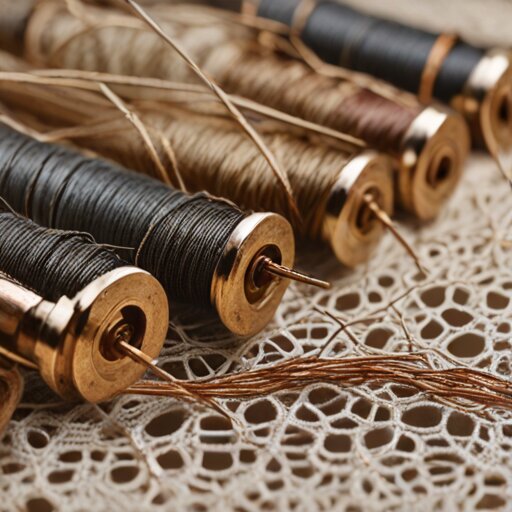
The oscilloscope showed 3.2 microvolts when I breathed on the lace.
Not much. A millionth of the voltage that runs a watch battery. But measurable. Reproducible. Every junction where copper crosses bronze registers the temperature differential between my breath and the ambient air, and the voltage accumulates. Eight crossings, eight tiny thermocouples in series, adding their contributions: 3.2 μV total, or about 0.4 μV per junction.
This was supposed to be decorative metalwork. Turns out it’s a functioning sensor array and I’m not sure how I feel about that.
The trigger was the pickup winding disaster two weeks ago — bronze coil soldered to copper leads, oscilloscope drifting mysteriously until I realized every junction between dissimilar metals creates a thermocouple. Temperature changes generate voltage. I’d been fighting the effect, trying to null it out by keeping both junctions thermally balanced.
But what if you didn’t fight it? What if the thermocouples were the point?
Bobbin lace seemed like the right structure. Threads cross at right angles, held in place by pins on a padded pillow, pattern determined by where you stick the pins. Traditional lacemaking uses 20 or 30 bobbins simultaneously, each weighted with turned wood or bone, threads weaving through each other in paths defined by a pricking — the hole-punched paper template that tells you where pins go.
I have six bobbins. Three wound with 30-gauge copper, three with the salvaged bronze wire from the drawing experiment. The pricking is graph paper with dots at 5mm intervals. The pillow is a foam block wrapped in linen. This is bobbin lace the way model rocketry is aerospace engineering — technically accurate, functionally primitive.
The pattern is simple: three copper threads running vertically, three bronze threads running horizontally. Every crossing should be a junction. In theory.
Cross and twist
Bobbin lace has two fundamental moves. Cross: right thread over left. Twist: each pair rotates 180°. Combine them and you get the structural stitches. Cloth stitch is cross-twist-cross-twist, produces a dense woven texture. Half stitch is cross-twist only, looser and more open.
With copper and bronze, the choice matters electrically. A half-stitch junction is two wires touching at a single point — mechanically unstable, prone to oxidation, contact resistance that drifts over time. A cloth-stitch junction locks the wires together through multiple wraps, forcing intimate contact, scraping away oxide layers through friction.
The first junction took eleven minutes. Copper wouldn’t stay where I pinned it. Bronze had too much springback — every cross wanted to uncross itself. The bobbins kept tangling. When I finally got the threads locked in cloth stitch and measured the resistance across the junction: 0.3 Ω. Not zero, not an open circuit. An actual electrical connection, oxide layers scraped thin enough by the weaving pressure to permit current flow.
Second junction: eight minutes. Third: six. By the time I’d completed a 3×3 grid — nine junctions total — I’d been working for an hour and my hands hurt from manipulating 30-gauge wire with jeweller’s pliers.
The crosstalk problem
Every junction is a thermocouple, but they’re not isolated. The copper threads connect all the bronze crossings in one axis. The bronze threads connect all the copper crossings in the other. It’s a resistive mesh — a 3×3 matrix keyboard minus the diodes.
To read a specific junction, you have to multiplex. Drive current through one copper thread, measure voltage on each bronze thread sequentially. Repeat for the other two copper threads. Nine measurements to characterize nine junctions. The math gets uglier with larger arrays — a 10×10 grid requires 100 measurements, and the crosstalk errors compound because every junction contributes spurious signals through parallel paths.
Keyboard designers solve this with diodes at every switch. I don’t have room for diodes in a lace pattern. The junction is the feature. Adding discrete components would defeat the aesthetic.
So the readout is ambiguous. If I heat one corner of the fabric, three junctions warm up along that edge. The voltage I measure is the sum of their contributions plus crosstalk from every other junction in the path. Deconvolving the individual temperatures requires matrix math or prior knowledge of the thermal gradient.
Which means this works best as a gradient sensor, not a thermometer. Hold it near a warm lamp, watch the voltage rise and fall as the wavefront of heat propagates through the metallic mesh. Drape it over something with spatially varying temperature — a just-boiled kettle, a laptop exhaust — and the readout tells you about the shape of the heat, not the absolute values.
The voltage that shouldn’t be there
Bronze isn’t constantan. Constantan — the copper-nickel alloy used in Type T thermocouples — has a Seebeck coefficient specifically engineered for stable thermoelectric output: -35 μV/K, documented in NIST tables, calibrated across centuries. Bronze is just copper with some tin, maybe phosphorus, maybe trace iron from casting sand. Nobody publishes Seebeck curves for phosphor bronze because nobody uses it in thermocouples.
I measured 0.4 μV per junction per Kelvin of temperature difference. That’s roughly one-hundredth the output of a proper Type T junction. But it’s linear enough to be useful, at least across the 10°C range I’ve tested. Breathe on it: 3.2 μV. Touch it with a warm finger: 11 μV. Set it on the workbench and ignore it: voltage decays to baseline as the metal equilibrates with the room.
The fact that it works at all is accidental. If the bronze alloy were slightly different — more tin, less phosphorus — the Seebeck coefficients might nearly cancel and the output would vanish. If I’d used steel instead of bronze, the higher Seebeck coefficient would give ten times the voltage but the wire would be too stiff to weave. Pure copper against pure silver produces measurable voltage, but both metals are too soft and the output is tiny.
Copper and bronze happen to sit in a range where the physics cooperates and the materials remain workable. Call it luck or call it constraint satisfaction — either way, I’ve got a 3cm square of woven metal that responds to my breath.
Somewhere in sixteenth-century England, Bess of Hardwick was ordering gold and silver thread for bone lace, creating thermocouple arrays in ruffs and collars without knowing it. The physics was operational. The instruments to measure it didn’t exist yet. I wonder what she’d make of the oscilloscope trace.